What Is Hotel SEO (and Why It Still Matters)
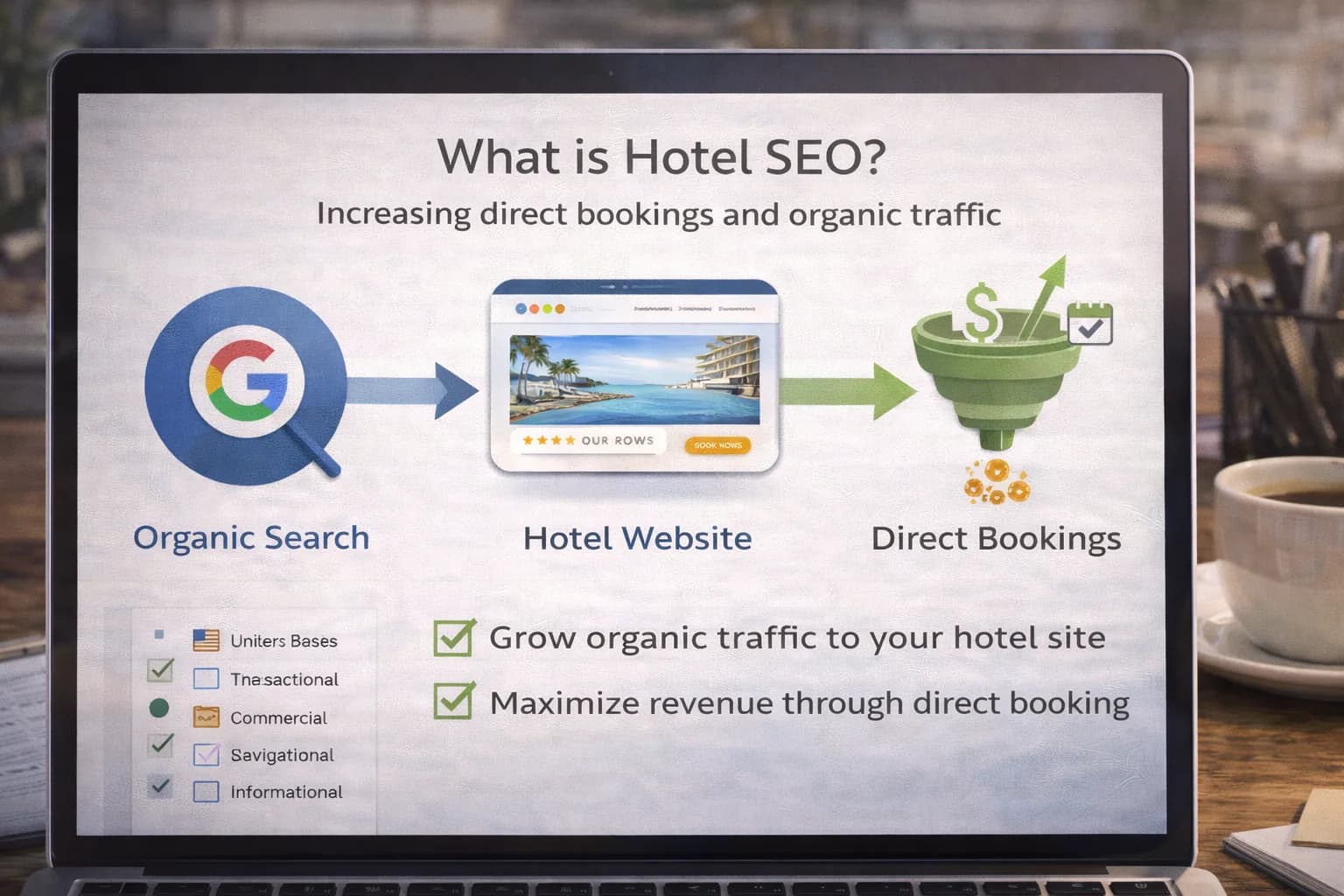
Hotel SEO is the work of making your property findable, clear and trustworthy wherever guests search: Google results, map packs, travel verticals, and AI answers. The goal isn’t “rankings” alone—it’s profitable direct bookings with fewer surprises at checkout.
This guide explains hotel SEO in plain language, shows how it connects to Answer Engine Optimisation (AEO) and Guest Experience Optimisation (GEO), and gives you a 90-day plan you can put on a roadmap today.
Fast answer
Hotel SEO is the process of making a hotel website technically crawlable, locally trusted, clearly structured and persuasive enough to turn organic discovery into direct bookings. It includes technical SEO, local SEO, content, links, schema, AI-answer readiness and conversion measurement.
1) Definition: what hotel SEO includes in 2026
Hotel SEO covers five connected areas:
- Technical SEO – indexability, page speed (Core Web Vitals), crawlability, structured data.
- Content & AEO – pages that answer guest questions (rooms, offers, parking, breakfast, accessibility) in ways that assistants can reuse.
- Local SEO (GBP) – Google Business Profile accuracy, photos, attributes, and reviews that drive map-pack visibility.
- Links & mentions – real citations and PR that grow authority and discovery.
- CRO/GEO – on-page clarity that turns visits into bookings (Key Facts, trust, mobile UX).
Useful background:
Google Search Essentials • web.dev: Core Web Vitals • Google Business Profile Help
2) Why it still matters (even with AI results and OTAs)
- Guests still research broadly: city + “hotel with parking”, “family rooms near [attraction]”.
- Maps are decision screens: ratings, photos and attributes drive clicks.
- AI overviews/assistants use your facts—clear copy and schema help them reuse the right details.
- Direct beats OTA on margin: SEO lowers your paid dependency and supports paid media with better landers.
Deeper strategy: Hotel SEO Strategy for 2026 and How AI Overviews Change Hotel SEO.
3) Where hotel SEO shows up (the surfaces)
- Classic SERP: blue links, rich results (FAQ, breadcrumbs, sitelinks).
- Map Pack & GBP: photos, attributes (parking, EV, accessibility), reviews, “website” and “call” actions.
- Verticals: Google Travel/Hotel modules (influenced by site clarity and brand demand).
- Assistant/AEO: answers that quote facts—check-in/out times, parking height, breakfast window.
See our Hotel SEO services for how these tie together.
4) Foundations you must get right first
- Indexing: only useful pages indexable; no duplicates (canonicals), fresh sitemaps. Use Indexed Pages.
- Speed: fast hero, stable layout, reasonable JS—validate with Website Speed.
- Mobile UX: thumb-reach CTAs, legible type, no intrusive popups—check with Mobile-Friendly.
- Information Architecture: brand → property → rooms → offers → location/parking/FAQ. See Hotel Information Architecture.
5) Technical SEO (hotel checklist)
- Fix crawl blocks, broken internal links, redirect chains; ship clean XML sitemaps.
- Add Hotel/LodgingBusiness schema on hotel pages, FAQ where relevant, and Product/Offer on room pages when appropriate.
- Avoid self-serving review markup on the main hotel page (see Review Schema for Hotels).
- Target LCP ~2.5s and low CLS; compress media and set width/height attributes.
Official guidance: Structured data docs.
6) Content & AEO (answer real guest questions)
Write for decision speed, not adjectives. Every core page should state:
- Who it suits (family, business, couples), what’s included, Key Facts (parking cost/height/EV, breakfast times, check-in/out, accessibility).
- Location clarity: walking minutes to transport/attractions; embed a simple map.
- Micro-FAQs near CTAs (3–6 Qs).
Use our patterns in Landing Page Blueprint and FAQ Content for Hotels.
For research and outlines, start with the Keyword Research tool.
7) Local SEO (Google Business Profile)
- Keep NAP identical to your site; choose accurate categories and attributes (parking, EV charging, accessibility).
- Upload current photos of rooms, breakfast, parking and accessibility features; refresh quarterly.
- Run a policy-safe review engine (no incentives, no gating) and respond within 72 hours.
See Increase Google Ratings and Handle Negative Reviews.
Docs: About reviews on Google.
8) Links, PR & citations (without spam)
- Earn links by publishing useful local content (parking guide, event pages, accessibility info) and partner features (tourism board, venue collaborations).
- For multi-property groups, centralise under one domain; build strong internal links from hubs to rooms/offers.
- Avoid paid directory blasts and irrelevant links; focus on relationships and real mentions.
Ideas roundup: Building Local Links and Digital PR Ideas.
9) GEO & CRO (turn traffic into bookings)
- Design Key Facts blocks and sticky CTAs for mobile.
- Use trust elements: review badge with 2–3 dated quotes, transparent fee/cancellation copy.
- Tight alt text and accessible components (tap targets ≥44×44).
Deep dives: Visual Identity & UX: Trust and Optimising Booking Forms.
10) Measurement (report bookings, not vanity)
Set up cross-domain measurement (site → booking engine → confirmation) and track only what matters.
GA4
- Primary conversion =
purchasewith value/currency. - Scoreboard: revenue/1k sessions, purchase rate, landing page performance by template (Rooms, Offers, Guides).
- Annotate releases and errors.
Docs: GA4 conversions.
Search Console
- Clicks/CTR by URL; index coverage; queries for brand vs non-brand.
Search Console.
GBP & PMS/CRM
- Calls, direction requests, photo views (GBP).
- Direct share vs OTA and ADR (PMS/CRM).
Build a simple board with Analytics Dashboard.
11) 90-day hotel SEO rollout (copy this plan)
Month 1 — Fix the base
- Indexing, sitemaps, canonicals, robots; remove low-value pages from index.
- Compress hero images; stabilise CLS; ship Key Facts on Home/Rooms.
- Align GBP categories/attributes/Photos; generate the review link.
Month 2 — Content that answers
- Publish Parking, Breakfast, Location and Accessibility pages (assistant-ready).
- Refresh 3 room pages (layout photos, inclusions, micro-FAQs).
- Build internal links from hubs to rooms/offers; add breadcrumbs.
Month 3 — Authority & measurement
- Secure 3–5 credible mentions (tourism board, venue partners, local press).
- Enable cross-domain purchases in GA4; annotate changes; run one A/B test (Key Facts placement).
- Quarterly photo refresh plan and review response SLA.
12) Common mistakes (and quick fixes)
- Chasing one keyword instead of building decision pages → create hubs (Parking/Breakfast/Location).
- Heavy carousels killing LCP → single hero + gallery below the fold.
- Self-serving review schema → remove; use FAQ/Breadcrumb/room-level Product instead.
- No cross-domain tracking → implement properly so bookings aren’t misattributed.
FAQ
Frequently Asked Questions
Conclusion
Hotel SEO is practical: make the site fast and clear, publish decision-helping pages, keep GBP clean with fresh photos and reviews, earn credible mentions, and measure everything against purchases and direct share. When you treat SEO as findability + clarity + trust, your search presence turns into bookings, not just rankings.
Audit and ship your SEO foundationsRelated commercial pages: Hotel SEO Services, Local SEO for Hotels, Hotel SEO by Location.

Kiril Ivanov
Performance Marketing Specialist
Kiril Ivanov is a digital marketing specialist with experience managing local, national and international campaigns for businesses ranging from growing independent companies to major consumer brands. His background includes leading advertising automation work for Michael Kors and working on campaigns involving Canon, Dormeo, esure, DLG Group, Village Gym, Cameron House, Crerar Hotels, Cromlix Hotel, Harrison Fund and the Advertising Standards Authority. His experience spans paid search, paid social, advertising automation, SEO, conversion optimisation and wider digital strategy across hospitality, retail, financial services, professional services and other competitive sectors.
View author profile →Related Hotel Marketing Guides
Continue with related topics to build a complete strategy.