Hotel Information Architecture Guide
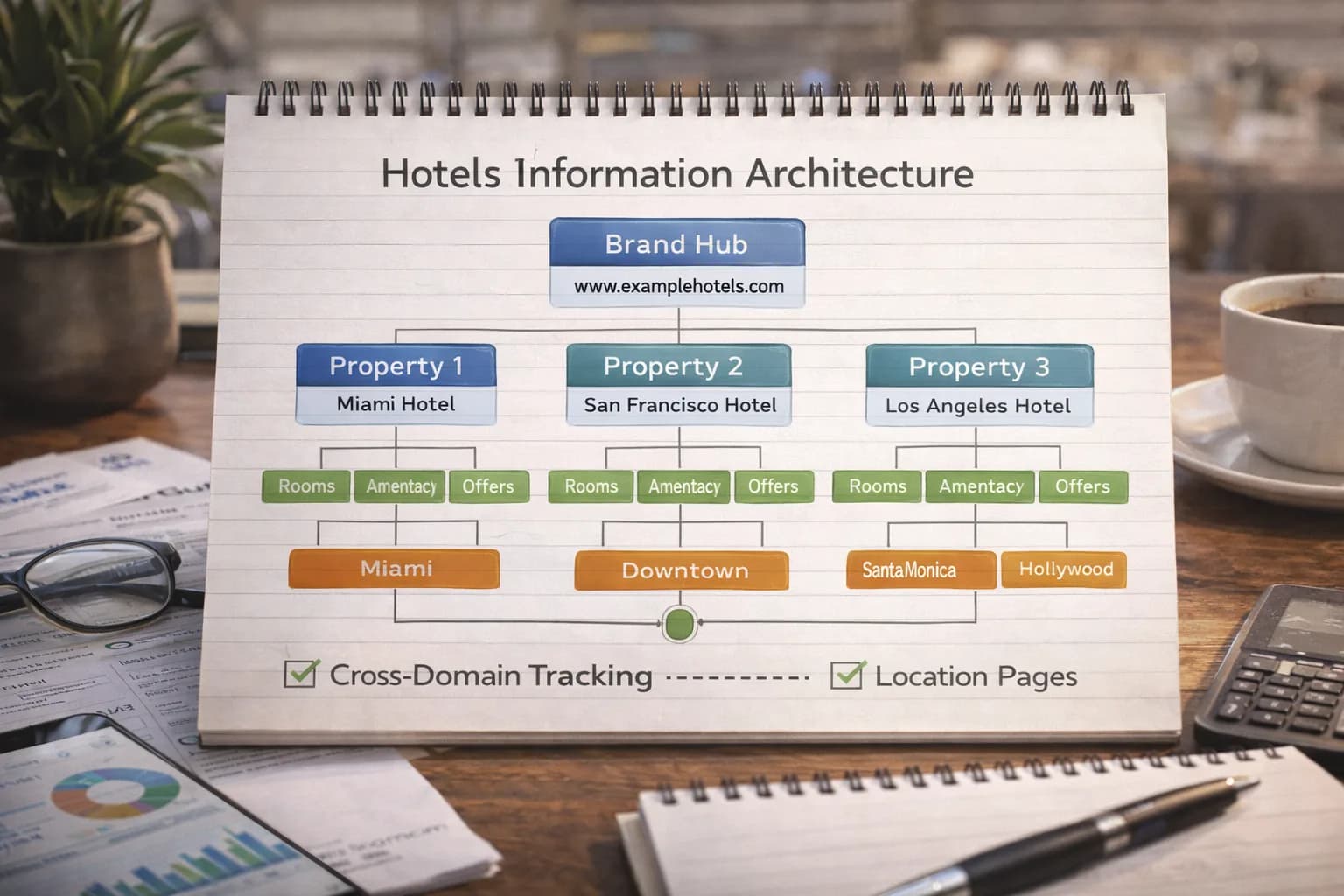
Hotel websites often struggle with organic performance because search engines cannot clearly understand how content fits together. When brand pages, property pages and local area content compete, Google may rank the wrong URL — or none at all.
This guide explains how to structure hotel websites using strong information architecture (IA). You will learn how to organise brand, property and location content so Google, Bing and AI assistants understand your site, helping you earn more direct bookings.
1. Why Information Architecture Matters for Hotels
A clear IA helps search engines understand what each page is about and when it is relevant. For hotel groups, this is essential because similar content often appears across properties.
Good IA reduces cannibalisation, strengthens entity understanding, and supports both SEO and AI-driven search results.
- Create a hierarchy: brand → region → city → property.
- Use structured navigation so guests can find information in fewer clicks.
For deeper website fundamentals, see our Hotel SEO services.
2. Build a Brand Hub That Explains the Portfolio
Your brand hub should be the strongest top-level navigation point. It is the anchor for your entity structure and helps Google understand your brand.
Include:
- What the brand stands for (USP, experience, amenities).
- Overview of all properties, grouped by country/region.
- Key links to offers, experiences and direct booking benefits.
Google’s guidance on how to organise a website confirms that clear hierarchy supports crawling and indexing.
Add internal links to related content, such as Hotel SEO Strategy 2026.
3. Create Location Hubs for Destination-Level SEO
Location hubs help avoid duplicate content across properties and strengthen local relevance. Each hub should act as a guide to the city or region.
A location hub should include:
- What makes the destination attractive.
- Main attractions, events and seasonal reasons to visit.
- How the property (or properties) fits into the destination.
Refer to Local SEO for Resorts & Destination Hotels for additional optimisation steps.
Google explains in its SEO basics that topic grouping helps relevance and improves crawler understanding.
4. Structure Property Pages Around Core Intent
Every property page should be structured around the questions potential guests ask:
- Where is the hotel located?
- What amenities are available?
- What room types are offered?
- What is nearby?
- Why book direct?
Align the page to commercial intent by including:
- Trust elements
- Direct booking benefits
- Location highlights
- Clear room type breakdown
- Reviews and social proof
You can expand this using the Hotel Landing Page Blueprint.
5. Avoid Cannibalisation Between Properties and Cities
Hotels often duplicate similar content across multiple property pages. This creates keyword cannibalisation and confuses search engines.
To prevent issues:
- Keep destination content in location hubs, not property pages.
- Explain each property differently, focusing on its characteristics.
- Cross-link properties within the same city using descriptive anchor text.
Use the Indexed Pages Tool to detect duplicate URL patterns and indexing gaps.
6. Use Structured Data to Support IA
Structured data helps search engines interpret your IA more accurately. For hotels, the most important schemas are:
- Hotel schema
- FAQPage schema
- Breadcrumb schema
- LocalBusiness schema
- Offer schema (for rooms and packages)
See Google's official guidance on structured data for eligibility and best practice.
Add breadcrumb schema aligned with brand → region → city → property for clarity.
7. Internal Linking Strategy for Stronger IA
A consistent internal linking structure is crucial.
Use links to:
- Connect brand → region → city → property pages.
- Link from blog posts to the most relevant property or location hub.
- Promote relevant SEO resources such as the Guides library.
Sibling cluster links you should reference in this article include:
Cross-pillar recommendation:
See our content marketing services for how IA shapes content performance.
8. Measuring Performance of Your IA
Measure the impact of IA using:
- Google Search Console: impressions, clicks, and URL-level performance.
- GA4: landing page sessions, conversions and assisted conversions.
- Our Crawlability Tool: ensure all hubs are discoverable.
- PMS/CRM data: direct booking share vs OTA reliance for each property.
Google’s documentation on GA4 landing page reporting helps validate performance improvements.
Frequently Asked Questions
Conclusion
A well-designed information architecture is one of the strongest SEO foundations for hotels. It helps guests find what they need, guides search engines to the right pages, and improves visibility across both traditional search and AI-generated answers.
If your hotel is restructuring its website, now is the ideal time to review your IA and ensure it supports your brand, locations and properties. Our benchmark of 139 UK luxury hotel websites shows how widely structural inconsistencies persist across the sector — and how much ground is available to properties that get the foundations right.
Schedule a Technical SEO Review
Kiril Ivanov
Performance Marketing Specialist
Kiril Ivanov is a digital marketing specialist with experience managing local, national and international campaigns for businesses ranging from growing independent companies to major consumer brands. His background includes leading advertising automation work for Michael Kors and working on campaigns involving Canon, Dormeo, esure, DLG Group, Village Gym, Cameron House, Crerar Hotels, Cromlix Hotel, Harrison Fund and the Advertising Standards Authority. His experience spans paid search, paid social, advertising automation, SEO, conversion optimisation and wider digital strategy across hospitality, retail, financial services, professional services and other competitive sectors.
View author profile →Related Hotel Marketing Guides
Continue with related topics to build a complete strategy.