Building Local Links for Hotels Without Directories
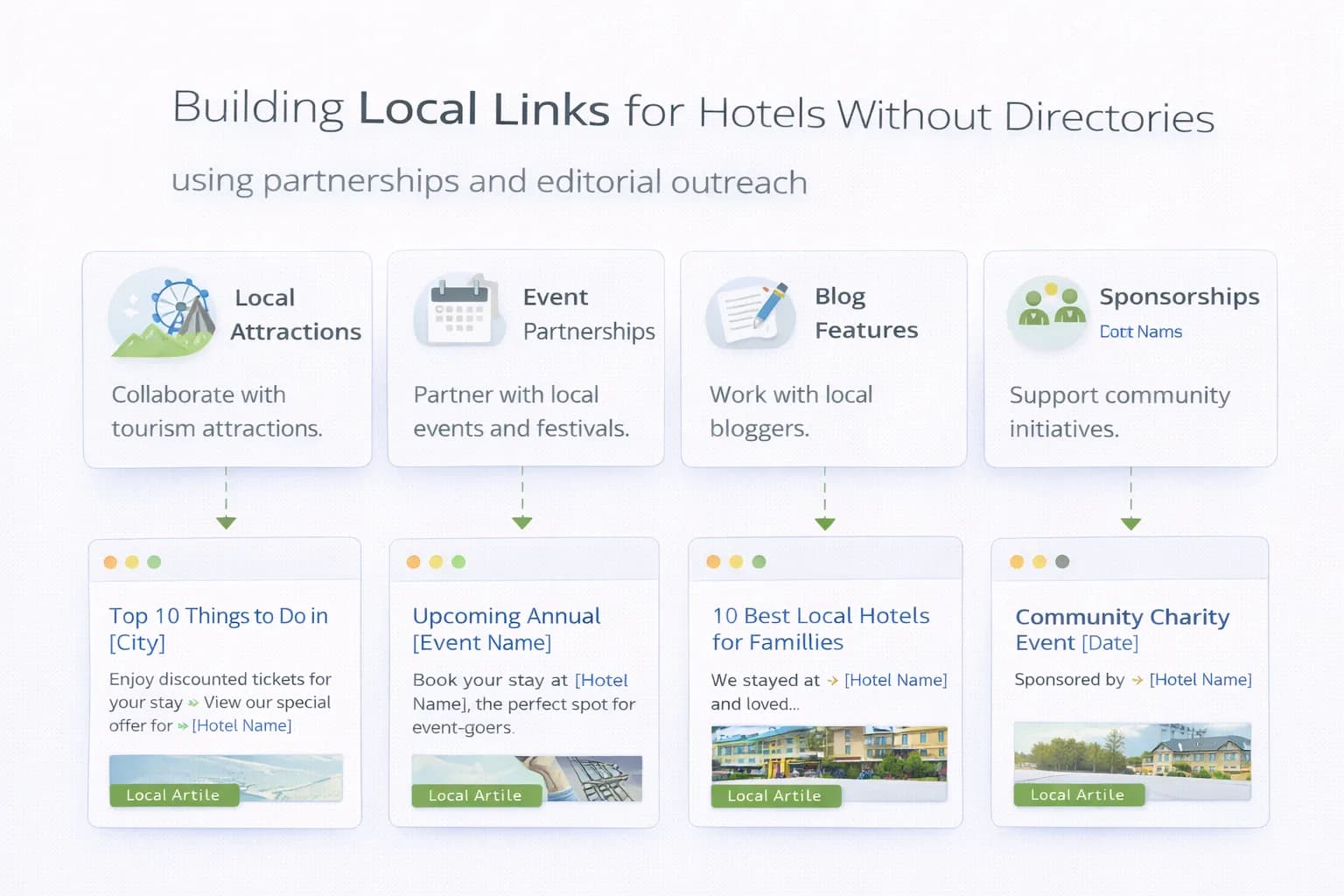
Directories and “submit your site” lists don’t build durable authority—and some can harm your brand. In 2026, the safest local links come from useful community assets and genuine partnerships your guests actually use.
This guide shows hotels how to earn editorial, place-relevant links without directories, while staying inside Google’s policies and protecting long-term visibility.
1) What “good” local links look like
High-quality local links are:
- Editorial (someone chose to reference you)
- Relevant (place, audience, topic)
- Useful (guide, map, checklist, data, venue info)
- Hosted on real sites (council, DMO, museum, venue, school, charity)
Stay aligned with Google Search Essentials and avoid link schemes per Google’s link spam policy.
2) Foundations: NAP, pages, and assets
Before outreach, fix the basics so links land on conversion-ready pages.
- Consistent NAP (name, address, phone) across your site and listings; audit with GBP Consistency.
- Place pages: parking, getting here, neighbourhood hubs; check crawl paths with Crawlability and indexation via Indexed Pages.
- Speed & mobile: validate with Website Speed.
- Assistant-ready structure (entities, short FAQs) per Google’s structured data guide.
3) Ten link sources that aren’t directories
Use these as quarterly programs, not once-offs.
-
City & neighbourhood guides on your site
Publish a well-researched hub (areas, walking times, itineraries) and pitch it to local press/DMO pages. Use the blueprint in Creating Location Guides That Support SEO & AEO. -
Accessible travel pages
Step-free routes, lift sizes, Blue Badge parking, quiet hours, sensory maps. Many councils and attractions link to accessibility resources. -
Stadium & venue day guides
Gates, bag policies, last trains, family sections; offer a static map and embed code. Venues and fan blogs often cite practical guides. -
Event micro-hubs
Festival weekends, marathons, exhibitions. Keep URLs stable each year; refresh dates. DMOs and organisers like reliable “where to stay” explainers. -
Walkable city map (GPX + static image)
Ten places within 20 minutes’ walk; publish a downloadable GPX and credit-free map. Photographers, local bloggers and museums love these. -
Schools & universities partnerships
Open-day accommodation info, alumni weekends, visiting faculty—provide a clear page and contact. Many institutions list “where to stay” with links. -
Community sponsorships (with a useful asset)
Support a junior team, gallery, or charity—but add value (fixture calendar, gallery trail map) so coverage is editorial, not just a logo. -
Restaurant & café trails
Three streets, six stops; rights-cleared photos. Local BID/Chamber sites often link to curated trails. -
Business traveller playbook
Coworking nearby, early check-in windows, best midweek rates, fast Wi-Fi details; pitch to chamber and conference organisers. -
Sustainability & rail-first itineraries
Car-free weekend plans with live links to rail/bus operators and bike hire. Councils and green groups frequently cite these.
Deep-dive PR ideas and page kits are in Digital PR Ideas for Hotels That Don’t Feel Spammy.
4) The linkable page kit (copy this)
Every asset page should include:
- Standfirst (who it helps + what’s inside)
- Map or list module (jump links)
- Short FAQ (3–5 practical Qs)
- Media kit (6–8 images, captions, usage terms)
- Embed block (copy/paste snippet if relevant)
- Contact (real name + email for editors)
- Next steps (rooms/offers blocks + availability widget)
Validate mobile UX and speed with Website Speed.
5) Outreach lists (quality, not volume)
Build a small, accurate list:
- Local/regional press (travel, lifestyle, events desks)
- DMO/tourism board editors (editorial calendars help: see VisitBritain insights)
- Council pages (transport, accessibility, parks)
- Universities/museums/venues (visitor info)
- Community creators (family travel, accessibility, food)
Keep a simple CRM: outlet, contact, beat, last relevant article, angle fit, status.
6) Two respectful pitch templates
Calendar/guide pitch
Subject: Updated [City] Visitor Guide + rights-cleared images
Hi [Name], we’ve updated our [City] guide with walking times, step-free routes and a downloadable map. It’s designed for visitors planning weekends and events. Details and an image pack below—use anything with credit.
— 3 bullet highlights —
Guide: [URL] • Images: [URL] • Contact: [Name, phone]
Explainer/venue pitch
Subject: Stadium day guide with last-train times + family tips
Hi [Name], we’ve published a practical [Stadium] day guide (gates, bag policy, last trains, family sections). Editors can embed the static map; captions inside. Happy to supply quotes from our concierge.
Guide: [URL] • Map: [URL]
No attachments on first send; link to a clean page.
7) What to avoid (so links stay safe)
- Mass BCC blasts, spun content, “guest posts” at scale
- Paying for links or “placements” (request rel="sponsored" if there is value exchange)
- Thin “city listicles” with stock images
- Duplicate guides across multiple hotel sites in the same group
Review Google’s guidance on spammy practices before major campaigns.
8) Measurement: prove links help bookings
Search & links
- Monitor new referring domains in Search Console; annotate big wins (Search Console).
- Track ranking movement for target queries with SERP Tracker.
Traffic & revenue (GA4)
- Cross-domain enabled with your booking engine (GA4 cross-domain).
- Bookings and vouchers marked as key events (GA4 conversions).
- Compare revenue/1k sessions from linked pages vs other content.
- Watch brand search lift 24–72h after large placements with SERP Tracker.
Local visibility
- Keep your Google Business Profile optimised; see GBP Help for categories, attributes and posts. Strong local content often increases map pack engagement.
9) 30-day local link sprint
Week 1 – Pick & build
- Choose one asset (accessibility page, venue guide, walkable map).
- Draft copy, images, FAQ, and an embed block. QA speed with Website Speed.
Week 2 – Lists & soft launch
- Compile 40–60 high-fit contacts (press, DMO, venues, institutions).
- Send 10–15 personalised pitches; collect feedback; refine page.
Week 3 – Scale & partnerships
- Pitch remaining contacts; brief 1–2 creators for visuals.
- Offer co-branded versions for institutions (with their logo and link back).
Week 4 – Measure & iterate
- Track new linking domains and GA4 revenue/1k sessions.
- Document learnings in Resources (guides) and plan the next quarter’s asset.
FAQ
Frequently Asked Questions
Conclusion
Local links that last are earned by usefulness—clear guides, accessibility info, venue explainers, and community partnerships. Publish fast, assistant-ready pages, pitch respectfully, and measure impact in GA4 and Search Console. Over time, you’ll build defensible authority that also helps guests choose—and book direct.
Build local links the right way
Kiril Ivanov
Performance Marketing Specialist
Kiril Ivanov is a digital marketing specialist with experience managing local, national and international campaigns for businesses ranging from growing independent companies to major consumer brands. His background includes leading advertising automation work for Michael Kors and working on campaigns involving Canon, Dormeo, esure, DLG Group, Village Gym, Cameron House, Crerar Hotels, Cromlix Hotel, Harrison Fund and the Advertising Standards Authority. His experience spans paid search, paid social, advertising automation, SEO, conversion optimisation and wider digital strategy across hospitality, retail, financial services, professional services and other competitive sectors.
View author profile →Related Hotel Marketing Guides
Continue with related topics to build a complete strategy.