How Hotel Websites Actually Rank: A Simple Breakdown
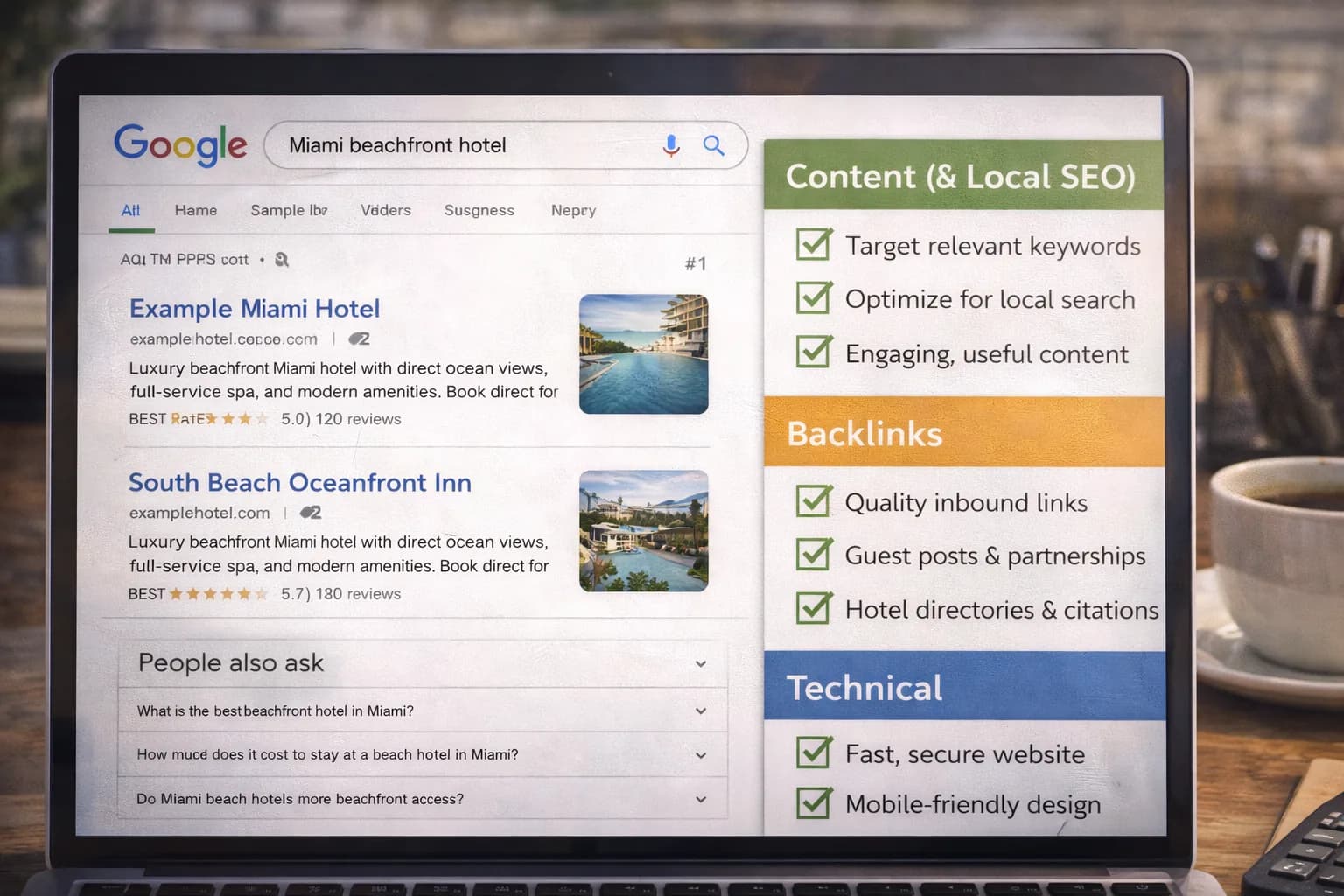
Most hotel marketers hear: “We need more keywords and backlinks.” In reality, ranking is simpler and more practical: make it crawlable, relevant, high-quality, fast and stable, then earn credible mentions—and keep local signals consistent.
This guide breaks down how hotel pages rank in 2026 and gives you a first-things-first plan that turns visibility into direct bookings.
1) The short model: six levers you control
Ranking = Crawlability → Relevance → Quality → Page Experience → Mentions → Local Signals
- Crawlability: Google can fetch and index what matters (clean links, sitemaps, no blocks).
- Relevance: the page answers the query + intent (e.g., “hotel with parking in [city]”).
- Quality: useful, factual detail; clear headings; assistant-ready Key Facts.
- Page Experience: fast LCP, stable CLS, responsive UX on mobile.
- Mentions & Links: real citations (tourism board, venues, media).
- Local Signals: GBP category/attributes, reviews, photos, NAP consistency.
Useful primary docs:
Google Search Essentials •
Structured data guide •
web.dev: Core Web Vitals •
How local ranking works (GBP)
2) Crawlability: can Google reach your best pages?
Check the basics before writing another blog.
- Index only what helps guests decide (rooms, offers, parking, breakfast, location, accessibility).
- Ship XML sitemaps; keep canonicals correct; avoid parameter traps.
- Use internal links from hubs → rooms/offers.
- Test with Crawlability and read our indexing issues guide.
Quick win: remove thin/duplicate pages from index and link more prominently to Rooms and Offers.
3) Relevance: match the query and the intent
Relevance comes from page purpose, not keyword stuffing.
- Map pages to real queries:
- Rooms → “[room type] in [city]”
- Parking → “hotel with parking/EV [city]”
- Breakfast → “breakfast hours [hotel]”
- Location → “near [station/attraction]”
- Reflect the query in H1, intro, and Key Facts block.
- Use Keyword Research to scope demand, then follow Landing Page Blueprint patterns.
4) Quality: answer decisively (and honestly)
Quality = clear, verifiable specifics guests can trust and assistants can reuse.
- State occupancy, bed, bathroom, accessibility, cancellation terms on room pages.
- Add parking cost/height/EV bays and breakfast times on site (and in pre-stay emails).
- Use micro-FAQs (3–6) near CTAs; keep reading level B1–B2.
- Mark up Hotel/LodgingBusiness, FAQ, Breadcrumb; Product/Offer for room pages when appropriate (see Review Schema—what’s allowed).
5) Page experience (Core Web Vitals): speed is brand
Fast, stable pages rank and convert better.
- Target LCP ~2.5s, minimal CLS, quick input response.
- Export smaller hero images, set
width/height, lazy-load below the fold. - Keep JS light; defer non-critical scripts (manage via GTM).
- Validate with Website Speed and review Core Web Vitals for Hotels.
Authoritative guidance: Core Web Vitals guide.
6) Mentions & links: earn, don’t spray
Not all links are equal. Focus on credible, contextual mentions.
- Local tourism boards, city guides, event partners, universities, venue collaborations.
- Publish assets worth citing: parking map, accessible routes, location guides.
- See Building Local Links and Digital PR Ideas.
7) Local signals: how maps and organic work together
Map-pack visibility influences organic CTR and vice versa.
- Keep GBP categories, attributes (parking, EV, accessibility), photos and hours accurate.
- Run a policy-safe review engine (no incentives, no gating).
- Sync NAP with your site; monitor with GBP Consistency.
Deep dives: GBP Optimisation, Increase Google Ratings.
8) Entities & structure: make meaning machine-readable
Clear entities help assistants and search understand you.
- Use Hotel/LodgingBusiness with
amenityFeature,checkinTime,checkoutTime,petsAllowed. - For rooms, consider
Product+Offerwhere supported. - Keep content consistent with site copy and GBP attributes.
Background: Entity Optimisation and Structuring Content for AI Assistants.
9) Information architecture (IA): shape signals at scale
An organised site ranks more predictably.
- Brand → Property → Rooms / Offers / Location / Parking / Breakfast / Accessibility.
- Use breadcrumbs and contextual links between related pages.
- Follow the model in Hotel Information Architecture.
10) What to fix first (90-day sequence)
Month 1 — Make it crawlable & fast
- Indexing, canonicals, sitemaps, internal links to Rooms/Offers.
- Compress hero images; remove heavy carousels; stabilise CLS.
Month 2 — Make it relevant & useful
- Publish/refresh Parking, Breakfast, Location, Accessibility pages.
- Add Key Facts to Home/Rooms; add micro-FAQs near CTAs.
Month 3 — Build authority & local momentum
- Secure 3–5 local mentions (tourism board, venue partners).
- Refresh GBP photos; start review engine; align attributes.
- Measure with SERP Tracker and GA4.
11) How to measure ranking properly (bookings, not just positions)
Ranking should support revenue, not vanity charts.
- GA4: primary conversion =
purchase(value & currency). Scoreboard = revenue/1k sessions, purchase rate by landing page template. - Search Console: impressions, clicks, CTR per URL; coverage and canonical status.
- GBP: profile actions (website, calls, directions) and photo views.
- PMS/CRM: Direct vs OTA share, ADR trend.
Use Analytics Dashboard to unify SEO + local + revenue.
Helpful references:
Search Console •
GA4 conversions
12) Common myths (and what to do instead)
- “We need exact-match domains.” → Build a brandable domain; focus on clarity, IA and speed. See Naming & Domains.
- “More blogs = more rankings.” → Publish decision pages first; then write helpful guides that support those journeys.
- “Stars on our homepage schema will help.” → Self-serving review markup is disallowed; use FAQ/Breadcrumbs and room-level Product where appropriate (see Review Schema).
- “Rankings alone prove success.” → Track purchases, not just positions.
13) Practical checklist (copy this)
- [ ] Crawl the site; fix blocks, canonicals, sitemaps.
- [ ] Add Key Facts to Home/Rooms; create Parking/Breakfast/Location/Accessibility pages.
- [ ] Compress hero media; set image dimensions; validate CWV.
- [ ] Add Hotel/FAQ/Breadcrumb schema; room Product/Offer where appropriate.
- [ ] Refresh GBP (photos, attributes); start a compliant review ask.
- [ ] Secure 3–5 credible local mentions/links.
- [ ] Measure revenue/1k sessions, CTR/URL, and GBP actions weekly.
FAQ
Frequently Asked Questions
Conclusion
Ranking isn’t magic—it’s foundations + clarity + trust, reinforced by real-world mentions and consistent local signals. Make pages crawlable and fast, answer the query with useful facts, earn credible citations, and measure everything against purchases. That’s how hotel SEO translates into more direct bookings and less reliance on OTAs.
Run the 90-day ranking plan
Kiril Ivanov
Performance Marketing Specialist
Kiril Ivanov is a digital marketing specialist with experience managing local, national and international campaigns for businesses ranging from growing independent companies to major consumer brands. His background includes leading advertising automation work for Michael Kors and working on campaigns involving Canon, Dormeo, esure, DLG Group, Village Gym, Cameron House, Crerar Hotels, Cromlix Hotel, Harrison Fund and the Advertising Standards Authority. His experience spans paid search, paid social, advertising automation, SEO, conversion optimisation and wider digital strategy across hospitality, retail, financial services, professional services and other competitive sectors.
View author profile →Related Hotel Marketing Guides
Continue with related topics to build a complete strategy.