Hotel SEO Strategy for 2026: A Complete Playbook
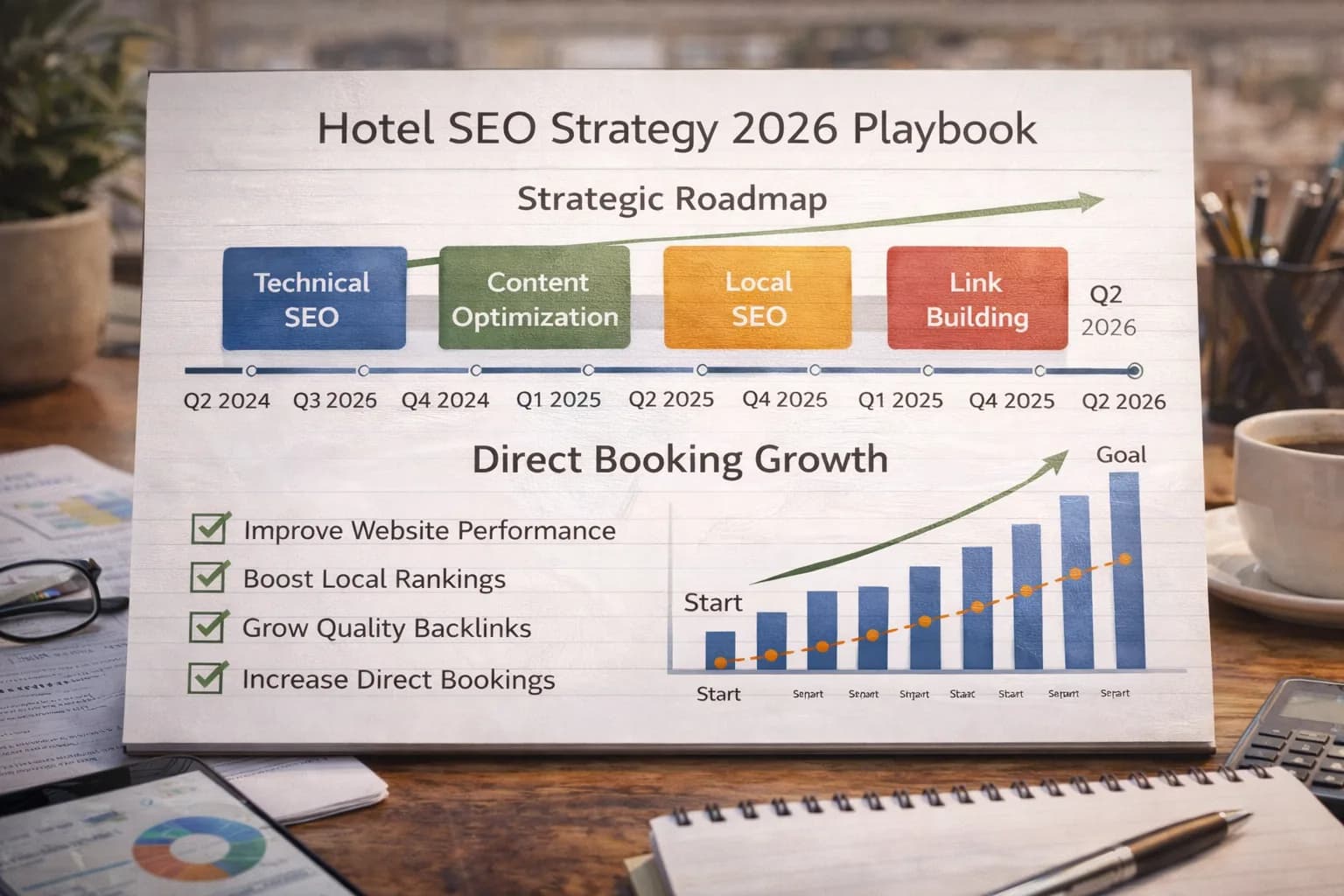
Hotel SEO in 2026 is no longer just about ranking for a handful of generic keywords. Your visibility now spans classic search results, AI overviews, map packs, travel verticals and assistant experiences – all of which can drive or dilute direct bookings.
This playbook gives you a pragmatic, hotel-specific SEO strategy for 2026 built around six pillars: technical SEO, content, links, local visibility, conversion optimisation and AEO/GEO. The goal is simple – grow profitable direct bookings and reduce reliance on OTAs.
2026 recovery priority
If rankings dropped after consolidating thin pages, do not rebuild everything. Use Search Console to identify commercial URLs with real impressions, rebuild only the strongest opportunities, and support them with internal links from homepage, service pages, guides and case studies.
Pillar 1: Technical Foundations
Technical SEO is the plumbing that keeps every other channel performing. In 2026, search engines and AI systems expect hotel sites to be fast, secure and easy to crawl – especially on mobile.
Technical priorities for hotels
- Fix crawl and indexation issues so all key room, offer and location pages are reachable.
- Meet Core Web Vitals targets for key templates, especially mobile search and booking flows.
- Ensure a clean URL structure with logical folders for
/rooms,/offers,/meetings,/spa,/dining,/location, and/blog. - Implement HTTPS correctly and fix mixed-content and tracking-script issues.
- Audit structured data (Hotel, LocalBusiness, FAQ, Review) and remove invalid markup.
- Provide an up-to-date XML sitemap per content type and a clean
robots.txtthat doesn’t block essential assets (JS/CSS/images). - Standardise canonical tags (self-referencing canonicals for unique pages; canonical to primary for variants).
- Localise correctly: one URL per language/region with
hreflang, translated UI, and currency/measure formatting. - For multi-property groups, implement a clear information architecture (brand hub → location hubs → property pages → room/offer detail).
Helpful external references:
- Google Search Central: Technical SEO basics and sitemaps
- web.dev: Core Web Vitals & performance guidance
- schema.org: Hotel, LocalBusiness, FAQ markup
Quick technical checklist (copy/paste)
- [ ] All room/offers/location pages discoverable from the homepage within 3 clicks
- [ ] PSI “field data” available for key templates; LCP/INP/CLS passing on mobile at the 75th percentile
- [ ] 2xx for canonical URLs; 3xx to canonical from legacy or campaign URLs
- [ ] One sitemap index; child sitemaps under 50k URLs or 50MB
- [ ]
hreflangpairs validated; no orphaned language versions - [ ] Web font loading without layout shift (font-display swap/optional; preloaded if needed)
- [ ] Analytics and tag loading audited on booking flow; non-critical tags deferred
If you need a rapid, prioritised diagnosis, a focused SEO audit is typically the fastest win. For a detailed picture of where the UK luxury hotel sector currently stands on these foundations, see our 139-property benchmark report.
Pillar 2: Search-Led Content
Your content must attract relevant demand, answer intent thoroughly and move visitors towards booking – not just generate vanity traffic.
Core content types for hotel SEO
- Commercial pages: room types, offers, packages, meeting & events, dining, spa, experiences – all with clear CTAs and rate parity messaging.
- Location content: neighbourhood guides, “things to do”, seasonal itineraries, event-led pages (concerts, festivals, sports), and travel “how to” (parking, airport transfers, public transport).
- Support content: FAQs, policies, accessibility, pet policy, check-in/out, parking. These power snippets for AEO and reduce pre-stay friction.
- Editorial/blog: deep guides that genuinely help the traveller (e.g., “3-Day Glasgow Itinerary for Families”, “Best Whisky Bars Near [Hotel]”), interlinked to relevant commercial CTAs.
Intent mapping & template pairing
Create a table mapping keyword clusters to page templates:
| Intent | Example Queries | Template | Primary CTA | |---|---|---|---| | Transactional (book) | “hotel in [city] with parking”, “[brand] [city] rooms” | Rooms / Offers | Book now | | Commercial research | “best family hotel near [attraction]” | Rooms + Family guide | Check availability | | Local discovery | “things to do in [city] this weekend” | Blog/Guide | Stay with us + offer | | Event-led | “[festival] hotels”, “near [stadium]” | Event landing | Rooms near venue | | Support | “check in time [hotel]” | FAQ/Policy | Manage booking |
Conversion-first content standards
- One purpose per page, one primary CTA, consistent secondary CTA (newsletter/offer alerts).
- Above-the-fold clarity: headline, value prop, trust (reviews/awards), and next step.
- Internal links from guides → relevant rooms/offers; from rooms → relevant guides (nearby attractions).
- Media discipline: right-sized images, modern formats, descriptive alt text.
Pillar 3: Links, Mentions & Authority
Authority for hotels is about trust and relevance, not brute force volume. Aim for a natural footprint across your destination’s ecosystem.
Safe link-building for hotels
- Local partnerships: tourism board pages, city guides, conference/venue partner pages, university accommodation pages, attraction “where to stay” lists.
- Digital PR: renovations, new chef/restaurant, sustainability milestones, awards, cultural collaborations, charity events.
- Supplier & association listings: accredited bodies, wedding directories you truly use, industry associations.
- Brand mention recovery: monitor unlinked mentions and request tidy, branded links to the correct page.
- Event sponsorships: ensure sponsor listings link to the most relevant landing page (event package page, not just the homepage).
What to avoid: bulk “guest post” schemes, irrelevant directories, site-wide footers, or paid links.
Treat links as the by-product of meaningful content and PR.
Pillar 4: Local SEO & GEO
Local SEO underpins map-pack discovery; GEO (Generative Engine Optimisation) helps assistants and AI systems associate your brand with the right location and intent.
Local SEO essentials
- Google Business Profile (GBP): complete all fields, primary + secondary categories, attributes (parking, EV charging, pet-friendly), structured services (spa, meeting rooms), opening hours, and holiday hours.
- NAP consistency: ensure name, address, phone and website are identical across citations and partner sites.
- Reviews: solicit, respond, and reference location context in replies.
- Photos & videos: fresh, seasonal, and representative of room types and amenities.
- Posts & Q&A: address common pre-stay questions; keep responses concise and helpful.
- Local links & mentions: reinforce proximity to landmarks with honest, guest-centric copy on your site.
GEO signals for assistants/AI surfaces
- Clear location hubs:
/location/[city]with embedded FAQs, transport details, proximity blocks to landmarks, and structured data. - Entity clarity: consistent brand naming,
Organizationmarkup at brand level,Hotel/LodgingBusinessat property level, and interlinking across properties. - Fact stability: ensure the same check-in time, pet policy, parking policy appear identically on GBP, your site, and major listings.
- FAQ coverage: write canonical answers on your domain and reuse the same wording in GBP Q&A where appropriate.
Pillar 5: Conversion Optimisation (CRO)
SEO without conversion is just cost. Close the gap between research and booking.
Where to focus CRO efforts
- Direct value props: rate parity, flexible cancellation, perks (breakfast, parking, late checkout), loyalty points.
- Booking engine UX: mobile-first calendars, guest-friendly copy, minimal field count, clear errors, saved progress between steps.
- Trust & reassurance: review snippets, awards, security seals, clear policies.
- Speed & stability: keep booking flow lean; delay heavy scripts until after the first render.
- Offer personalisation: highlight relevant packages based on referrer (e.g., event pages → event rate).
- Exit prevention: gentle reminders or “save for later” rather than aggressive pop-ups.
Pair ongoing tests with your conversion optimisation plan so traffic gains translate into revenue.
Pillar 6: AEO/GEO and Measurement
Measure what matters across classic SEO, AI overviews and local surfaces.
What to track
- Core commercial KPIs: organic revenue, bookings, conversion rate, average order value, cancellation rates.
- Brand vs non-brand: revenue split, impression share, and trend lines.
- SERP ownership: presence across blue links, site-links, map pack, hotel pack, FAQs, and AI answers.
- Local KPIs: GBP views, calls, website clicks, direction requests, booking actions.
- Experience metrics: Core Web Vitals (field), scroll depth, interaction events on booking steps.
- Attribution sanity: report together with Paid Search/Metasearch to avoid cannibalisation and double counting.
Dashboard essentials (implementation notes)
- Connect GA4/e-commerce to booking engine with server-side tagging if possible.
- Pipe GBP Insights into your dashboard (manual export/API where available).
- Track template-level performance (rooms/offers/guides) rather than just URLs.
- Capture
web-vitalsevents for LCP/INP/CLS with template labels.
Putting It All Together: 90-Day Hotel SEO Roadmap
Weeks 1–2 – Discovery & Stabilisation
- Crawl the site; fix critical 4xx/5xx; verify canonicals; submit sitemaps.
- Audit CWV on key templates (mobile first); implement top 5 fixes.
- Validate GBP data; correct categories, hours, and attributes.
- Draft the information architecture (brand → city → property → rooms/offers).
Weeks 3–6 – Content & Local Lift
- Publish/refresh: Rooms (all types), Offers hub + 2 best-sellers, Location hub, Parking/Transport FAQ, Accessibility.
- Ship 3 destination guides tied to revenue moments (family weekend, event near venue, seasonal itinerary).
- Implement
Hotel/LodgingBusinessschema, FAQ schema on support pages.
Weeks 7–10 – Authority & CRO
- Launch one digital PR angle (e.g., new chef, sustainability milestone).
- Build/repair top 20 citations and partner links.
- Booking-flow CRO sprint: simplify calendar, reduce fields, surface perks; A/B a direct-booking banner.
Weeks 11–12 – AEO/GEO & Reporting
- Create property/city FAQs reflecting real guest queries.
- Align GBP Q&A with on-site answers; add structured data.
- Finalise dashboard with organic revenue, bookings by template, GBP actions, CWV trends.
- Produce the “Q next” roadmap for engineering/marketing.
Page Architecture: What “Great” Looks Like
Rooms (template)
- H1: “Deluxe King Room in [City]”
- Lead: 2–3 lines with unique value (view, size, amenities).
- Primary CTA: Book now (visible above the fold).
- Content blocks: room features, in-room amenities, policies (concise), gallery (optimised), “Why book direct” panel, and related offers.
- Internal links: to hotel overview, location hub, relevant guide (“Best family activities near us”).
- Structured data:
HotelRoom(where appropriate),AggregateRating(if policy-compliant). - Performance: single LCP hero, lazy-loaded gallery, no layout shifts.
Offers (template)
- Offer card SSR, details lazy-expanded, clear terms, availability hint.
- Internal links from guides and event pages; “Nearby event” block where relevant.
- Schema:
Offerwhere appropriate (avoid over-marking non-eligible content).
Location / Things to Do (template)
- Sub-sections for “Getting here”, “Neighbourhoods”, “Top attractions”, “Events”.
- Static map image with a “View interactive map” button to defer heavy scripts.
- Short FAQs answering canonical questions (parking, distances, pet policy).
- Internal links to rooms/offers with relevant hooks.
Structured Data (starter snippets)
Property-level (simplified)
{
  "@context": "https://schema.org",
  "@type": "Hotel",
  "name": "Example Hotel Glasgow",
  "url": "https://www.examplehotel.com/",
  "image": "https://www.examplehotel.com/images/hero.jpg",
  "telephone": "+44 141 000 0000",
  "address": {
    "@type": "PostalAddress",
    "streetAddress": "123 Example Street",
    "addressLocality": "Glasgow",
    "postalCode": "G1 1AA",
    "addressCountry": "GB"
  },
  "amenityFeature": [
    {"@type":"LocationFeatureSpecification","name":"Parking","value":true},
    {"@type":"LocationFeatureSpecification","name":"Free Wi-Fi","value":true}
  ],
  "sameAs": [
    "https://www.google.com/travel/hotels",
    "https://www.instagram.com/examplehotel"
  ]
}
Frequently Asked Questions
Frequently Asked Questions
Build high-converting pages with the Landing Page Blueprint, reduce OTA dependency with our 2026 guide, and balance paid tactics in SEO vs OTA Bidding.

Kiril Ivanov
Performance Marketing Specialist
Kiril Ivanov is a digital marketing specialist with experience managing local, national and international campaigns for businesses ranging from growing independent companies to major consumer brands. His background includes leading advertising automation work for Michael Kors and working on campaigns involving Canon, Dormeo, esure, DLG Group, Village Gym, Cameron House, Crerar Hotels, Cromlix Hotel, Harrison Fund and the Advertising Standards Authority. His experience spans paid search, paid social, advertising automation, SEO, conversion optimisation and wider digital strategy across hospitality, retail, financial services, professional services and other competitive sectors.
View author profile →Related Hotel Marketing Guides
Continue with related topics to build a complete strategy.