Hotel Landing Page Blueprint
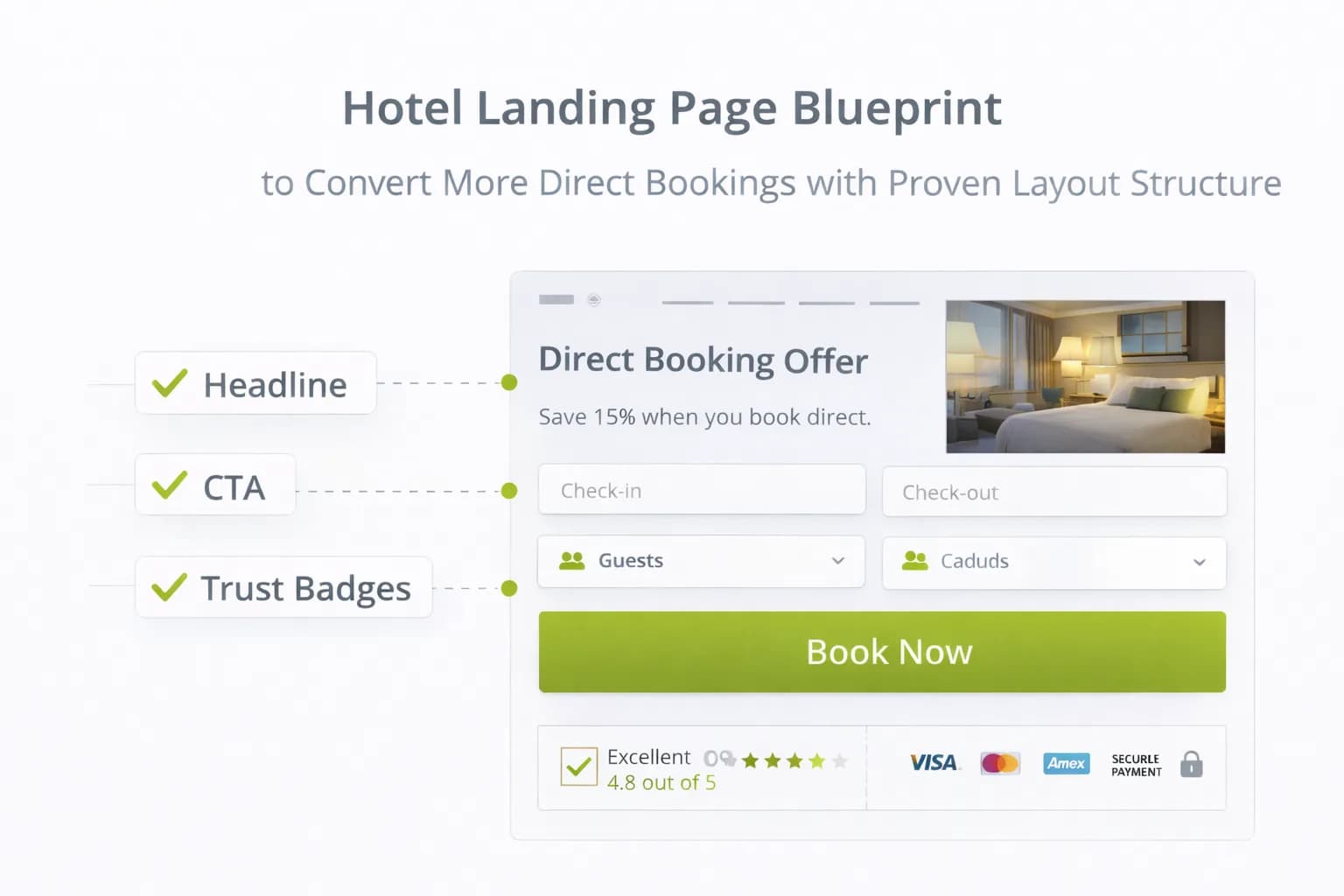
Your hotel landing page is the first impression most guests will have of your property. It is where SEO traffic, paid ads and social campaigns all converge. Yet most hotel websites send visitors to generic homepages that confuse, distract and fail to convert. The result is lost bookings and wasted marketing spend.
In this blueprint, you will learn how to design and structure high-converting hotel landing pages that turn visitors into direct bookings. We cover the foundational principles, above-the-fold essentials, body section structure, copy and design rules, and optimisation tactics. By the end, you will have a repeatable framework you can apply to any hotel, offer or audience.
1. Foundations: One Page, One Intent
The most common mistake hotel marketers make is trying to serve multiple audiences on one page. A business traveller searching for "hotel near airport" has different needs than a couple searching for "romantic weekend getaway". If your landing page tries to speak to everyone, it will convert no one.
The foundational rule is simple: one page, one intent. Each landing page should target one specific audience, one offer or one search query. This improves relevance, increases conversion rates and supports better SEO and PPC performance.
Examples of intent-focused pages
- Business travellers: "Executive rooms near Manchester Airport with free Wi-Fi and meeting rooms."
- Couples: "Romantic spa breaks in the Cotswolds with champagne and dinner."
- Families: "Family-friendly hotel in Brighton with kids' club and connecting rooms."
- Event planners: "Conference venues in London with AV equipment and catering."
For deeper insights on targeting intent, see our SEO strategy playbook.
2. Above the Fold: Clarity in 5 Seconds
Above the fold is the most valuable real estate on your landing page. Visitors decide whether to stay or leave within 5 seconds. Your goal is to communicate your unique value proposition immediately and remove all friction.
What must appear above the fold
- Compelling headline: Clear, benefit-driven and specific.
- High-quality hero image: Show your best room, lobby or view.
- Unique value proposition (UVP): Why choose your hotel over competitors?
- Primary CTA: "Check Availability", "Book Now", "View Rooms".
- Trust signals: Star rating, awards, review score, recognisable badges.
- Booking widget (optional): If your engine is fast and mobile-friendly.
Example headline structure
- Problem + Solution: "Tired of noisy city hotels? Enjoy peaceful luxury in our countryside retreat."
- Benefit-driven: "Wake up to sea views and complimentary breakfast in Brighton's best boutique hotel."
- Offer-specific: "Save 20% on spa breaks this February – limited availability."
Avoid vague headlines such as "Welcome to Our Hotel" or "Experience Luxury". Be specific and benefit-focused.
3. The Body: Sections That Build Trust & Desire
After the hero section, your landing page should guide visitors through a logical flow that builds trust, showcases benefits and removes objections. Structure your body content in this order:
3.1. Benefits & Features
Start by explaining what guests get and why it matters. Use bullet points or icons for scanability.
Example:
- Free Wi-Fi & workspace in every room (business travellers value productivity).
- Rooftop terrace bar with city views (unique selling point).
- Pet-friendly rooms with welcome pack (removes a common objection).
- 24-hour room service (convenience for late arrivals).
3.2. Room Types & Photos
Show your best rooms with high-quality photos, clear descriptions and pricing indicators. Use a grid or carousel layout for easy browsing.
What to include:
- Room name (e.g., "Deluxe King Room").
- Size in square metres.
- Key features (king bed, sea view, balcony).
- Starting price ("From £120 per night").
- CTA button ("View Availability").
For photo guidelines, see our GBP optimisation guide.
3.3. Social Proof & Reviews
Social proof is one of the most powerful conversion drivers. Display recent reviews, star ratings, awards and testimonials prominently.
Where to get reviews:
- Google Business Profile
- TripAdvisor
- Booking.com (if allowed by contract)
- Direct guest feedback
Use real names, photos and specific quotes. Avoid generic testimonials such as "Great hotel!" – instead use "The rooftop bar had stunning views and the staff went above and beyond to arrange our anniversary dinner."
3.4. Location & Nearby Attractions
Help guests visualise their stay by showing your location and what is nearby. Use an embedded map and a short list of attractions.
Example:
- 5 minutes' walk to Brighton Pier
- 10 minutes to The Lanes shopping district
- 15 minutes to Brighton Station
- Direct beach access
This section also supports local SEO. For more on local signals, see our local SEO guide.
3.5. Amenities & Services
List all hotel amenities in a scannable format. Use icons for visual appeal.
Common amenities:
- Free Wi-Fi
- On-site parking
- Gym & spa
- Restaurant & bar
- Pet-friendly
- Airport transfers
- 24-hour reception
3.6. FAQs
A well-structured FAQ section reduces friction and answers objections before they stop a booking. It also supports SEO by targeting question-based queries.
Common questions:
- What time is check-in?
- Do you allow pets?
- Is parking available?
- Do you offer airport transfers?
- What is your cancellation policy?
For FAQ schema implementation, see our schema markup guide.
3.7. Final CTA
End with a clear, prominent call-to-action. Repeat your primary CTA from the hero section and reinforce urgency or value.
Examples:
- "Book now and save 15% on your stay."
- "Only 3 rooms left at this price – check availability."
- "Reserve your room now – free cancellation up to 24 hours before arrival."
4. Copy & Design Rules That Convert
Great landing pages follow proven principles of persuasion, clarity and design. Here are the non-negotiables:
Copy rules
- Write in short, scannable sentences.
- Use active voice and benefit-driven language.
- Avoid jargon and buzzwords ("world-class", "unparalleled").
- Speak directly to your target audience.
- Include numbers and specifics ("5-minute walk", "20% discount").
Design rules
- Use high-quality, authentic photos (no stock images).
- Ensure strong visual hierarchy (headings, subheadings, bullet points).
- Use white space generously to avoid clutter.
- Stick to 2–3 brand colours for consistency.
- Make CTAs stand out with contrasting colours.
- Ensure mobile responsiveness (60%+ of traffic is mobile).
Performance rules
- Aim for a Largest Contentful Paint (LCP) under 2.5 seconds.
- Compress images using WebP or modern formats.
- Lazy-load images below the fold.
- Minimise third-party scripts (tracking pixels, chat widgets).
- Use a fast hosting provider.
Test your speed with the Website Speed Checker.
5. Optimisation: Test, Measure, Improve
Landing pages are never "finished". The best-performing pages are continuously tested and refined based on real data.
What to test
- Headlines (benefit-driven vs offer-driven).
- Hero images (rooms vs exterior vs lifestyle shots).
- CTA copy ("Book Now" vs "Check Availability" vs "View Rooms").
- CTA placement (above fold vs below fold vs both).
- Form length (booking widget vs simple enquiry form).
- Trust signals (reviews vs awards vs star ratings).
Tools to use
- Google Analytics 4: Track conversions, bounce rates and behaviour flow.
- Hotjar or Microsoft Clarity: Heatmaps and session recordings.
- Google Optimize or VWO: A/B testing platforms.
- Search Console: Monitor landing page impressions and clicks.
For conversion tracking, see our ROI measurement guide.
Quick wins this week
- Create one intent-focused landing page for your top audience segment.
- Write a benefit-driven headline and UVP.
- Upload 5 high-quality photos of your best rooms.
- Add a prominent CTA above the fold.
- Display your star rating and review score.
- Add an FAQ section with 5–10 common questions.
- Test your page speed and compress any large images.
Common mistakes (and fixes)
- Mistake: Generic homepage used for all campaigns. Fix: Create dedicated landing pages for each audience or offer.
- Mistake: Slow page speed. Fix: Compress images, remove unnecessary scripts and use lazy loading.
- Mistake: Weak or vague headlines. Fix: Focus on specific benefits and outcomes.
- Mistake: No social proof. Fix: Add reviews, ratings and awards above the fold.
- Mistake: Too many CTAs. Fix: Stick to one primary CTA and repeat it strategically.
How to measure success
Track landing page performance with these KPIs:
- Conversion rate: Percentage of visitors who complete a booking or enquiry.
- Bounce rate: Percentage of visitors who leave without interaction.
- Average time on page: Longer is better for complex pages.
- Click-through rate: Percentage of visitors who click your CTA.
- Revenue per visitor: Total bookings divided by total visitors.
Set monthly benchmarks and test one variable at a time to isolate impact.
Frequently Asked Questions
Conclusion
Your hotel landing page is one of the most important assets in your direct booking strategy. A well-structured page can double or triple your conversion rate, reduce reliance on OTAs and improve the ROI of every marketing channel. Follow this blueprint to build pages that are clear, compelling and conversion-focused. Start with one intent-focused page, test it rigorously and scale what works. If you need help auditing your current pages or building a complete landing page strategy, we can help you create a practical plan that fits your goals and resources.
See Conversion Optimisation Services
Kiril Ivanov
Performance Marketing Specialist
Kiril Ivanov is a digital marketing specialist with experience managing local, national and international campaigns for businesses ranging from growing independent companies to major consumer brands. His background includes leading advertising automation work for Michael Kors and working on campaigns involving Canon, Dormeo, esure, DLG Group, Village Gym, Cameron House, Crerar Hotels, Cromlix Hotel, Harrison Fund and the Advertising Standards Authority. His experience spans paid search, paid social, advertising automation, SEO, conversion optimisation and wider digital strategy across hospitality, retail, financial services, professional services and other competitive sectors.
View author profile →Related Hotel Marketing Guides
Continue with related topics to build a complete strategy.