Review Schema and Rich Snippets for Hotels
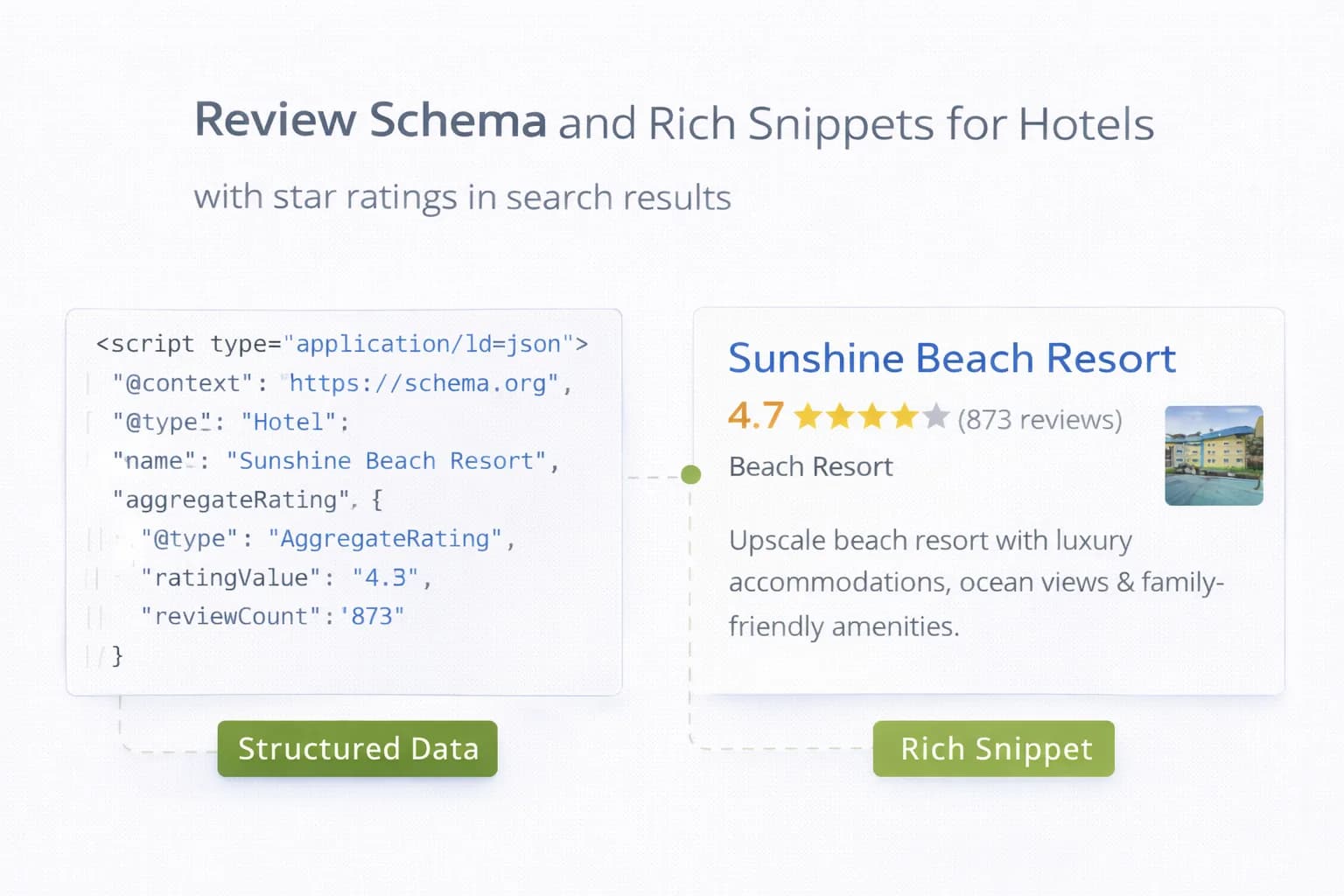
Hotels rely heavily on reputation, but many misunderstand how review schema actually works. Google restricts where and how “star ratings” may appear—and misuse can cause manual actions, rich result suppression, or loss of trust signals.
This guide explains exactly how hotels can use review schema safely, what Google allows, and how structured data supports SEO, AEO and Local SEO when implemented correctly.
1) First principle: Hotels cannot self-apply review stars to their main business entity
Google explicitly disallows self-serving reviews—meaning you cannot mark up reviews about your own hotel on your homepage, rooms pages, or location hub pages.
Official guidance:
Google Review Snippet structured data requirements
Google Search Essentials (spam & misleading behaviour)
Allowed: marking up reviews about products or services.
Not allowed: marking up reviews about your business as a whole.
Hotels are considered Local Businesses, which fall under the “self-serving restriction”.
2) What hotels can legally use review schema for
Google does allow review markup for:
✔ Room types (as products)
If your booking engine or site treats rooms as products with their own review data (e.g., “Deluxe Double Room”), you may apply:
ProductschemaReview/AggregateRating- Verified third-party reviews only (Booking.com, Expedia, Google, TrustYou, ReviewPro)
✔ On-site services (if reviewed separately)
Examples:
- Spa treatments
- Restaurant dining
- Afternoon tea
- Paid parking
- Experiences or activities you operate
✔ Third-party review widgets (if the provider writes the markup)
If a platform such as TrustYou, GuestRevu, Revinate, or TripAdvisor supplies its own schema, that’s typically acceptable because you are not generating it.
✔ “Critic Reviews” markup
Structured editorial reviews (magazines, travel publications, tourism boards), not user reviews.
3) What hotels cannot mark up
✘ Your overall hotel rating from Google/Booking/Tripadvisor
You can show these visually, but not mark them up.
✘ Manually copied or selected guest reviews
Self-serving → disallowed.
✘ Reviews that the hotel hosts itself
User-generated content on your own domain cannot be marked up unless it’s for a non-local-business product/service.
✘ Incentivised or requested-only-from-happy-guests reviews
Violates Google and CMA rules.
For policy details:
CMA guidance on online reviews.
4) Recommended architecture for hotels (safe & effective)
Use this structure across your site:
A) Rooms = Products
Each room type gets:
- Its own page
- Room-specific
Productschema AggregateRatingfrom a trusted external source- Optional:
Amenities,Occupancy,BedTypeas properties
B) Hotel = LocalBusiness
On your main hotel page:
- Use Hotel / LodgingBusiness schema
- No
RevieworAggregateRatingmarkup - Include
amenityFeature,checkinTime,checkoutTime,petsAllowed - Include FAQ markup if relevant
See Glossary for schema property definitions.
C) Restaurant / Spa / Wellness = Services
If your facilities have stand-alone reviews, mark them up separately with Service + Review.
D) Use JSON-LD only
Avoid microdata; JSON-LD is Google’s recommended format.
Reference:
Google Structured Data Intro
5) Rich snippets that do help hotel SEO
Even without review stars on your main hotel page, you can legitimately achieve:
- FAQ rich results (hotel policies, breakfast times, parking info)
- Breadcrumbs
- Sitelinks (automatic)
- Local Knowledge Panel enhancements
- Event schema (seasonal packages, spa events)
- Product snippets on room pages
For FAQ implementation, review FAQ Content for Hotels.
6) Why schema still matters for AEO & GEO (Answer Engines & Guest Experience)
Google, Apple, Meta and assistant models rely heavily on structured data:
- Answer engines recognise entities like parking, spa, breakfast, EV charging.
- AI assistants reference schema-backed facts more safely.
- GEO ranking (guest experience optimisation) improves when amenities and facts are machine-readable.
For deeper entity optimisation, see Entity Optimisation for Hotels.
7) Common implementation mistakes (avoid these)
- Adding
AggregateRatingto the homepage. - Using fake or hand-picked reviews in schema.
- Applying review markup to the entire hotel.
- Using a plugin that automatically marks up all reviews (dangerous).
- Not testing with Google’s Rich Results Test.
Check structured data using:
Google Rich Results Test
8) Measurement: track the impact of review schema properly
Structured data doesn’t guarantee stars—but it improves understanding, which lifts:
Search Console
- Impressions for room/product pages
- Click-through rate for FAQs and room pages
- Impressions for “rich results” categories
GA4
- Revenue/1k sessions for room pages
- Engagement rate on room detail pages
- Add
view_itemandpurchaseevents
Docs:
GA4 ecommerce setup
PMS/CRM
- Conversion rate for room types with enhanced schema
- Time-to-booking for guests who visited those pages
Local SEO
- Knowledge Panel completeness
- Consistency between schema and GBP attributes (use GBP Consistency)
9) Implementation checklist (copy & paste)
Rooms (Product)
- Separate page for each room
- Verified third-party ratings
- JSON-LD with Product + AggregateRating
- Add
offerswith correct URL → booking engine - Validate via Rich Results Test
Hotel (LocalBusiness)
- No reviews
- Add
amenityFeature,petsAllowed,checkinTime,checkoutTime - Add FAQ schema where relevant
- Ensure NAP consistency with GBP
Restaurant/Spa (Service)
- Mark up genuine reviews
- Only external ratings
- Add opening hours, menus, pricing
Site-wide
- Check for plugin conflicts
- Re-test after each deployment
- Keep schema updated when amenities change
- Ensure no PII appears in schema
Conclusion
Review schema is powerful—but only when used within Google’s rules. Hotels can’t mark up reviews about themselves, but they can enhance rooms, services, FAQs and amenities with accurate schema that boosts visibility in both SERPs and AEO surfaces. Build a clean, compliant schema architecture, validate regularly, and connect changes to GA4, Search Console and PMS metrics.
Get structured data implemented correctly
Kiril Ivanov
Performance Marketing Specialist
Kiril Ivanov is a digital marketing specialist with experience managing local, national and international campaigns for businesses ranging from growing independent companies to major consumer brands. His background includes leading advertising automation work for Michael Kors and working on campaigns involving Canon, Dormeo, esure, DLG Group, Village Gym, Cameron House, Crerar Hotels, Cromlix Hotel, Harrison Fund and the Advertising Standards Authority. His experience spans paid search, paid social, advertising automation, SEO, conversion optimisation and wider digital strategy across hospitality, retail, financial services, professional services and other competitive sectors.
View author profile →Related Hotel Marketing Guides
Continue with related topics to build a complete strategy.