Entity Optimisation for Hotels: Beyond Basic SEO
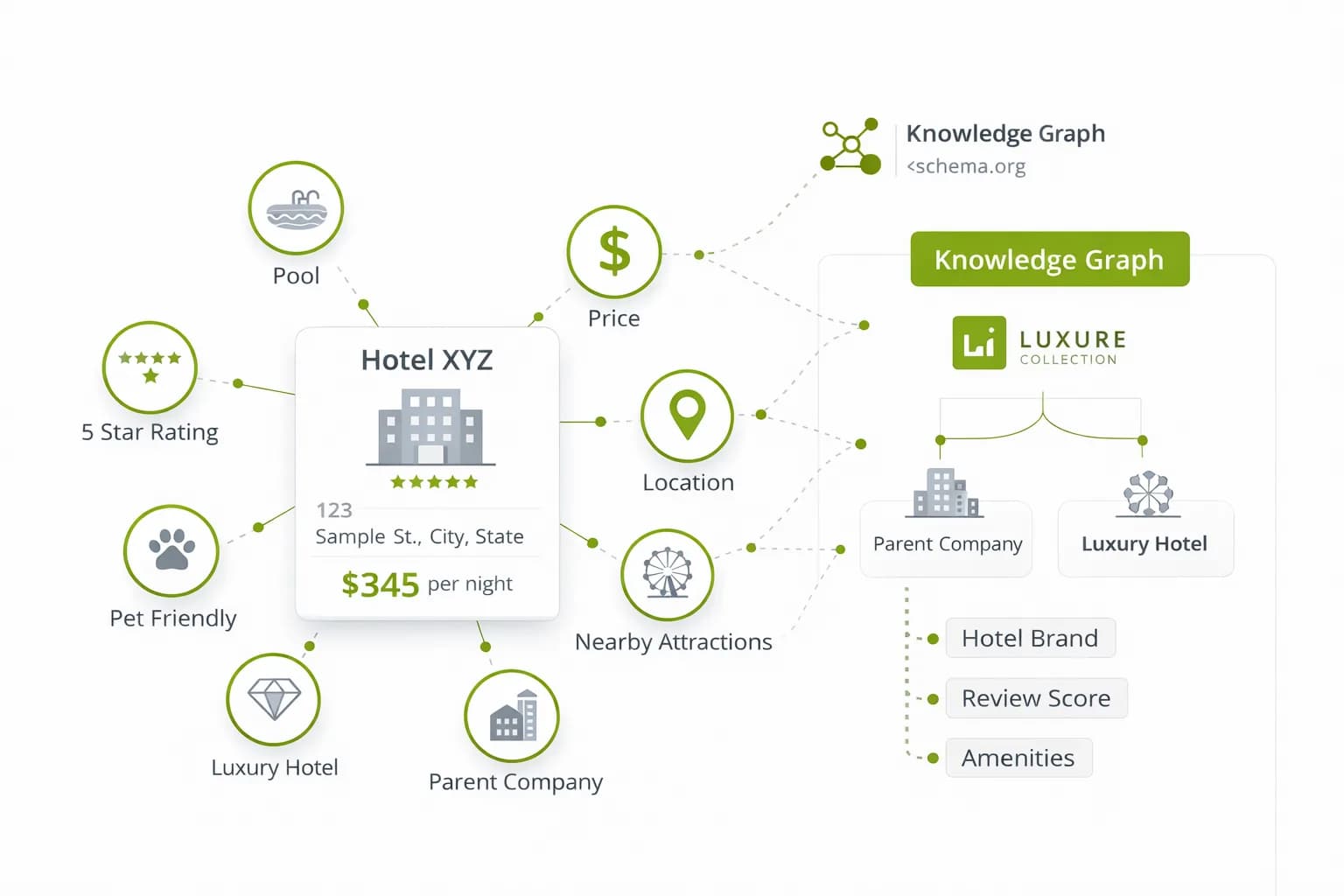
In 2026, rankings alone don’t guarantee visibility. Google, Maps, and assistants need to understand your hotel as an entity—how your brand, properties, amenities, locations, events, and offers relate. That understanding fuels AI answers, map packs, and rich results that drive direct bookings.
This guide shows hotels how to inventory entities, structure pages, implement schema, keep data consistent, and measure the impact across Search, Maps, and assistant surfaces.
1) What is an “entity” (and why hotels should care)
An entity is a thing with attributes and relationships: your brand, each property, room types, amenities (spa, parking), places (neighbourhoods, stadiums), and events. Search systems connect these to answer “Which hotel near [Stadium] has parking and family rooms?”
Your job is to:
- Describe entities in plain, structured ways.
- Keep them consistent across site, GBP (Google Business Profile), and the wider web.
- Link related entities so assistants can reuse facts.
See Google Search Essentials for quality fundamentals.
2) Build your hotel’s entity inventory (start here)
Create a simple table with Name → Type → Attributes → Source of Truth → URL → Schema type.
Core rows to include:
- Brand (Organization): legal/trading names, logo, contact, social profiles.
- Each Property (Hotel/LodgingBusiness): name, address (NAP), GEO (lat/long), phones, emails, check-in/out, amenities.
- Amenities (Place/LocalBusiness/Thing): spa, pool, parking (height limits, EV), restaurant/bar.
- Rooms (Accommodation/Room): occupancy, bed types, accessibility features.
- Offers (Offer): package names, dates, eligibility, cancellation.
- Nearby Places (Place/Attraction/Stadium): official names, distance/time on foot.
- Events (Event): seasonal markets, festivals, match days (if recurring, add
eventSchedule).
Host this table internally; the website becomes the published version.
3) Information architecture for entities
Design your IA so each key entity has a single, authoritative page:
- Brand hub (
/about): Organization facts, properties list, press assets. - Property page template (
/hotels/[city-hotel]): address, map, rooms, amenities, FAQs. - Amenity hubs (
/spa,/parking,/restaurant): details + FAQs. - Location hub (
/location/[city]): neighbourhoods, transport, itineraries (see Location Guide AEO framework). - Event/venue guides (
/guides/[stadium]): bag policy, gates, transport, walking times. - Offer pages (
/offers/[package]): dates, what’s included, cancellation terms.
Link up and down the graph (brand → property → amenity/offer → location). Validate crawl paths with Crawlability and indexability with Indexed Pages.
4) Schema: the minimum viable set (JSON-LD)
Add JSON-LD to published pages (not every tiny module). Follow Google’s documentation for markup eligibility and quality.
- Organization on brand hub + global
sameAs(official social profiles). - Hotel / LodgingBusiness on property pages (NAP, geo, amenities, check-in/out).
- Restaurant / Spa / ParkingFacility where relevant (hours, fees, accessibility).
- Offer / AggregateOffer on packages/rates pages (price ranges, availability if supported).
- FAQPage only where real Q&As exist (avoid duplication).
- BreadcrumbList sitewide.
References:
Use our AEO/GEO tool to sanity-check entity coverage and markup after publishing.
5) Attributes to write in plain English (assistant-ready)
Keep these details in short sentences or bullets near the top of the page:
- Parking: on-site/nearby, spaces, height limit, EV type & count, overnight fee.
- Family rooms: max occupancy, cot policy, connecting options.
- Accessibility: step-free access, lift size, accessible rooms/bathrooms, hearing loop.
- Check-in/out times (with timezone).
- Transport: walking times to station/stadium/attractions; last train times (link source).
- Direct benefits: flexibility, parking, breakfast credit, upgrade waitlist.
These also power FAQs—see FAQ Content for Hotels.
6) Consistency across the web (GBP, citations, metadata)
- GBP: match names, categories, attributes, photos, and hours; keep amenities synced with on-site facts. See GBP Help.
- Citations: prioritise official and guest-useful listings (DMO, council, venues).
- Open Graph/Twitter: ensure titles/descriptions match entity names (check with Meta Tags).
- Images: use stable filenames/ALTs tied to entities (“[hotel]-family-room-king.jpg”).
7) Content patterns that expose entities clearly
Use repeatable modules with headings that assistants can parse:
- Key facts (bullets) → Availability/CTA → Map → FAQ.
- Nearby module: “5 places within 15 minutes’ walk” (entity names + distances).
- Room cards: capacity, bed types, accessibility flags.
- Amenity explainer: what’s included, hours, booking method.
For editorial ideas that reinforce entities, see Hotel Blog Content Ideas.
8) Entity interlinking (what goes where)
- From location hub to property (best area fits) and offers (seasonal).
- From property to amenities and venue guides.
- From amenities back to property and to pre-stay email templates (Automation Essentials).
- Use descriptive anchors (no “click here”).
9) Performance matters (entities still need fast pages)
Entity clarity without speed won’t convert. Keep pages light; prioritise Core Web Vitals and mobile UX. Validate with Website Speed and Mobile-Friendly. See also web.dev’s Core Web Vitals guidance.
10) Measurement: how to know entity work is working
Search Console
- URL-level impressions/clicks for property/amenity/location pages.
- Queries that include your entity names (brand + property + venue names).
- Rich result eligibility for pages with valid markup.
GA4 (cross-domain with booking engine)
- Bookings and vouchers as key events (GA4 conversions).
- Revenue/1k sessions from entity entrance pages (property, amenity, venue).
- Assisted conversions from location/venue guides.
Brand & map signals
- GBP insights: calls, direction requests, website clicks.
- Brand search lift after publishing new entity hubs—monitor with SERP Tracker.
11) 21-day entity upgrade plan (repeatable)
Week 1 — Inventory & IA
- Build the entity table; map pages to entities; identify gaps.
- Decide canonical URLs and breadcrumb paths.
Week 2 — Publish & mark up
- Update two property pages + one amenity + one venue guide with facts and JSON-LD.
- Sync GBP categories/attributes; refresh images.
Week 3 — Wire measurement & iterate
- Validate schema, speed, and mobile UX.
- Ship internal links from blogs and emails.
- Review Search Console and GA4; annotate changes.
FAQ
Frequently Asked Questions
Conclusion
Entity optimisation turns your site from a collection of pages into a coherent knowledge map of your hotel. Build a clean inventory, give each entity an authoritative page, add accurate schema, and keep facts consistent across GBP and the wider web. Measure results in Search Console and GA4—and watch assistants, map packs, and rich results start working for your direct bookings.
Make your entities assistant-ready
Kiril Ivanov
Performance Marketing Specialist
Kiril Ivanov is a digital marketing specialist with experience managing local, national and international campaigns for businesses ranging from growing independent companies to major consumer brands. His background includes leading advertising automation work for Michael Kors and working on campaigns involving Canon, Dormeo, esure, DLG Group, Village Gym, Cameron House, Crerar Hotels, Cromlix Hotel, Harrison Fund and the Advertising Standards Authority. His experience spans paid search, paid social, advertising automation, SEO, conversion optimisation and wider digital strategy across hospitality, retail, financial services, professional services and other competitive sectors.
View author profile →Related Hotel Marketing Guides
Continue with related topics to build a complete strategy.