AI Overviews & Hotel SEO: 2026 Guide
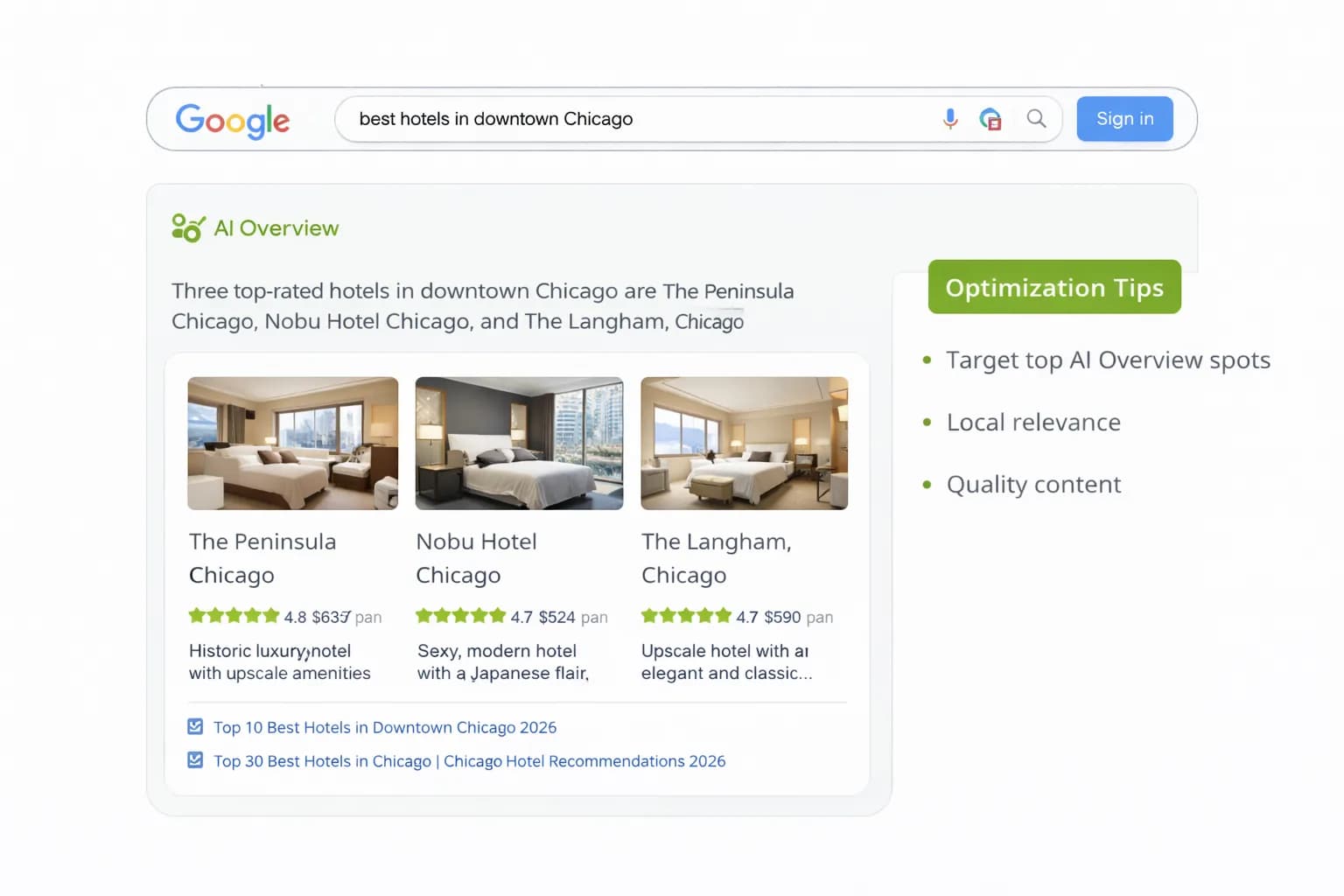
AI overviews and answer‑style results are changing how guests discover and evaluate hotels. Instead of ten blue links, travellers increasingly see summarised answers, entity cards and map‑pack style modules that blend information from multiple sources.
For hotels, this shift does not make classic SEO obsolete – but it does change what "good" looks like. You need strong technical foundations, clear entities and content that can be safely reused by AI systems without losing your brand story or direct booking proposition.
AEO/GEO recovery focus
AI visibility depends on the same recovery fundamentals as classic hotel SEO: canonical pages, crawlable content, entity clarity, structured data, local proof and internally linked commercial pages.
1. What Are AI Overviews in Practice?
AI overviews are answer modules powered by large language models and search‑index data. They attempt to answer a query directly, often combining information from multiple sites into a single summary, with links to the underlying sources.
For hotel‑related searches, this might mean an overview that lists neighbourhoods, hotel types, typical price ranges and travel tips – sometimes with a shortlist of properties, attractions or travel providers.
How this differs from classic SEO
- More emphasis on entities (brands, locations, amenities) than on single pages or keywords.
- Content is often skimmed and recombined rather than shown exactly as you wrote it.
- Visibility can come from both your main site and third‑party profiles such as guides or reviews.
AI overviews sit alongside existing results, so classic SEO – as covered in the 2026 strategy playbook – remains essential. The goal is to make your hotel easy and safe for AI systems to feature while still encouraging direct bookings.
2. How Hotels Appear in AI Overviews Today
Because AI experiences evolve quickly, it is worth running regular spot checks on your brand and local‑intent queries. Look at how hotels similar to yours appear and which sources are being used.
Queries to test
- Brand terms – "[Your Hotel Name] reviews", "[Your Hotel Name] location".
- Descriptive searches – "boutique hotel near [neighbourhood]", "family hotel with pool in [city]".
- Trip‑planning questions – "where to stay in [city] for a weekend", "is [area] safe for tourists".
Note which sites are cited – your own, OTAs, review platforms, tourism boards or publisher guides. This tells you where AI systems currently fetch trusted information about your brand and area.
3. Strengthen Your Hotel as an Entity
AI overviews rely heavily on entity understanding – knowing which brand is which, what it offers, where it is and how it relates to broader concepts like "luxury", "family‑friendly" or "eco‑conscious".
Core entity signals for hotels
- Consistent name, address and phone (NAP) across your website, GBP and major listings.
- Clear description of your property type, star rating, key amenities and unique selling points.
- Structured data that supports these facts (Hotel and LocalBusiness schema with key attributes populated).
- High‑quality images and copy that reflect the same positioning across channels.
If you manage multiple properties, the GEO optimisation work you do for multi‑property SEO is closely aligned with entity work for AI.
4. Create Content That AI Can Re‑Use Safely
AI systems tend to surface content that is clear, well‑structured and uncontroversial. For hotels, that means focusing on helpful, factual information that answers common questions about your property and destination.
Content formats that work well
- Location and neighbourhood guides that explain where you are, what is nearby and how to get around – ideal for trip‑planning queries.
- Practical FAQs about check‑in, facilities, parking, family policies and accessibility, marked up with FAQ schema where appropriate.
- Thematic guides (for example, "spa weekends", "meetings and events", "pet‑friendly stays") that map to common guest intents.
This complements your content marketing work – the same pages that perform well in classic search often provide strong raw material for AI overviews.
5. Align Technical SEO with AEO Requirements
AI overviews still depend on crawlable, indexable, fast websites. Any technical weaknesses – especially on mobile – reduce the chances of your content being surfaced or trusted.
- Fix crawl and indexation issues highlighted in your indexing guide.
- Maintain strong Core Web Vitals on key templates using the CWV optimisation checklist.
- Ensure HTTPS, canonical tags, hreflang (if you target multiple languages) and XML sitemaps are correctly implemented.
These foundations make it easier for search engines and AI systems to fetch, interpret and reuse your content with confidence.
6. Balance Direct Site Visibility and Third‑Party Presence
AI overviews will often reference multiple sources for a given destination – official tourism sites, publisher guides, travel blogs and OTAs. It is unrealistic to appear everywhere, but you can be deliberate about where your hotel shows up.
Where to focus beyond your own site
- Ensure your Google Business Profile is complete and accurate – opening hours, categories, attributes, photos and Q&A.
- Maintain high‑quality listings on key vertical platforms where guests genuinely research stays, avoiding low‑quality directories or link schemes.
- Consider selective digital PR and link‑building to earn coverage in reputable travel and lifestyle publications.
7. Measure AI Visibility Without Chasing Every Change
Unlike classic rankings, AI experiences do not yet have perfect tracking. However, there are still pragmatic ways to understand whether your AEO efforts are paying off.
- Run regular manual checks for your most important keywords and locations.
- Monitor brand and non‑brand organic traffic, especially to informational content that is likely to be used in AI answers.
- Track changes in direct bookings and brand search volume alongside AEO and OTA reduction efforts.
The goal is not to obsess over every interface tweak but to see whether guests increasingly find – and trust – your brand when asking broad trip‑planning questions.
8. Practical Next Steps for Hotel Teams
Adapting to AI overviews does not require a separate, parallel strategy. Instead, it is about evolving your existing SEO and content plans so they serve both classic search and emerging AI surfaces.
A simple 6–12 month roadmap
- Stabilise technical foundations and Core Web Vitals across key templates.
- Update entity and local signals (NAP, GBP, schema, key directory listings).
- Build an AEO‑friendly content layer – FAQs, guides and thematic pages that answer real guest questions in depth.
- Test a handful of supporting off‑site placements where AI systems regularly source travel information for your region.
- Review performance quarterly and adjust focus based on where you see traction and gaps.
9. Conclusion: AEO as an Extension of Solid SEO
AI overviews are simply another way guests encounter your brand. Hotels that already invest in clear technical foundations, helpful content and strong local signals are well placed to benefit. Those efforts become even more important as AI systems lean on structured, trustworthy information.
Our benchmark of 139 UK luxury hotel websites found that only 6 properties had an llms.txt file and just 3 blocked GPTBot — but the more important finding was how widespread the underlying structural gaps were. AI readiness starts with a well-built site, not an AI-specific file.
If you would like to understand how ready your property or group is for AEO and AI‑driven search, we can review your current setup and build a practical roadmap that fits your markets, tech stack and team capacity.
Request an AEO/GEO reviewNext pages to review: Technical SEO for hotels, Hotel content marketing, and 2026 indexation recovery proof.

Kiril Ivanov
Performance Marketing Specialist
Kiril Ivanov is a digital marketing specialist with experience managing local, national and international campaigns for businesses ranging from growing independent companies to major consumer brands. His background includes leading advertising automation work for Michael Kors and working on campaigns involving Canon, Dormeo, esure, DLG Group, Village Gym, Cameron House, Crerar Hotels, Cromlix Hotel, Harrison Fund and the Advertising Standards Authority. His experience spans paid search, paid social, advertising automation, SEO, conversion optimisation and wider digital strategy across hospitality, retail, financial services, professional services and other competitive sectors.
View author profile →Related Hotel Marketing Guides
Continue with related topics to build a complete strategy.