How to Reduce OTA Dependency (2026)
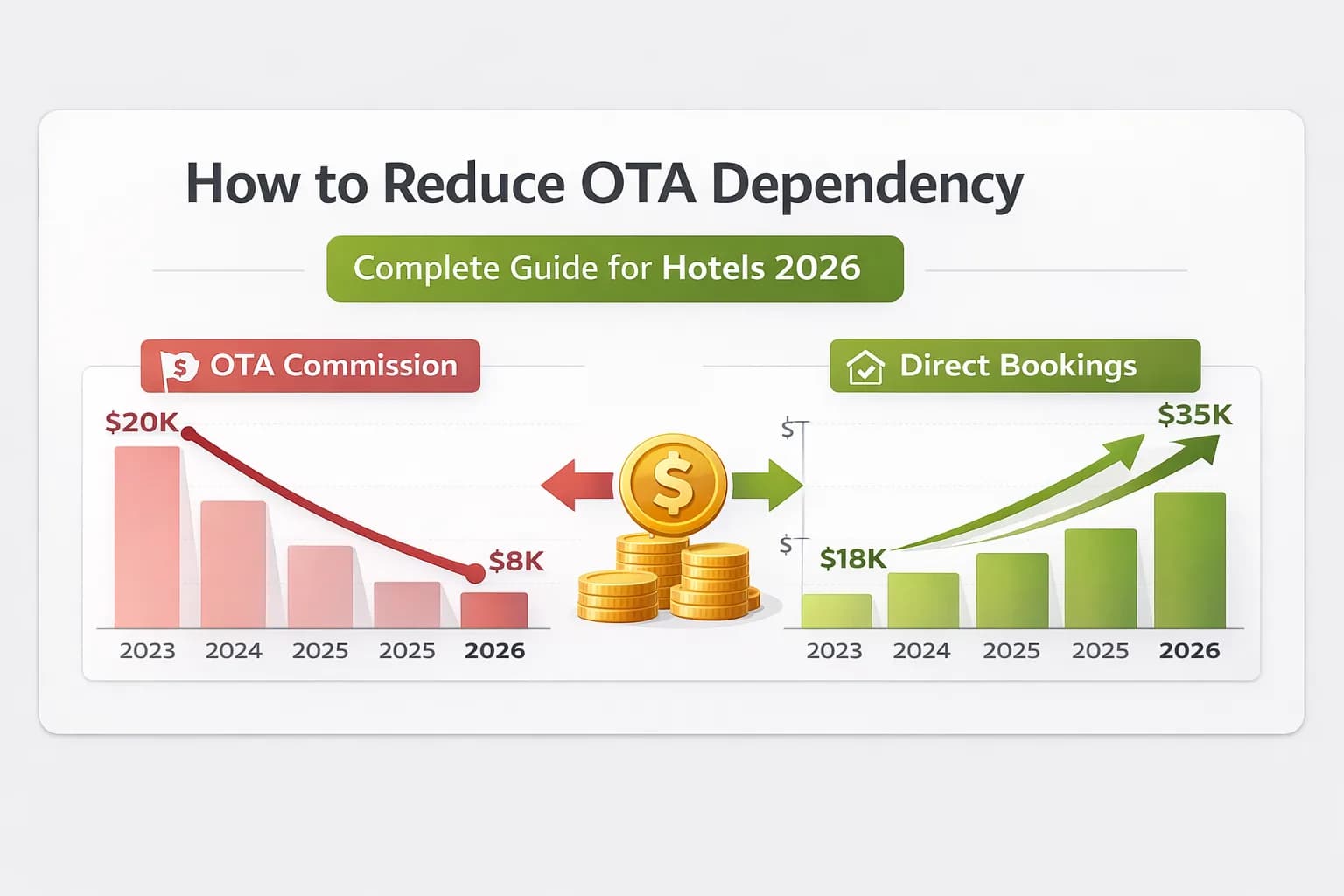
Online Travel Agencies (OTAs) like Booking.com and Expedia are a reality for most hotels. They bring visibility and bookings – but at a steep cost, typically 15–25% commission per booking. For a hotel generating $2M in annual revenue through OTAs, that's $300K–$500K in commissions.
The goal is not to switch OTAs off overnight. Instead, you want to rebalance your channel mix so more bookings come in direct, at a healthier margin, while OTAs play a more controlled role.
Understanding Why Hotels Become OTA‑Dependent
Before you can reduce OTA dependency, it helps to be honest about why it happens in the first place:
- Instant visibility – OTAs invest heavily in SEO, PPC and brand marketing, making them visible for almost every relevant search.
- Trust factor – travellers recognise and trust the big platforms, especially in unfamiliar destinations.
- Convenience – comparing hotels, prices and availability in one place is easy.
- Mobile experience – OTA apps are often faster and more polished than many hotel sites and booking engines.
Strategy 1: Dominate Branded Search
Your brand name should be the one place where OTAs find it hard to beat you. When someone searches for "[Your Hotel Name]", your website should be the obvious, compelling first choice.
Action steps
- Optimise your homepage title tag with your exact brand name and primary location.
- Build a complete set of branded content: about page, location guides, amenities and policies.
- Ensure citations and backlinks use consistent NAP (Name, Address, Phone).
- Claim and optimise your Google Business Profile for each property.
- Monitor and respond to reviews across OTAs and GBP – guests often read these before searching your brand.
Strategy 2: Target High‑Intent Keywords
Relying only on brand searches leaves a lot of demand to OTAs. You also want to show up when travellers search generically for options in your area.
High‑intent keyword types
- "boutique hotel downtown [city]"
- "luxury beachfront resort [location]"
- "pet‑friendly hotel near [landmark]"
- "hotel with spa [city]"
Strategy 3: Create Content That Earns Attention
Content marketing helps you rank for informational queries and build trust before travellers are ready to book. Done well, it also gives OTAs fewer reasons to be the default research destination.
Content ideas for hotels
- Local guides: "Top 10 things to do in [your city]".
- Event‑led content: "Where to stay during [local event]".
- Seasonal content: "Best time to visit [destination]".
- Comparison content: "Boutique vs chain hotels – what's right for you?".
Strategy 4: Optimise the Booking Flow
Even if you drive traffic to your site, a clunky booking experience will send visitors back to OTAs. Your booking engine needs to feel at least as safe and easy as the OTA alternative.
Booking‑flow best practices
- Reduce booking steps to three or fewer where possible.
- Show real‑time availability and pricing clearly.
- Offer direct‑only perks – breakfast, parking, upgrades, late checkout.
- Enable guest checkout so guests do not have to create accounts.
- Optimise forms and calendars for mobile devices.
Strategy 5: Use Rate Parity Smartly
Rate‑parity agreements with OTAs can feel restrictive, but there are often compliant ways to make direct more attractive.
- Offer value‑adds (parking, breakfast, late checkout) instead of undercutting rates.
- Create member‑only rates via a simple loyalty or email sign‑up.
- Bundle packages that OTAs cannot easily replicate.
- Offer more flexible cancellation on direct bookings.
Strategy 6: Leverage Email & CRM
Past guests are your most valuable audience. They already know and trust you, and are far more likely to book direct again.
Email campaign ideas
- Post‑stay thank‑you emails with an incentive for the next visit.
- Seasonal promotions and special event packages.
- Birthday and anniversary offers.
- Last‑minute availability deals.
- Local event notifications and curated guides.
Measuring Progress
To know whether your OTA reduction strategies are working, track:
- Direct booking percentage – the share of bookings that come via your own channels.
- Organic traffic growth – especially for brand and high‑intent non‑brand queries.
- Branded search volume – more people searching for your hotel by name.
- Average booking value and margin – direct bookings often have higher ADR and lower acquisition costs.
Conclusion
Reducing OTA dependency is about rebalancing the mix, not cutting a channel that still plays a role in discovery and filling certain dates. By investing in SEO, content, local visibility, CRO and email in a coordinated way, most hotels can meaningfully shift bookings towards higher‑margin direct channels over a 12–18‑month period.
If you want a clearer view of where you stand and what is realistic for your market, we can start with a focused audit and channel strategy workshop.
Schedule a channel strategy session
Angel Luis Almonte Perez
Accommodation Revenue & Distribution Contributor
Angel Luis Almonte Perez is a hospitality and accommodation professional with approximately 15 years of experience across Venice (Italy) and Edinburgh (Scotland). Co-Founder and Director of StaysIn, Luis specializes in dynamic pricing, revenue management, portfolio yield optimization, and commercial strategies that reduce hotel dependency on Online Travel Agencies (OTAs).
View author profile →Related Hotel Marketing Guides
Continue with related topics to build a complete strategy.