GEO for Multi‑Property Hotels
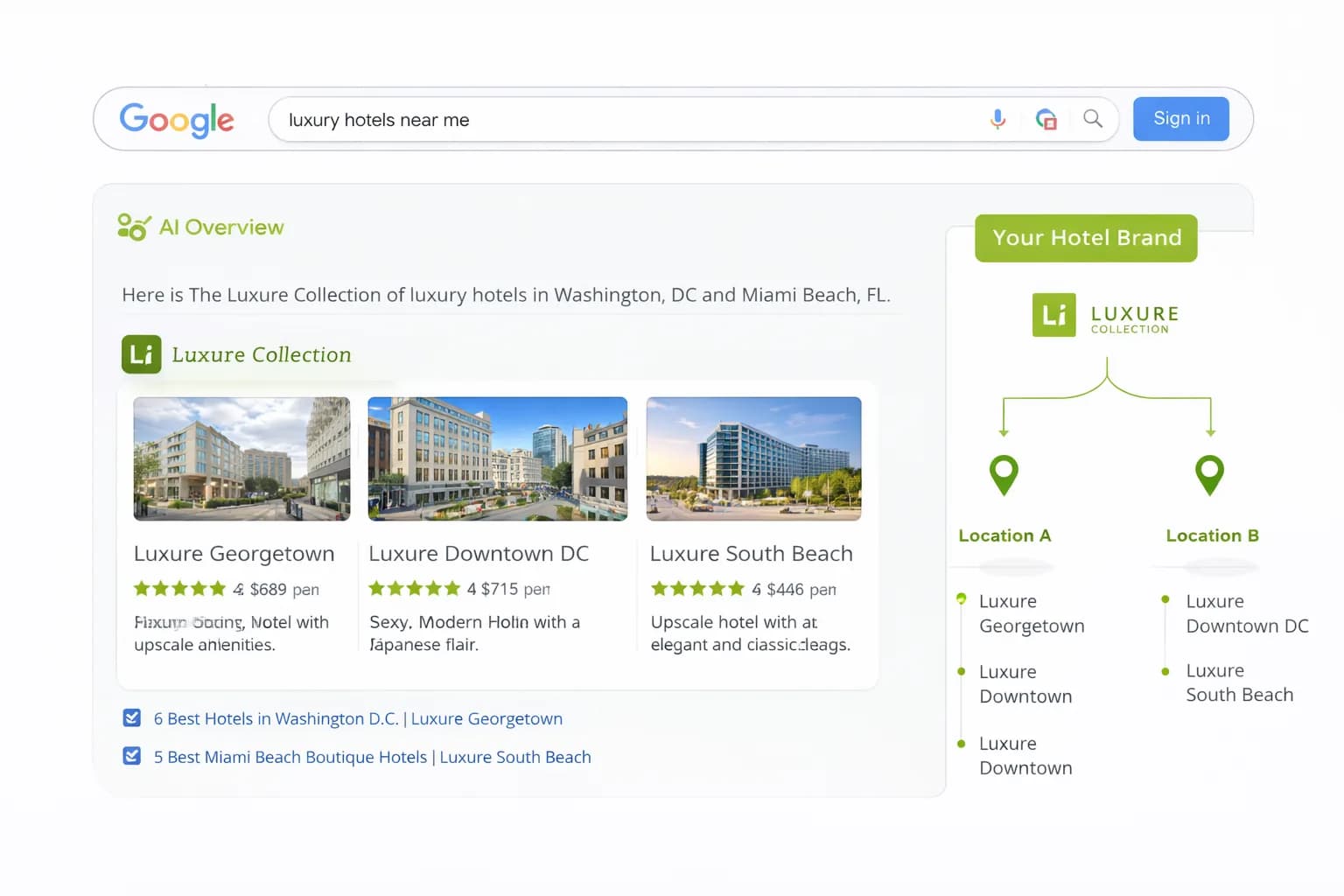
Multi-property hotel groups often struggle with SEO because search engines cannot clearly separate each location. When city pages overlap, Google may show the wrong hotel for the wrong query or reduce visibility altogether. This can slow down direct bookings, especially in competitive destinations.
In this guide, you will learn how to build a strong geo optimisation framework across all your hotels. You will understand how search engines read locations, what signals matter most, how to structure content, and how to stop properties from competing with each another. By the end, you will have a simple, repeatable system your team can apply to any new hotel you add to the portfolio.
1. Why Geo Optimisation Matters for Hotel Groups
Geo optimisation is the process of aligning your websites, content and signals to specific locations so Google can confidently show the right hotel to the right guest. When you operate many hotels in different cities, you must help search engines understand which property belongs to which query.
Without clear geo signals, search engines may mix your properties together. This causes cannibalisation, reduces map visibility and splits authority that should support direct bookings. Google's documentation on structured data and business information explains how important clear entities and locations are for ranking.
Key benefits
- Stronger Map Pack visibility for each property.
- Fewer cases of hotels competing with their own group websites.
- Clearer intent matching for "hotel in London", "spa hotel in York", etc.
- Better support for Paid Search and Meta Ads geo-targeting.
- More direct bookings from location-specific queries.
2. How Search Engines Understand Hotel Locations
Google uses a mix of technical, content and off-site signals to decide whether your hotel is relevant for a local search. For multi-property brands, it is vital that these signals are unique to each location.
Google Search Central notes that consistent naming, structured data, and accurate business details are central signals for any location-based entity such as a hotel. Your goal is to reduce ambiguity and create clean, structured information across all your pages and platforms.
Signals Google checks
- Address, name and category consistency (NAP consistency).
- Structured data markup (LocalBusiness, Hotel, FAQs).
- Clear page titles and headings with location indicators.
- Unique content for each hotel and each room type.
- GBP (Google Business Profile) accuracy and category selection.
- Local landing pages and internal link structure.
- Local reviews and authority from nearby websites.
For deeper technical checks, see our audit checklist and explore our Hotel SEO services.
3. How to Build a Geo Framework for All Your Hotels
A geo framework is a clear and repeatable structure for your website, content, links and metadata. It ensures that each property has a unique digital footprint and avoids competing with the rest of your group.
Step-by-step
- Create one dedicated landing page per hotel with a unique URL.
- Use unique meta titles and descriptions targeted to the local intent.
- Include full address, map embed and local FAQs.
- Add Hotel or LocalBusiness structured data using schema.org.
- Link to local attractions and related hotels nearby.
- Upload photos showing the actual property and surroundings.
- Connect to a fully verified Google Business Profile.
For better content alignment, use the insights from our meta title guide and landing page blueprint.
4. GBP Consistency Across All Hotels
A strong Google Business Profile strategy is essential for multi-property groups. Google states in its GBP documentation that accurate categories, names and opening times are essential for visibility. Many groups lose traffic due to small inconsistencies across properties.
Checklist
- Use a proper primary category (e.g., "Hotel", "Boutique Hotel").
- Ensure the hotel name is consistent with your website.
- Add all secondary categories (e.g., "Spa Hotel", "Wedding Venue").
- Upload high-quality photos (rooms, lobby, restaurant, exterior).
- Add local descriptions focused on unique selling points.
- Verify attributes such as free Wi-Fi, parking or pet-friendly.
Use the GBP Consistency Checker to review all your properties at once.
5. Preventing Location Cannibalisation
Cannibalisation happens when multiple pages target the same keyword or intent. Multi-property groups experience this most often when several hotels are located in the same city or region. The result is unstable rankings and lost revenue.
How to prevent it
- Assign one primary intent per page (e.g., "hotel in Leeds city centre").
- Do not reuse room descriptions across locations.
- Keep local attractions local to each property.
- Ensure all internal links point to the correct hotel page.
- Use FAQ sections with local-specific answers.
- Give each property unique reviews and testimonials.
6. Supporting Geo Signals with Technical SEO
Even the best local content will struggle if your technical foundations are weak. For multi-property websites, the main issues are duplicate URLs, slow mobile performance and missing structured data.
Technical priorities
- Use canonical tags to prevent duplicate location pages.
- Add LocalBusiness or Hotel schema to every hotel page.
- Improve mobile speed using compression and lazy loading.
- Fix mixed content for map embeds and booking engine links.
- Ensure your booking engine supports clean UTM tagging.
Test your performance with the Page Speed Checker and track Google's evolving standards using the AEO/GEO Tool.
Quick wins this week
- Fix NAP consistency across all GBP listings.
- Add unique meta titles for each property.
- Upload fresh local photos to every GBP.
- Add Hotel schema to your main property pages.
- Update internal links so the correct hotel ranks for each city.
- Run a speed check for your slowest property pages.
- Rewrite duplicated room descriptions.
Common mistakes (and fixes)
- Mistake: All hotels using the same city guide content. Fix: Write unique guides with local relevance and nearby attractions.
- Mistake: GBP names not matching website hotel names. Fix: Align all naming across platforms.
- Mistake: Several hotels targeting the same city keyword. Fix: Assign clear keyword ownership per property.
- Mistake: Weak internal linking. Fix: Link from location hubs to each hotel page with correct anchor text.
- Mistake: Slow mobile performance. Fix: Compress media and use modern formats (WebP).
How to measure success
Track simple KPIs with official tools.
- GA4: bookings and revenue attributed to each location page.
- Search Console: clicks and impressions per property URL.
- GBP Insights: photo views, calls, direction requests.
- PMS/CRM: direct share vs OTA per property.
- Paid search: quality scores and cost per booking by location.
Frequently Asked Questions
Conclusion
Geo optimisation is one of the most effective ways for multi-property hotel groups to win more direct bookings. When search engines clearly understand each property, rankings improve, local visibility increases and paid media becomes more efficient. Build a clean and consistent structure now, and your new hotels will enjoy strong visibility from day one. If you want a tailored roadmap, we can help review your full multi-property setup and build a plan that fits your resources and goals.
See Technical SEO for Hotels
Kiril Ivanov
Performance Marketing Specialist
Kiril Ivanov is a digital marketing specialist with experience managing local, national and international campaigns for businesses ranging from growing independent companies to major consumer brands. His background includes leading advertising automation work for Michael Kors and working on campaigns involving Canon, Dormeo, esure, DLG Group, Village Gym, Cameron House, Crerar Hotels, Cromlix Hotel, Harrison Fund and the Advertising Standards Authority. His experience spans paid search, paid social, advertising automation, SEO, conversion optimisation and wider digital strategy across hospitality, retail, financial services, professional services and other competitive sectors.
View author profile →Related Hotel Marketing Guides
Continue with related topics to build a complete strategy.