Turning Hotel Case Studies into SEO and Sales Assets
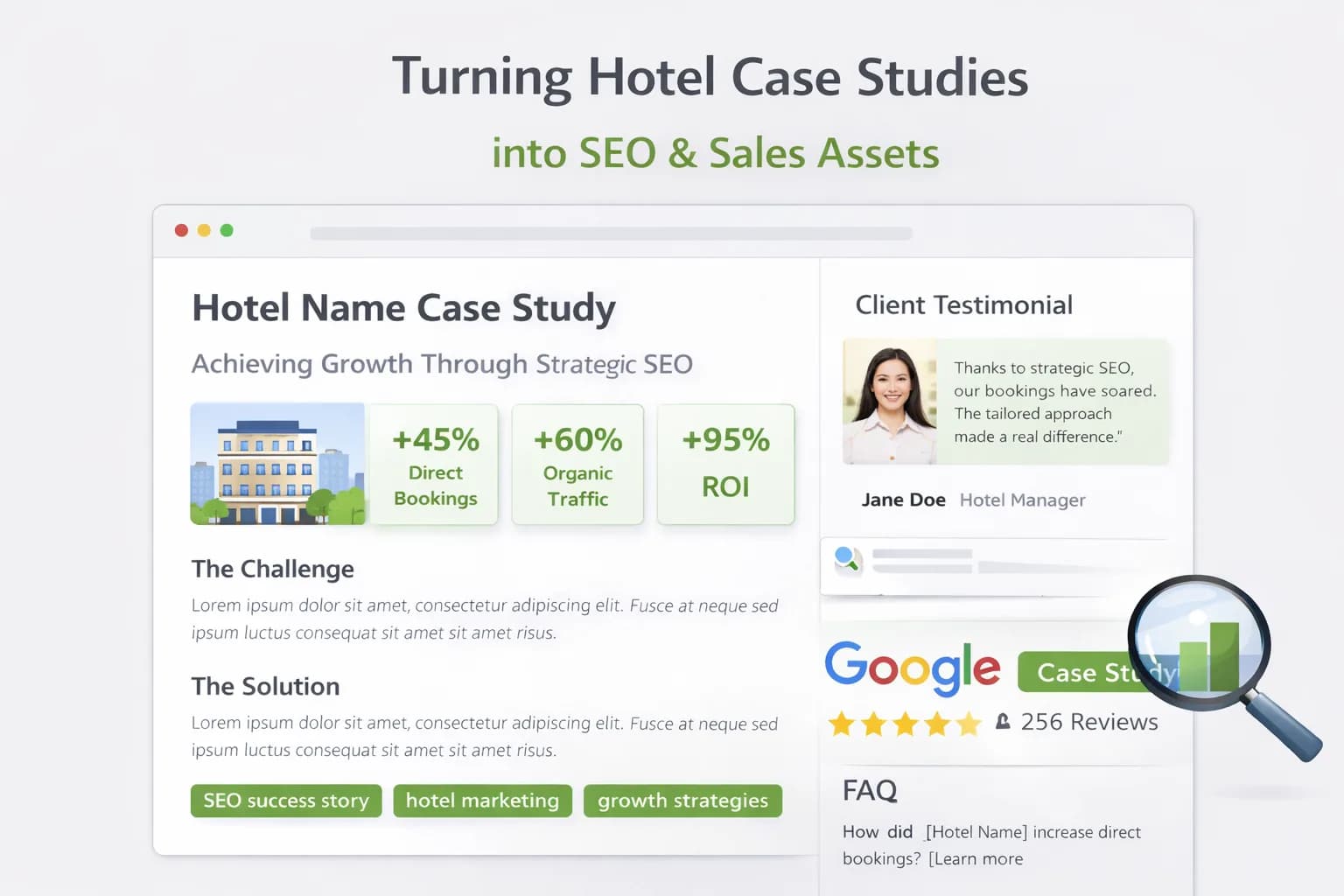
Most hotel “case studies” are vague slides with no steps, no proof, and no next action. A good case study is a conversion page: it proves expertise, answers objections, and moves prospects to enquire or book a consultation.
This guide shows you how to turn case studies into SEO and sales assets—with a repeatable structure, data discipline, distribution plan, and clear measurement.
1) What a hotel case study must do
- Prove expertise without hype (plain English, concrete steps).
- Explain the plan (inputs → actions → outcomes) so others can repeat it.
- Offer a next step (audit, consultation, guide).
For search quality fundamentals, review Google Search Essentials and keep pages technically fast with web.dev Core Web Vitals guidance.
2) Data discipline (truth only)
- Use verifiable numbers (dates, sources, exact metrics). Avoid extrapolations.
- Label benchmarks as examples, not client results (no fabrication).
- Blur or anonymise sensitive details; keep approvals on file.
- Track in GA4 with cross-domain booking set-up so revenue attribution is defendable (GA4 cross-domain, GA4 conversions).
3) The case study page blueprint (copy this)
Each section ≤3 sentences; keep it skimmable.
-
Who/Context (1–2 lines)
Property type, location, seasonality, core channels. -
The Blockers
E.g., slow pages, thin location content, OTA leakage. -
Actions We Took
- Technical fixes (speed, crawl, schema).
- Content changes (location hubs, FAQs).
- Activation (brand PPC cover, newsletter, pre-stay upsells).
-
Outcomes
- Booking/revenue impact with date window.
- Assisted conversions and brand search lift (show how measured with SERP Tracker).
- Secondary wins (map pack engagement, call reduction).
-
Screens & Evidence
Annotated screenshots (GA4 charts, Search Console by URL). Keep alt text clear. -
Playbook to Reuse
5–7 steps others can follow. -
CTA
Link to audit or relevant service.
Add Breadcrumbs and interlink to your content marketing and Analytics Dashboard for depth.
4) Visuals that sell (and load fast)
- Prefer simple charts from GA4/Search Console with timeframes labelled.
- Use before/after page-speed and layout captures.
- Compress images; keep LCP healthy per web.dev guidance.
- Add descriptive captions (“Direct bookings +18% QoQ, Apr–Jun 2026; GA4 data”).
5) SEO & AEO fundamentals for case studies
- H1 = the problem solved (“Reducing OTA leakage at a city hotel”).
- Short FAQ at the end answering the exact approach (“How did you track?” “What did you change?”).
- Use clear entities: hotel type, city, amenities; add schema where relevant (structured data guide).
- Link out to official docs you followed (GA4, Search Console) to strengthen credibility.
6) Distribution plan (turn 1 page into 5 assets)
- Blog tie-ins: link from content ideas and related execution posts.
- Email: a newsletter block (“Playbook we used to lift direct revenue in spring”).
- Sales deck: 1-slide summary with problem → actions → outcomes.
- PPC sitelinks: point brand ads to a relevant case study during campaigns.
- Internal linking: reference from relevant service pages such as Conversion Optimisation and SEO Audits.
7) Compliance & privacy (no shortcuts)
- Written consent for names, logos, and quotes.
- Anonymise where needed, but keep timeframes and methods.
- Do not include personal data; keep screenshots free of emails or booking IDs.
- Align with your Privacy Policy.
8) Measurement: how to know the page is working
Wire tracking before publish.
In GA4
- Event for lead form submit / contact click on the case study.
- Report revenue/1k sessions from case-study entrances.
- Attribute assisted conversions from case-study paths (model comparison).
In Search Console
- URL-level impressions/clicks; queries like “hotel seo case study [city]”.
- Coverage & indexing; annotate updates (Search Console).
On-page UX
- Time to first interaction, scroll to CTA, LCP/CLS (see Website Speed).
- Use Indexed Pages for index checks and Meta Tags to validate SERP presentation.
9) Reusable playbook modules (grab & go)
- Speed win module: before/after Core Web Vitals, actions taken, impact on conversion rate.
- Content hub module: location guide launch, internal links added, Search Console delta by URL.
- Brand protection module: brand PPC + SERP sitelinks, drop in OTA cannibalisation.
- Email lift module: pre-stay add-ons, revenue per 1k recipients (ties to email measurement).
10) 21-day production sprint
Week 1 — Gather & verify
- Pull GA4, Search Console, and PMS/CRM data; define the date window.
- Draft “Blockers → Actions → Outcomes”.
- Get client approvals for facts/visuals.
Week 2 — Build & QA
- Assemble page using the blueprint; compress images; add captions.
- Add short FAQ and CTAs; validate speed & mobile (web.dev).
- Interlink from /case-studies hub and relevant services.
Week 3 — Launch & measure
- Publish; submit to Search Console; add GA4 annotation.
- Add to newsletter and brand PPC sitelinks.
- Review leads, revenue/1k sessions, and assisted conversions after 14 days.
FAQ
Frequently Asked Questions
Conclusion
Case studies are sales pages in disguise. Keep them truthful and specific, show the exact steps you took, prove the impact in GA4 & Search Console, and give a clear next step. Treated this way, each case study becomes a compounding SEO and conversion asset across your site, email, and PPC.
Turn your results into repeatable revenue
Kiril Ivanov
Performance Marketing Specialist
Kiril Ivanov is a digital marketing specialist with experience managing local, national and international campaigns for businesses ranging from growing independent companies to major consumer brands. His background includes leading advertising automation work for Michael Kors and working on campaigns involving Canon, Dormeo, esure, DLG Group, Village Gym, Cameron House, Crerar Hotels, Cromlix Hotel, Harrison Fund and the Advertising Standards Authority. His experience spans paid search, paid social, advertising automation, SEO, conversion optimisation and wider digital strategy across hospitality, retail, financial services, professional services and other competitive sectors.
View author profile →Related Hotel Marketing Guides
Continue with related topics to build a complete strategy.