Measuring Email’s Impact on Direct Bookings
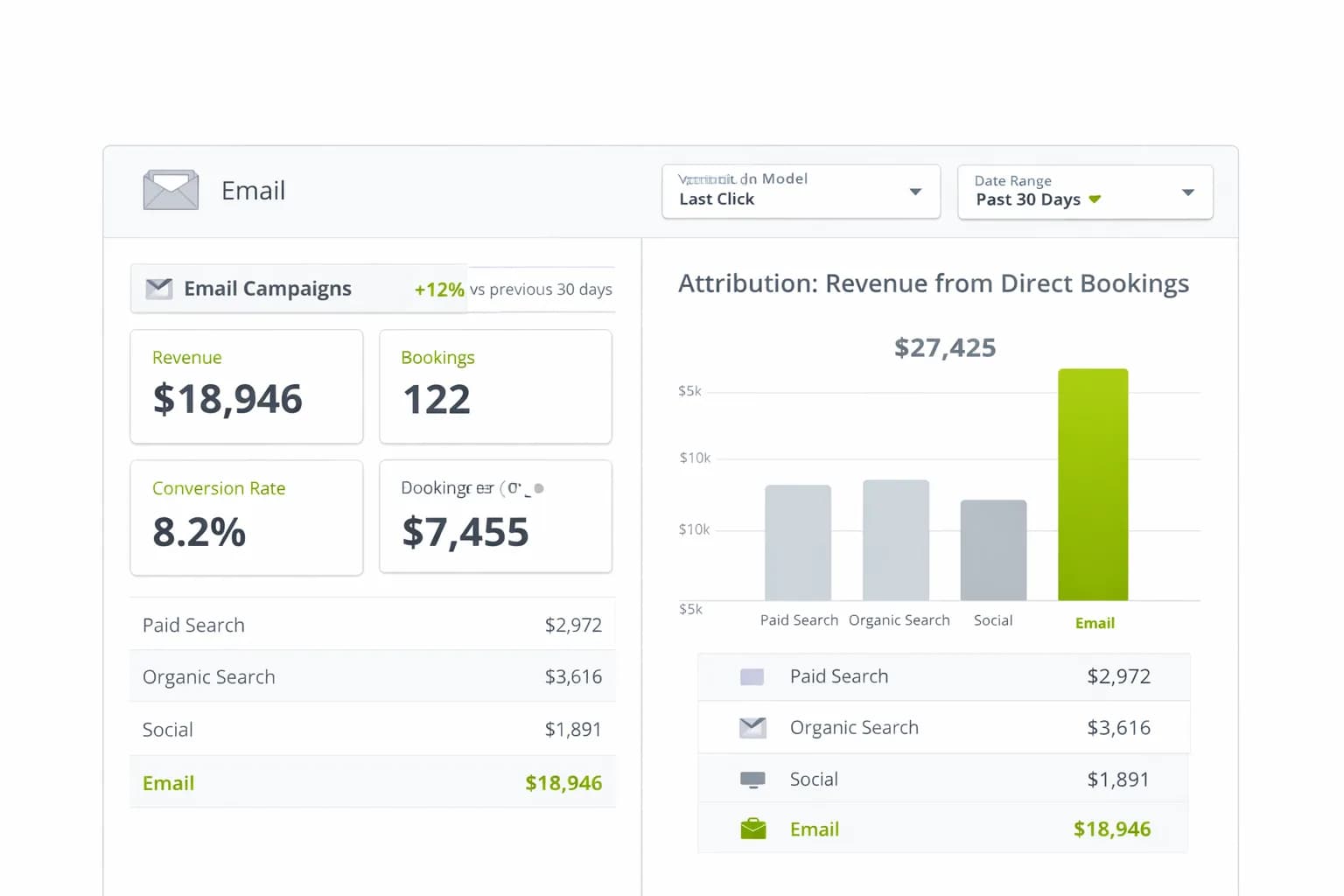
If your email report ends at opens and clicks, you’re missing the point. In 2026, hotel email must be measured on bookings and revenue—including assisted impact on search and brand demand.
This guide gives hotels a complete, no-nonsense measurement setup using GA4 + CRM/PMS, so you can prove email’s contribution to direct bookings and reduce waste.
1) Principles: What “Good” Measurement Looks Like
- Revenue over vanity: bookings, voucher sales, upsells—not opens.
- Unified view: GA4 + CRM/PMS; same campaigns, same naming.
- Cross-domain: email ⇒ site ⇒ booking engine tracked as one journey.
- Assist aware: capture search lift and assisted conversions.
- Repeatable: dashboards you can use weekly without analysts.
For commercial context, connect outputs to Hotel Analytics and your Email Marketing strategy.
2) GA4 Setup: The Non-Negotiables
-
Cross-domain tracking with your booking engine so sessions don’t break.
See GA4 cross-domain guidance. -
Key events (conversions) for bookings, voucher sales, and key upsells.
See GA4 conversions. -
UTM standards for every email send:
utm_source=email&utm_medium=email&utm_campaign=theme-YYYY-MM&utm_content=block-or-offer -
Audiences for lifecycle types (welcome, pre-stay, on-stay, post-stay, newsletter) to slice results later.
-
Consent & tagging aligned with your policy; if using Consent Mode v2, review Google guidance.
If your site isn’t crawlable or fast, clicks won’t convert. Validate email landing pages with Crawlability, Indexed Pages, Website Speed, and Mobile-Friendly.
3) The Metrics That Matter (and how to read them)
Primary
- Bookings and revenue attributed to email (last click + data-driven).
- Revenue per send and per 1k recipients.
- Booking rate (bookings ÷ recipients) by flow and segment.
- Rebook rate for post-stay cohorts (30/90/180 days).
Assisted & demand
- Assisted conversions where email touch appears on the path.
- Brand search uplift 24–72h after sends—track with SERP Tracker.
- Landing-page engagement: scroll to availability, time to first interaction.
Quality
- Unsubscribe and complaint rate (ESP).
- Deliverability health (bounces, spam placement trends).
4) Reporting Views You’ll Actually Use
Build three simple, recurring looks:
A) Channel ↔ Campaign Performance (Weekly)
- GA4 report filtered to
utm_source=email. - Columns: sends (ESP), sessions, bookings, revenue, revenue/1k, booking rate.
- Breakdown by campaign (
utm_campaign) and flow (audience).
B) Lifecycle Cohorts (Monthly)
- Compare Welcome vs Pre-Stay vs On-Stay vs Post-Stay vs Newsletter.
- Metrics: bookings, revenue/1k, time-lag to booking, rebook rate.
C) Assisted Impact + Brand Lift (Monthly)
- Model comparison/paths for assists.
- SERP Tracker for brand search lift after major newsletters or offers.
- Annotate peaks with campaign names.
5) Joining GA4 with CRM/PMS
GA4 gives the click-to-book view; CRM/PMS provides guest value:
- Map email (subscriber ID) to guest (PMS profile) using a stable key.
- Create segments: OTA-origin subscribers vs direct-origin (see Using Email to Reduce OTA Dependency).
- Track LTV, visit frequency, ancillary spend by email segment.
- Feed back RFM tiers (recency/frequency/monetary) to personalise flows.
6) Attribution: Fair Credit Without the Spin
- Use GA4’s default data-driven attribution for a balanced view (GA4 attribution overview).
- Keep a last-click lens for sanity checks on conversion pages.
- Always read alongside assisted conversions and brand lift to reflect demand creation.
If PPC is in play, align measurement with How to Align Hotel Email, SEO and PPC.
7) Benchmarks (Starting Points, Not Targets)
These vary by location, list quality, ADR, and brand strength—start here and tune:
- Welcome series booking rate: 0.4–1.0% within 60 days.
- Pre-stay upsell take-rate (late checkout/breakfast): 5–12%.
- Post-stay rebook within 180 days: 3–8% (leisure) if flows are solid.
- Newsletter booking rate: 0.6–1.4% (quality lists).
- Revenue per 1k recipients: aim to beat your last quarter by +10–20% after restructuring.
Use these as directional; track your own baselines for each segment and season. For more context on costs and ROI, see Measuring the ROI of Hotel SEO.
8) QA the Click-Through Experience (CRO basics)
Your attribution is only as good as the page:
- Above-the-fold date picker and direct-benefit bullets (flex terms, parking, breakfast).
- Load fast on mobile—follow Core Web Vitals guidance.
- Clear policies and reassurance (map, contact).
- Structure content so assistants can reuse it: see Google’s structured data docs and our AEO/GEO tool.
For page structure patterns, use the Hotel Landing Page Blueprint.
9) 21-Day Implementation Plan
Week 1 — Wire & Verify
- Enable cross-domain; confirm key events fire on engine and site.
- Lock UTM and naming standards; create lifecycle audiences.
- Smoke test with a small campaign.
Week 2 — Dashboards & Cohorts
- Build weekly Channel ↔ Campaign view and monthly Lifecycle cohort.
- Add a brand-lift panel using SERP Tracker.
Week 3 — Optimise & Document
- Run one A/B on subject or CTA; annotate revenue impact.
- Document baselines and set quarterly targets by segment.
FAQ
Frequently Asked Questions
Conclusion
When measured properly, email is a predictable revenue channel—not a vanity metric. Track bookings and revenue in GA4, read assisted impact honestly, and connect CRM/PMS data to prove lifetime value. With this framework, every send becomes a decision you can defend.
Stand up a revenue-first email analytics stack
Kiril Ivanov
Performance Marketing Specialist
Kiril Ivanov is a digital marketing specialist with experience managing local, national and international campaigns for businesses ranging from growing independent companies to major consumer brands. His background includes leading advertising automation work for Michael Kors and working on campaigns involving Canon, Dormeo, esure, DLG Group, Village Gym, Cameron House, Crerar Hotels, Cromlix Hotel, Harrison Fund and the Advertising Standards Authority. His experience spans paid search, paid social, advertising automation, SEO, conversion optimisation and wider digital strategy across hospitality, retail, financial services, professional services and other competitive sectors.
View author profile →Related Hotel Marketing Guides
Continue with related topics to build a complete strategy.