Hotel Meta Titles & Descriptions: The Complete Guide
Most hotel websites lose easy wins in search results because their meta titles and descriptions are vague, duplicated, or missing key signals. Guests scan quickly. They compare prices, location and perks in seconds. Your title and description must do the heavy lifting: explain where you are, why stay with you, and why book direct.
In this guide, you will learn a simple, repeatable method to write hotel meta titles and descriptions that actually earn clicks. We will cover format, length, wording, and how to adapt for brand, non-brand and special offer pages. You will also see how titles connect to AI Overviews and rich results, and how to measure real impact using Google Search Console (GSC) and GA4.
1. What Titles and Descriptions Do (and Don't Do)
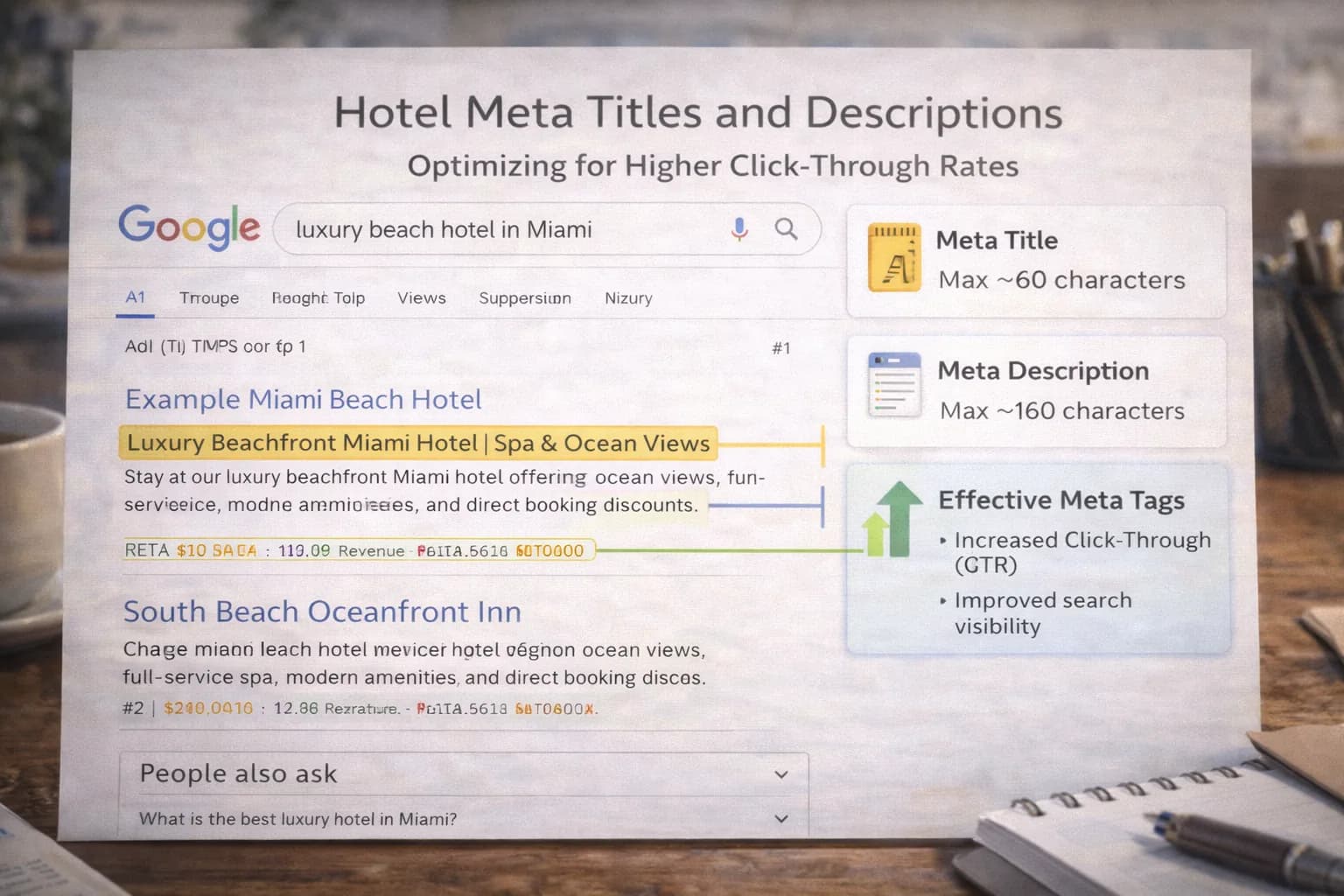
A meta title (title tag) is the main text shown as the blue link in Google. A meta description is the short snippet under the title. Google may not always use your exact text, but helpful, truthful tags still matter. They influence how search engines understand the page and what guests see on the results page.
Google explains that good titles and snippets should be descriptive and helpful for the query. If your content is unclear, Google can replace it with other on-page text. So write strong tags, but also support them with matching headings, body copy and structured data.
Learn more from Google's own docs on helpful titles and how snippets are generated.
2. A Simple Hotel Title Formula (That Works)
Titles must be unique, specific, and clear. Use location and one core reason to book. Keep the brand near the end unless it is very strong. Avoid stuffing. Write for the person first, then confirm the wording fits your main keyword.
Title pattern
- [Primary Page Topic / USP] in [City or Area] | [Brand/Hotel Name]
- Examples:
- Riverside Hotel in York City Centre | The Copper Bridge
- Spa Hotel with Pool in Bath | Crescent House
- Family Rooms near Edinburgh Zoo | Murrayfield Lodge
This pattern keeps the most helpful information upfront: what you are + where you are. The brand follows after a separator. If you have a famous brand, you can swap the order, but keep the topic and location clear.
3. Meta Descriptions That Win Scans
Descriptions should summarise the page and speak to the guest's top questions: "Is this in the right area?", "Does it have what I need?", "Why book direct here?". Avoid cliché and vague language. Stick to what a guest can act on now.
Description pattern
- [Specific location + key USPs]. Book direct for [benefit: best rate / free parking / flexible cancellation].
- Examples:
- City-centre hotel by the Minster with spa and secure parking. Book direct for best rate.
- Quiet boutique near Royal Mile; modern rooms, late check-out, family options. Book direct for perks.
- Seafront rooms with balconies, pool and on-site dining. Book direct for free breakfast.
Keep it truthful. If you offer perks only on some rates, say so or remove the claim. The goal is confidence, not click-bait.
4. Writing for Different Page Types
Not every page needs the same message. Adjust your title and description to the page's job and the user's intent. Below are baseline patterns for key hotel page types.
a) Homepage (Brand + Location)
- Title: [Hotel Type] in [City] | [Brand] — [1 USP]
- Description: [Neighbourhood/landmark]. [2–3 USPs]. Book direct for [benefit].
b) Room Type Pages
- Title: [Room Type] at [Hotel] in [City] — [Key Feature]
- Description: [Sleeps X], [room features], [view if any]. Book direct for [benefit].
c) Facilities (Spa, Pool, Gym, Restaurant)
- Title: [Facility] at [Hotel] in [City] — [Signature Benefit]
- Description: [Facility highlight], [guest access details], [opening times/booking notes].
d) Offers & Packages
- Title: Hotel Offers in [City] | [Brand] — [Offer Type]
- Description: [What's included], [dates/blackouts], [CTA]. Keep price claims accurate.
e) Weddings & Events
- Title: Wedding Venue in [City] | [Hotel] — [Capacity/USP]
- Description: [Spaces/capacity], [packages], [planning support]. Enquiry CTA.
For page structure beyond tags, see Hotel Landing Page Blueprint and align with our Hotel SEO services.
5. Character Counts vs. Clarity
Many teams write to fixed character limits. This is fine as a starting point, but the real rule is clarity. Google may trim or rewrite longer titles. A safe baseline is about 45–60 characters for titles and 120–160 for descriptions. Do not force short phrasing that loses meaning. If a longer title is clearer, use it, then test.
Use our Meta Title & Description Preview to see how your title and description may appear on mobile and desktop. Always check mobile first.
6. Local Signals: City, Area and Landmarks
Location terms help guests and search engines. Add the city and, when helpful, a neighbourhood or landmark. This is vital if your brand name is shared with another hotel in a different city. It also reduces the risk of search engines mixing your multi-property portfolio.
For multi-property groups, follow the playbook in Geo Optimisation for Multi-Property Hotel Groups.
7. Direct Booking Value Props (without Hype)
Guests have learned to compare OTAs and hotel sites. Your tags should show a real reason to book direct, but never over-promise. Use one clear benefit. Keep it consistent with the on-page offer and checkout.
- Best rate guarantee (state conditions).
- Free breakfast or parking on direct rates (if truly included).
- Flexible cancellation or pay-at-hotel where applicable.
- Loyalty member perk (explain quickly).
8. Aligning Titles with On-Page Content & Schema
Google sometimes rewrites titles if the page content does not match the title. Keep your H1 and first paragraph aligned with the title's topic and location. Add relevant structured data, especially Hotel, FAQ and Breadcrumb where useful. Structured data does not guarantee rich results, but it helps search engines understand your page.
Read how Google forms title links and structured data basics.
9. Titles, Snippets and AI Overviews
AI Overviews and other answer-style results rely on clear entities and helpful content. If your title is vague, and your page does not answer common questions, you are less likely to be featured or cited. Keep titles literal and helpful; use on-page FAQs with short, factual answers; label your content with simple schema.
Track changes with the AEO & GEO Tracker.
10. Quality Control at Scale (Without Burning Time)
Large sites or multi-property groups need a light process to keep titles and descriptions fresh. Start with a naming pattern and a short checklist. Store the "source of truth" for each page's title/description in your CMS or a shared sheet. Review high-value pages quarterly, event pages monthly.
QC checklist
- Unique per URL (no duplicates across properties).
- Clear location in title; precise USPs in description.
- Matches H1 and first paragraph meaning.
- Accurate claims (price, perks, cancellation).
- Previewed on mobile and desktop.
- Updated after major offer or facility changes.
11. Testing & Iteration: CTR and Beyond
Success is not only a higher click-through rate (CTR); it is more direct bookings. Start by measuring CTR in Search Console for your top pages. Then check GA4 for conversion rate and revenue. If CTR rises but conversion falls, your message may over-promise. Fix the mismatch.
A simple iteration loop
- Export GSC queries/URLs for top hotel pages (last 28–56 days).
- Flag URLs with high impressions but low CTR.
- Rewrite titles/descriptions using the patterns above.
- Preview with Meta Preview and publish.
- Review 2–4 weeks later; keep winners, iterate on others.
Make sure slow pages are not depressing CTR and conversion. Check with the Website Speed Checker.
Quick wins this week
- Add city/area to every hotel title; remove vague adjectives.
- Rewrite home and rooms descriptions with one real direct-booking perk.
- Fix duplicate titles across your portfolio.
- Preview top five pages on mobile using the Meta Preview tool.
- Ensure H1 matches the title's topic and location.
- Update wedding and event page titles with capacity or standout USP.
- Add a short FAQ to key pages to support helpful snippets.
Common mistakes (and fixes)
- Mistake: Using the same title across multiple hotels. Fix: Unique titles with city and USP per property.
- Mistake: Titles without location. Fix: Add city, neighbourhood or landmark to reduce confusion.
- Mistake: Vague descriptions ("luxury, unforgettable"). Fix: Use concrete USPs guests care about.
- Mistake: Over-promising perks. Fix: Keep claims accurate and consistent with the checkout.
- Mistake: Ignoring mobile truncation. Fix: Preview on mobile; front-load key terms.
How to measure success
Track simple KPIs with official tools.
- Search Console: impressions, clicks, CTR per page and per query.
- GA4: conversion rate and bookings from organic to the edited pages.
- PMS/CRM: direct share vs OTA over the same periods.
- Page speed: Core Web Vitals on edited pages (mobile focus).
- Paid media: if you run brand PPC, watch overlap and change in net direct revenue (see SEO vs OTA Bidding).
Frequently Asked Questions
Build conversion-ready pages with the Landing Page Blueprint, improve portfolio clarity with Geo Optimisation, and align paid tactics with our PPC services.

Kiril Ivanov
Performance Marketing Specialist
Kiril Ivanov is a digital marketing specialist with experience managing local, national and international campaigns for businesses ranging from growing independent companies to major consumer brands. His background includes leading advertising automation work for Michael Kors and working on campaigns involving Canon, Dormeo, esure, DLG Group, Village Gym, Cameron House, Crerar Hotels, Cromlix Hotel, Harrison Fund and the Advertising Standards Authority. His experience spans paid search, paid social, advertising automation, SEO, conversion optimisation and wider digital strategy across hospitality, retail, financial services, professional services and other competitive sectors.
View author profile →Related Hotel Marketing Guides
Continue with related topics to build a complete strategy.