Internal Linking for Multi-Property Hotels
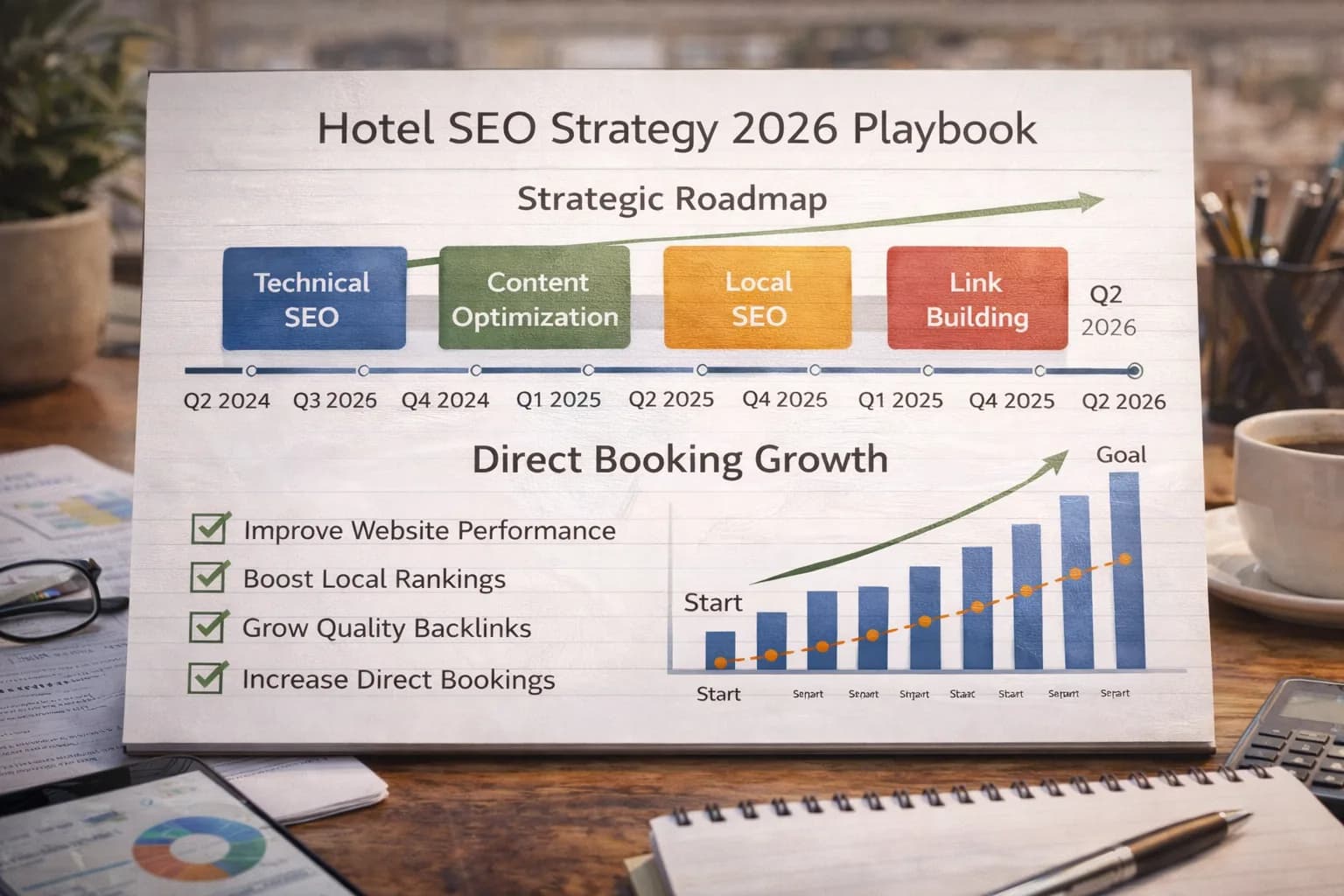
Multi-property hotel sites often grow as separate microsites and ad-hoc pages. The result: diluted authority, orphaned offers, and rooms that never rank. A clean internal linking system fixes that—by giving Google and guests a predictable path from brand hubs → property hubs → rooms/offers.
This guide gives you a brand-safe, scalable internal linking framework for hotel groups, plus templates and measurement so you can prove uplift in discovery, CTR and direct bookings.
1) Principles (why internal links matter more for hotels)
- Findability: links tell crawlers what to index first and most often.
- Meaning: anchor text clarifies entities (rooms, parking, breakfast).
- Commerce: links route users to money pages (Rooms, Offers) with fewer clicks.
Useful background:
Google Search Essentials •
Google SEO Starter Guide •
Search Console: Links report
For structure patterns, see Hotel Information Architecture.
2) The scalable hotel pattern (copy this IA)
Brand hub → Region hub (optional) → Property hub → Rooms / Offers / Location / Parking / Breakfast / Accessibility / FAQ
- Brand hub: explains the portfolio; links to regions and flagship properties.
- Property hub: the anchor for each hotel; links out to core decision pages with descriptive anchors.
- Core decision pages (money pages):
- Rooms (by type)
- Offers/Packages
- Location / Things to Do
- Parking (cost, height, EV)
- Breakfast (times, menu)
- Accessibility (facts + photos)
- FAQ (top 6)
Use this to keep links predictable across all properties.
3) Anchor text rules (keep it human, keep it consistent)
- Describe the thing and benefit: “Hotel parking, prices & EV bays” beats “Read more”.
- Keep anchors short (3–6 words) and consistent across properties.
- Avoid keyword stuffing; write like a concierge, not a bot.
- Place links early in the body and near primary CTAs.
See how this shapes CTR in our Landing Page Blueprint.
4) Navigation vs body links (you need both)
- Persistent nav: Brand → Properties; Properties → Rooms/Offers/Location.
- Body links: Contextual pointers to Parking, Breakfast, Accessibility from any page that mentions them.
- Footer: one row of brand-level links (About, Contact, Careers, Press) + legal; avoid duplicating every property.
Body links move users and crawlers between related entities; nav handles orientation.
5) Hubs that distribute authority
A) Brand hub
- Short intro, map of properties, and cards linking to property hubs.
- Featured links to brand-wide offers and loyalty.
- Link to pillar knowledge for trust: Hotel SEO services (for HotelsSEO context) or brand-story content.
B) Region hub (if you have 10+ properties)
- Introduce the region and list properties.
- Link to regional location guides and event pages.
C) Property hub
- Above the fold: Rooms, Offers, and Location buttons.
- In the first paragraph, add contextual links to Parking, Breakfast, Accessibility.
6) Property page template (link blocks you must include)
On every property hub:
- Primary buttons: Rooms, Offers, Location.
- Key Facts strip with inline links: “Parking info”, “Breakfast hours”, “Accessibility details”.
- Room type grid: each tile links to a unique room page (internal link + schema where appropriate).
- Local highlights: 3–5 cards linking to location/attraction pages.
- FAQ micro-links to detail pages (e.g., “Do you have EV chargers?” → Parking).
7) Rooms linking pattern (by type, not a single page)
- One URL per room type (e.g.,
/edinburgh-hotel/rooms/deluxe-double). - From the Rooms index, link to each type; from each room type, include:
- Offers (relevant packages)
- Location (distance to station/venue)
- Accessibility details if relevant
- Sibling rooms (“More options”)
For performance and markup tips, see Core Web Vitals for Hotels and Review Schema—what’s allowed.
8) Local & decision helper pages (link both ways)
Create Parking, Breakfast, Accessibility, and Location pages for each property:
- From Property hub → link to each helper page.
- From each helper page → link back to Rooms and Offers with clear anchors.
- Add micro-FAQs with contextual links (“Where can I park a high vehicle?” → Parking).
- Cross-link Location pages to Events/Guides.
This two-way linking reduces pogo-sticking and removes booking friction.
9) Offers architecture (avoid dead ends)
- Each live offer page links to:
- Eligible room types (view rooms)
- Property hub (overview)
- Parking/Breakfast if included
- On Rooms pages, surface relevant live offers (reciprocal link).
For campaign synergy, pair with Combining SEO & PPC.
10) Cross-property links (use sparingly and only when helpful)
- On regional pages, suggest nearby sister properties for sold-out dates.
- On event/location guides, show closest sister properties with distance in minutes.
- Keep self-competition in check: link to 1–2 best alternatives, not the whole portfolio.
11) Technical guardrails (so links actually help)
- Keep core links HTML (not JS-only).
- Use canonical URLs; no parameter-only variants.
- Keep a fresh XML sitemap (properties, rooms, offers, helpers).
- Monitor orphan pages with a crawl.
Validate with Crawlability and our guide to fixing indexing issues.
Docs: Google: Sitemaps overview.
12) Content rules that strengthen links
- Put the most important link once, early in the copy.
- Use plain language anchors (“Family rooms with sofa bed”).
- Add Key Facts near the first CTA and link out where a fact deserves its own page.
- Keep paragraphs ≤ 3 sentences (B1–B2 level).
For UX that builds trust, see Visual Identity & UX: Trust.
13) Rollout checklist for groups (copy this plan)
Week 1 — Map the structure
- List all properties and their core pages (Rooms, Offers, Location, Parking, Breakfast, Accessibility, FAQ).
- Identify orphan pages and consolidate duplicates.
Week 2 — Implement hubs
- Build/refresh Brand → Region → Property hubs with button rows and Key Facts strips.
- Add room grids and helper links to every property hub.
Week 3 — Fix money-page routes
- Ensure every Rooms/Offers page links to at least two related pages (Location + one helper).
- Add reciprocal links from helpers back to Rooms/Offers.
Week 4 — Measure & iterate
- Crawl again; check inlinks to rooms/offers.
- Review CTR/URL in Search Console; update anchors where CTR lags.
- Improve speed on slow templates (LCP/CLS).
14) Measurement: prove internal links drive bookings
Search Console
- Clicks, CTR and impressions per URL (rooms, offers, helpers).
- Coverage status; canonical validity.
Search Console.
GA4 (cross-domain on)
- Revenue/1k sessions and purchase rate by landing page template.
- Path exploration: Property hub → Rooms → Engine.
- Event for clicks on internal CTAs (non-PII).
Docs:
GA4 conversions.
Crawl diagnostics
- Inlink count to each room/offer page; zero-orphan policy.
Use Crawlability and track volatility with SERP Tracker.
PMS/CRM
- Direct vs OTA share trend as discovery improves.
- Room-type mix after linking fixes (are high-margin rooms seen more?).
15) Common pitfalls (and safer alternatives)
- Microsites per property → centralise under one brand domain; keep a consistent template.
- “Read more” anchors everywhere → replace with descriptive, short anchors.
- JS-only buttons → add real
<a>links for crawlers and accessibility. - Dead-end offer pages → add links to eligible room types and helpers.
- Over-linking everything → prioritise money pages and the nearest helper page.
FAQ
Frequently Asked Questions
Conclusion
Internal linking is the lowest-risk, highest-control lever multi-property brands have. Structure the site with hubs, route authority to rooms and offers, add helpful helper pages, and measure results in Search Console, GA4 and PMS/CRM. When links are clear and consistent, discovery improves—and so do direct bookings.
Implement the multi-property IA now
Kiril Ivanov
Performance Marketing Specialist
Kiril Ivanov is a digital marketing specialist with experience managing local, national and international campaigns for businesses ranging from growing independent companies to major consumer brands. His background includes leading advertising automation work for Michael Kors and working on campaigns involving Canon, Dormeo, esure, DLG Group, Village Gym, Cameron House, Crerar Hotels, Cromlix Hotel, Harrison Fund and the Advertising Standards Authority. His experience spans paid search, paid social, advertising automation, SEO, conversion optimisation and wider digital strategy across hospitality, retail, financial services, professional services and other competitive sectors.
View author profile →Related Hotel Marketing Guides
Continue with related topics to build a complete strategy.