Combining SEO and PPC for Maximum Direct Bookings
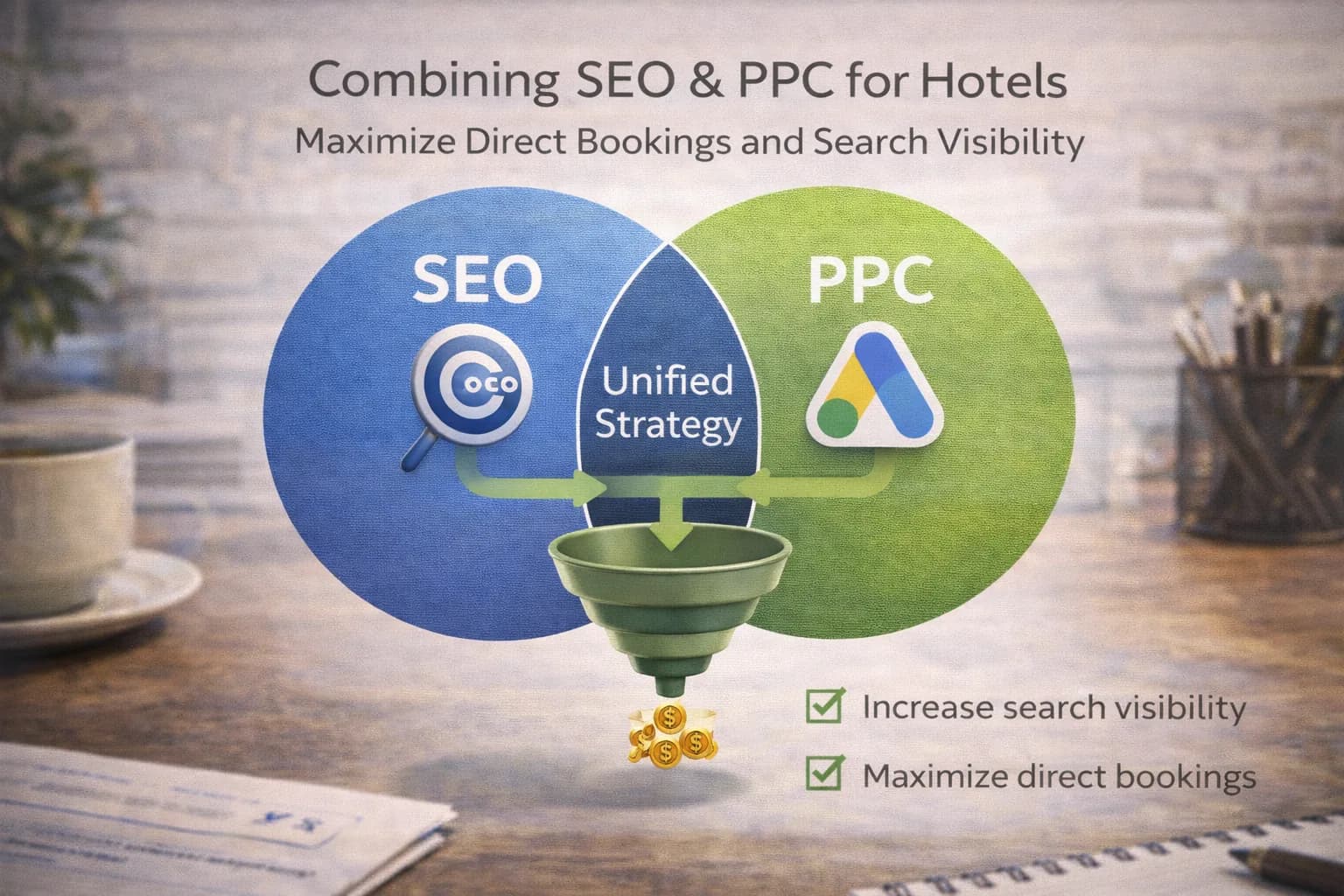
SEO and PPC shouldn’t compete for budget—they should share a roadmap. When your keyword strategy, landing pages, and measurement are aligned, you capture demand at every stage and convert more direct bookings with less waste.
This guide shows how hotels can run SEO and PPC as one system: which themes to prioritise, how to split budgets, what to measure, and how to prove the combined impact to finance.
1) One demand map for both channels
Start with a single, living list of themes you want to win—used by both SEO and PPC:
- Brand & navigational (hotel/collection name, brand + city).
- Destination + qualifier (“spa hotel in [city]”, “family hotel near [attraction]”).
- Amenity/experience (“parking”, “pet friendly”, “ski-in/ski-out”, “pool”).
- Occasions & seasonal (“winter breaks”, “weekend getaway”, “valentine’s package”).
- MICE/spa/restaurant (if offered).
Map each theme to (a) primary landing page and (b) supporting content you’ll build for SEO. PPC then mirrors the structure with ad groups and sitelinks. For information architecture foundations, see Hotel Information Architecture.
Use Search Console data to validate opportunity and Keyword Research Tool for expansion. Reference: Search Console Performance report.
2) Landing pages that serve both SEO and PPC
A shared destination model prevents duplication and boosts conversion:
- Location hub (neighbourhood cues, map, getting here)
- Room type pages (real photos, max occupancy, benefits)
- Offers page (clear inclusions, price cues, lead-time hints)
- Amenity pages (spa, family, parking—internal links to rooms & offers)
Speed and clarity matter for both channels. Validate with our Website Speed Tool and see Core Web Vitals guidance. For conversion detail, use the Landing Page Blueprint.
3) Role split: when PPC leads vs when SEO leads
- PPC leads when you need volume now (new hotel, rebrand, promotions, short booking windows) or where SERP competition is intense.
- SEO leads for evergreen demand (destination, amenity, brand protection), to capture long-tail queries at scale and reduce reliance on paid.
Where both run, coordinate: PPC should emphasize offers and date-specific hooks; SEO should anchor evergreen utility (guides, FAQs, transport, parking).
4) Brand protection as a joint project
- SEO: Maintain accurate Google Business Profile (photos, attributes, Q&A) and brand/collection schema. See GBP Optimisation for Hotels.
- PPC: Always-on brand search with sitelinks to Rooms, Offers, Parking, Location. See Brand Bidding for Hotels.
When OTAs increase pressure, raise brand coverage and sharpen value props (flexible terms, direct-only perks where policy-true).
5) The shared measurement spine
Run one conversion definition and a consistent revenue payload across channels:
- GA4 purchase event with
value,currency,transaction_id, and property identifiers. - Cross-domain tracking (site → engine) so sessions don’t split.
- Google Ads ↔ GA4 linking; pick a single source of truth to avoid duplicates.
- Report by intent layer (Brand / Destination / Amenity / Deals / MICE).
Useful references: GA4 conversions and attribution. Full wiring: Tracking Direct Bookings from PPC.
6) Budgeting: an adaptive split you can defend
A practical starting point for independent hotels:
- Brand PPC: 5–10% of paid media (ring-fenced).
- Non-brand PPC: 40–60% depending on season and competitiveness.
- Display/Remarketing: 15–25% (heavier pre-season for resorts).
- SEO projects/content/tech: funded as a separate OPEX/CAPEX line with milestones.
Adjust monthly based on cost/booking, ROAS, and direct share in PMS. Use holdouts to estimate incrementality:
- Pause/scale PPC in one feeder market; monitor SEO + total bookings.
- Launch an SEO location hub; watch PPC dependence for that theme drop.
See seasonal nuances in Seasonal PPC Planning.
7) Make Smart Bidding and SEO work together
- Feed Smart Bidding clean revenue and audience signals (dates selected, checkout start).
- Use tCPA for new non-brand themes; graduate to tROAS once stable revenue flows.
- Avoid PMax cannibalising brand; exclude brand terms and isolate budgets. Smart Bidding docs: overview & Target ROAS.
SEO benefits: PPC uncovers converting queries quickly, informing content priorities (FAQ sections, amenity terms, nearby attractions). Add structured data where relevant; see Google’s guidance on structured data.
8) Query governance: no internal bidding wars
- Keep a shared list of “SEO-first” queries (informational, guides, FAQs) and “PPC-first” queries (urgent dates, promotional, market launches).
- For brand and key destination + qualifier terms, run both but monitor incrementality and cost/booking.
- Maintain a negative list to prevent PPC drift into low-value informational terms.
Track competitive shifts with the SERP Tracker Tool.
9) Shared creative system
- Reuse best PPC headlines in SEO title experiments and meta descriptions (without keyword stuffing).
- Reuse SEO hero copy and photography in RSAs and display; keep benefits factual: parking, proximity, flexible terms, loyalty perks (if valid).
- Refresh seasonals monthly to keep both channels current.
10) OTA displacement math (combined)
When a direct booking happens through either channel, estimate commission avoided:
Direct bookings × Avg. OTA commission × Booking value × Conservative displacement %
Include this in your combined ROI pack, with the conservative assumption documented. For the full model, see Measuring the ROI of Hotel SEO.
11) 30-day alignment plan (do this first)
Week 1 — Inventory & measurement
- List themes, map to pages, confirm GA4 purchase + cross-domain.
- Link Ads ↔ GA4; standardise UTMs and naming conventions.
Week 2 — Structure & pages
- Restructure PPC by intent layer; add missing sitelinks to shared pages.
- Fix at least two high-value landing pages (speed, clarity, deep links).
Week 3 — Insights loop
- Pull top PPC queries & converting terms → prioritise 2 SEO pages/posts.
- Add Search Console insights → negative keywords and RSA copy updates.
Week 4 — Dashboard & test
- Build a single page for combined results: bookings, revenue, ROAS, direct share, OTA displacement.
- Launch a small geo holdout (pause non-brand PPC in Market A for a week) to estimate incremental lift.
Internal links to reinforce learning
- Service: Services (SEO, PPC & performance)
- Tools: Keyword Research Tool • SERP Tracker • Website Speed Tool
- Resource: Guides Library
- Siblings (PPC cluster):
Hotel PPC Strategy • Brand Bidding • Remarketing Campaigns • Hotel Ads vs Traditional PPC • Common PPC Mistakes - Cross-pillar: Hotel SEO & Analytics Dashboard
- Trust: About • Contact
Frequently Asked Questions
Conclusion
Treat SEO and PPC as one commercial engine. Share themes and pages, align measurement, fund both appropriately, and run regular tests to prove incrementality. The result is a stable growth loop: PPC fuels quick wins and insights, SEO builds durable visibility, and together they lift direct bookings while reducing OTA dependency.
Get a Unified Growth Plan
Kiril Ivanov
Performance Marketing Specialist
Kiril Ivanov is a digital marketing specialist with experience managing local, national and international campaigns for businesses ranging from growing independent companies to major consumer brands. His background includes leading advertising automation work for Michael Kors and working on campaigns involving Canon, Dormeo, esure, DLG Group, Village Gym, Cameron House, Crerar Hotels, Cromlix Hotel, Harrison Fund and the Advertising Standards Authority. His experience spans paid search, paid social, advertising automation, SEO, conversion optimisation and wider digital strategy across hospitality, retail, financial services, professional services and other competitive sectors.
View author profile →Related Hotel Marketing Guides
Continue with related topics to build a complete strategy.