Creating Location Guides That Support SEO & AEO
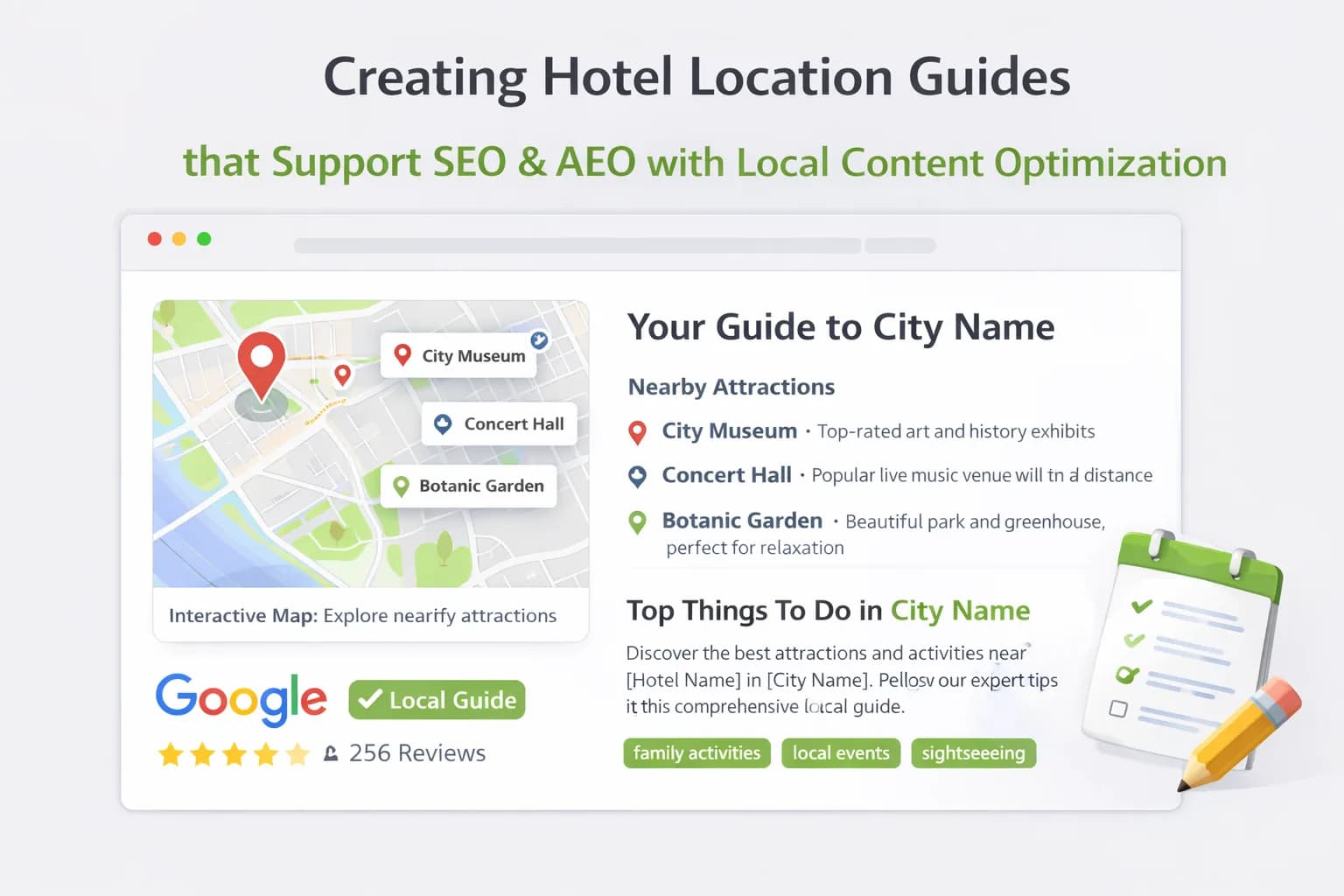
Great location guides do three jobs at once: attract searchers, answer assistants, and convert into direct bookings. Most hotel guides fail because they’re thin, generic, or disconnected from rooms and offers.
This playbook shows how to plan, structure, write, and measure assistant-ready city and neighbourhood guides that boost organic traffic and on-site conversion.
1) What a “good” hotel location guide does
A strong guide is not a listicle; it’s a decision helper that answers where to stay, what to do, and how to get around.
- Serves search intent (discovery → planning → decision).
- Uses clear entities (places, venues, routes) assistants can parse.
- Pushes a single next step: check availability or view an offer.
For search fundamentals, review Google Search Essentials and keep pages fast per Core Web Vitals guidance.
2) Plan with intent, not keywords only
Map queries to stages, then size them with Keyword Research.
- Discovery: “things to do in [city]”, “best time to visit [region]”.
- Planning: “where to stay in [city]”, “family itinerary [city]”.
- Decision: “parking near [hotel]”, “hotel near [venue]”.
For travel demand context, pair your research with VisitBritain insights or your DMO’s data.
3) Information architecture: hub → area pages → deep guides
Keep the structure predictable and crawlable.
- City hub (H1: “Your Guide to [City]”)
- Sections: neighbourhoods, transport, top things to do, seasonal calendar.
- Interlink to rooms, offers, and FAQs.
- Neighbourhood pages (one per area)
- Who it suits, walking times, safety/accessibility notes, nearby venues.
- Deep guides (events, stadiums, markets)
- Highly seasonal; refresh yearly with stable URLs.
Use breadcrumbs and keep URLs short. Validate crawl paths with Crawlability and visibility with Indexed Pages.
4) AEO fundamentals: write for assistants with entities & FAQs
Assistants extract facts. Make them obvious.
- Use entity names (museums, stations, stadiums) and distances/time on foot.
- Add a short FAQ (3–5 Qs) that answers common tasks: parking, check-in times, airport routes, accessibility.
- Mark up content where relevant; see Google’s structured data guide.
Run a quick sanity check after publishing with AEO/GEO.
5) Page blueprint (copy this)
Each section ≤3 sentences, scannable bullets, one CTA per block.
- Intro (who it’s for): couples, families, business.
- Top 5 highlights: short bullets with official names + links.
- Where to stay (areas explained): pros/cons, walking times, transport.
- Getting around: train/airport links, parking, EV chargers, taxi apps.
- When to visit: seasonal calendar + average temps (link source).
- Two mini itineraries: 48h couples / 48h family.
- Map & essentials: GP surgeries, pharmacies, ATMs, accessibility notes.
- Next step: availability widget and 1–2 relevant offers.
Keep images compressed and lazy-loaded; aim for solid LCP/CLS metrics per web.dev guidance.
6) Local SEO tie-ins (maps + GBP)
Your guide should reinforce map pack visibility and vice versa.
- Ensure your Google Business Profile matches NAP, categories, and hours; see GBP Help.
- Use consistent place names across site, GBP, and guides.
- Add directions links from key hubs (airport, station, stadium).
- Embed a static map image and link to live directions (avoid heavy interactive embeds on mobile).
7) Interlinking that actually helps users
Interlink naturally from the guide to conversion pages and supporting content:
- Rooms & offers above the fold near itineraries.
- Parking and breakfast pages where relevant.
- Sibling posts like Hotel Blog Content Ideas and Repurposing Hotel Blogs for distribution.
- Cross-pillar references to Hotel SEO for broader visibility strategy.
8) Writing standards (tone, compliance, accessibility)
- Plain English (B1–B2). Short paragraphs. Descriptive anchor text.
- Include accessibility details (step-free routes, accessible stations, lift access) where known.
- Use official sources for facts (opening hours, ticketing), linking out with
target="_blank" rel="noopener".
9) Templates for two common modules
A) Neighbourhood snapshot
- Who it suits, 3 highlights, walking times to hotel/transport, evening safety note, link to rooms suitable for that audience.
B) Stadium/event guide
- How to get there (train/bus/walk), gates/sections to aim for, bag policy link, pre-/post-event dining options near the hotel, last trains.
10) Measure success (GA4, Search Console, on-site UX)
Prove guides move revenue, not just pageviews.
- GA4: cross-domain tracking with your booking engine; mark bookings/vouchers as key events (GA4 conversions).
- Track assisted bookings and revenue per 1k sessions from guide entrances.
- Search Console: monitor impressions/clicks by URL and query; annotate updates (Search Console).
- Check mobile usability and speed using Mobile-Friendly and Website Speed.
- Watch brand search lift after guide publication with SERP Tracker.
11) 14-day production sprint (repeatable)
- Day 1–2: Pull intents with Keyword Research, draft outline, collect official sources.
- Day 3–5: Write copy; add two mini itineraries and a short FAQ.
- Day 6–7: Build page kit (availability widget, rooms/offers blocks, map image).
- Day 8–9: Internal links to rooms, offers, and pillar pages; compress images.
- Day 10: QA AEO entities and schema; run AEO/GEO.
- Day 11–12: Publish; validate speed with Website Speed.
- Day 13–14: Add to newsletter (newsletter guide), set GA4 annotations, and brief PPC if needed.
FAQ
Frequently Asked Questions
Conclusion
Assistant-ready location guides align SEO, local visibility, and CRO. Structure them around real traveller decisions, make entities and facts easy to extract, and connect every section to a clear next step. Measure in GA4 and Search Console, improve speed, and keep guides fresh so they continue to convert.
Get your location guides production-ready
Kiril Ivanov
Performance Marketing Specialist
Kiril Ivanov is a digital marketing specialist with experience managing local, national and international campaigns for businesses ranging from growing independent companies to major consumer brands. His background includes leading advertising automation work for Michael Kors and working on campaigns involving Canon, Dormeo, esure, DLG Group, Village Gym, Cameron House, Crerar Hotels, Cromlix Hotel, Harrison Fund and the Advertising Standards Authority. His experience spans paid search, paid social, advertising automation, SEO, conversion optimisation and wider digital strategy across hospitality, retail, financial services, professional services and other competitive sectors.
View author profile →Related Hotel Marketing Guides
Continue with related topics to build a complete strategy.