Geo-Targeting PPC for International Guests
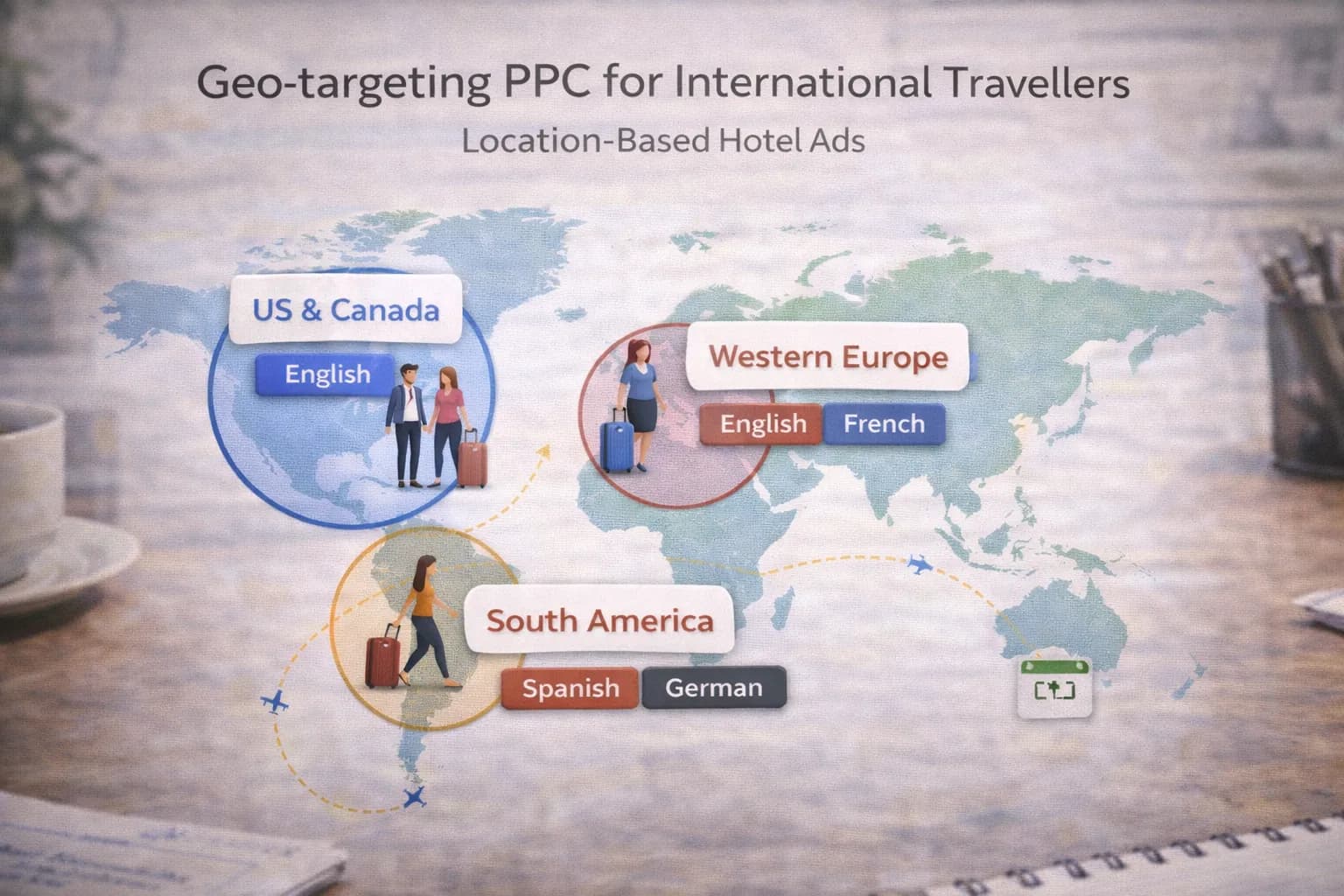
International travellers account for a significant portion of hotel bookings, yet many properties struggle to reach them efficiently with PPC. Generic campaigns waste budget on unqualified clicks, while poorly localised ads fail to convert planners who speak different languages or search with different intent.
This guide shows you how to build geo-targeted PPC campaigns that reach real international travellers—in their language, at the right time, with messaging that addresses their specific concerns.
Why geo-targeting matters for hotel PPC
International markets have distinct characteristics:
- Search behaviour: Different keyword patterns, query length, and device preferences
- Lead time: Varies by market (2-3 months for Europe, 6+ months for Asia-Pacific)
- Language preferences: Even English-speaking markets have local nuances
- Conversion factors: Different concerns about payment methods, cancellation policies, and travel logistics
- Competition levels: OTA dominance and local player strategies differ by region
Without proper geo-targeting, you'll either miss valuable international demand or waste budget on users who can't or won't book.
1) Identify your high-value inbound markets
Start with data, not assumptions.
Where to look:
- PMS data: Last 12-24 months of booking origins, ADR, and length of stay
- Google Analytics 4: Users by country, conversion rate, and revenue
- Search Console: Queries and impressions by country
- Competitor analysis: Where similar properties advertise
What to evaluate:
- Volume: Sufficient search demand to justify spend
- Value: Higher ADR or longer stays that justify acquisition cost
- Seasonality: When each market books (lead time + travel time)
- Competition: How aggressive OTAs and competitors are in that market
Prioritise 2-4 markets initially rather than spreading budget too thin.
2) Structure campaigns by market and intent
Don't lump all international traffic into one campaign.
Recommended structure:
Campaign: [Market] - Brand
- Ad Group: [Hotel Name]
- Ad Group: [Hotel Name] + Location
Campaign: [Market] - Destination
- Ad Group: Hotels in [City/Region]
- Ad Group: [Attraction] Hotels
- Ad Group: [Type] Hotels [City]
Campaign: [Market] - Amenity/Experience
- Ad Group: Spa Hotels [City]
- Ad Group: Family Hotels [City]
- Ad Group: Pet-Friendly Hotels [City]
Why separate by market:
- Different languages and messaging
- Different bid strategies and CPA targets
- Different ad schedules (time zone alignment)
- Easier performance analysis and budget allocation
3) Keyword research for each market
What works in one market won't necessarily work in another.
Per market, build:
- Brand defence:
[hotel name],[hotel] + city - Destination + qualifier: "hotel in [city]", "spa hotel [city]", "family hotel near [attraction]"
- Amenity/experience: "pet friendly hotel [city]", "hotel with parking [city]"
- Late deals: Only in short-haul markets with close-in demand
Language considerations:
- UK: "hotel near [airport]"
- Germany: "hotel nähe [airport]" or "unterkunft [city]"
- France: "hôtel proche [attraction]"
- Netherlands: "hotel in de buurt van [landmark]"
Tools:
- Google Keyword Planner (set location to target country)
- Search Console (query data by country)
- Competitor ad copy (use VPN to see local results)
4) Create localised ad copy
Generic "Book Now" ads won't cut it for international travellers.
Address market-specific concerns:
UK/Ireland:
- Distance from airports/stations
- Free parking availability
- Flexible cancellation
- "No booking fees" if true
Germany/Austria/Switzerland:
- Sustainability credentials
- Wellness facilities
- Clear pricing (inclusive vs. exclusive)
- Direct booking benefits
Nordic countries:
- Premium positioning
- Nature/outdoor access
- Modern amenities
- Eco-certifications
France:
- Charm and character
- Gastronomy
- Proximity to attractions
- "Meilleur tarif garanti"
5) Landing page requirements
Match language: Send German ads to German pages (or at minimum, have language switcher prominent)
Fast mobile load: International users often have variable connection speeds
Clear pricing: Show currency, all fees, and payment methods accepted
Address travel concerns:
- Distance from major transport hubs
- Parking availability and cost
- Local attractions and access
- Check-in flexibility for late arrivals
Trust signals:
- Reviews in their language
- Local payment methods
- Recognised certifications
- Clear cancellation policy
6) Geo-targeting settings in Google Ads
Location targeting:
- Use "People in or regularly in your targeted locations" (Presence)
- Avoid "People interested in your targeted locations" for conversion campaigns (too broad)
Language targeting:
- Match ad language to target market
- Consider bilingual users (e.g., English + Dutch for Netherlands)
Ad scheduling:
- Align with target market's time zone
- Peak booking times are typically evenings (7-11 PM local time)
- Protect brand 24/7 in high-season
Device bid adjustments:
- Mobile usage varies by market (higher in Asia, lower in Germany)
- Test and adjust based on actual conversion data
7) Bidding and budget allocation
Start with tCPA (Target CPA):
- Set based on target booking value and acceptable CAC
- Allow 2-4 weeks for learning phase per market
- Requires conversion tracking
Budget by market:
- Allocate based on market size and value
- Typical pilot: €50-100/day per market for 4 weeks
- Scale markets that hit CPA/ROAS targets
- Pause or reduce markets that underperform
Seasonal adjustments:
- Increase budget during high booking periods (2-3 months before travel)
- Reduce in low season unless defending brand
8) Conversion tracking essentials
Track by market:
- Set up goals/events in GA4 segmented by country
- Tag PPC bookings in PMS or booking engine
- Track booking value, not just form fills
Attribution challenges:
- International travellers have longer research cycles
- Use data-driven attribution if volume permits
- Consider view-through conversions for display/YouTube
Key metrics per market:
- Impressions and CTR
- Cost per click
- Conversion rate
- Cost per acquisition (CPA)
- Return on ad spend (ROAS)
- Lead time (click to booking date)
9) Common pitfalls (and quick fixes)
Using "Presence or interest" → Switch to presence only for conversion campaigns to control spend
Sending everyone to homepage → Deep link to relevant room/offer/location pages
Ignoring currency/friction → Clarify fees, taxes, and payment methods on landing page
One budget pool for all markets → Split budgets per market; stop poor performers quickly
No local ad schedule → Shift spend to target market's evening hours; protect brand 24/7 in season
Not tracking lead time → International bookings happen weeks/months ahead; measure booking-to-travel time
10) 4-week pilot framework
Week 1 — Setup:
- Select 2-3 markets based on PMS data
- Build campaigns, ad groups, and keyword lists
- Create localised ads (2 RSA per ad group)
- Set up conversion tracking and remarketing tags
Week 2 — Launch & test:
- Start with tCPA at conservative target
- Monitor search terms daily, add negatives
- Check landing page speed and mobile experience
- Set ad schedules to match market time zones
Week 3 — Optimise:
- Adjust bids based on device/time performance
- Pause weak ads, test new variants
- Add sitelinks and callout extensions
- Layer in remarketing campaigns
Week 4 — Decide:
- Evaluate each market: CPA, ROAS, lead time, booking quality
- Scale markets at or under CPA target with ≥1 booking per ad group
- Pause or narrow markets with poor ROAS or weak lead time
- Document learnings for next quarter
Frequently Asked Questions
Frequently Asked Questions
Related resources
Learn more with Hotel PPC Strategy, recover lost visitors with Remarketing Campaigns, and track correctly with Tracking Direct Bookings from PPC.
Download our Google Ads & Meta Ads Guide and explore PPC Management for Hotels.
Conclusion
Geo-targeted PPC works when you pick the right markets, mirror search intent in your campaign structure, respect language and cultural context, and measure results by market and lead time.
Keep pages fast, protect your brand, and scale only where bookings justify the spend. Your international direct revenue will grow profitably without runaway costs.

Kiril Ivanov
Performance Marketing Specialist
Kiril Ivanov is a digital marketing specialist with experience managing local, national and international campaigns for businesses ranging from growing independent companies to major consumer brands. His background includes leading advertising automation work for Michael Kors and working on campaigns involving Canon, Dormeo, esure, DLG Group, Village Gym, Cameron House, Crerar Hotels, Cromlix Hotel, Harrison Fund and the Advertising Standards Authority. His experience spans paid search, paid social, advertising automation, SEO, conversion optimisation and wider digital strategy across hospitality, retail, financial services, professional services and other competitive sectors.
View author profile →Related Hotel Marketing Guides
Continue with related topics to build a complete strategy.