Using PPC to Launch New Hotels and Rebrands
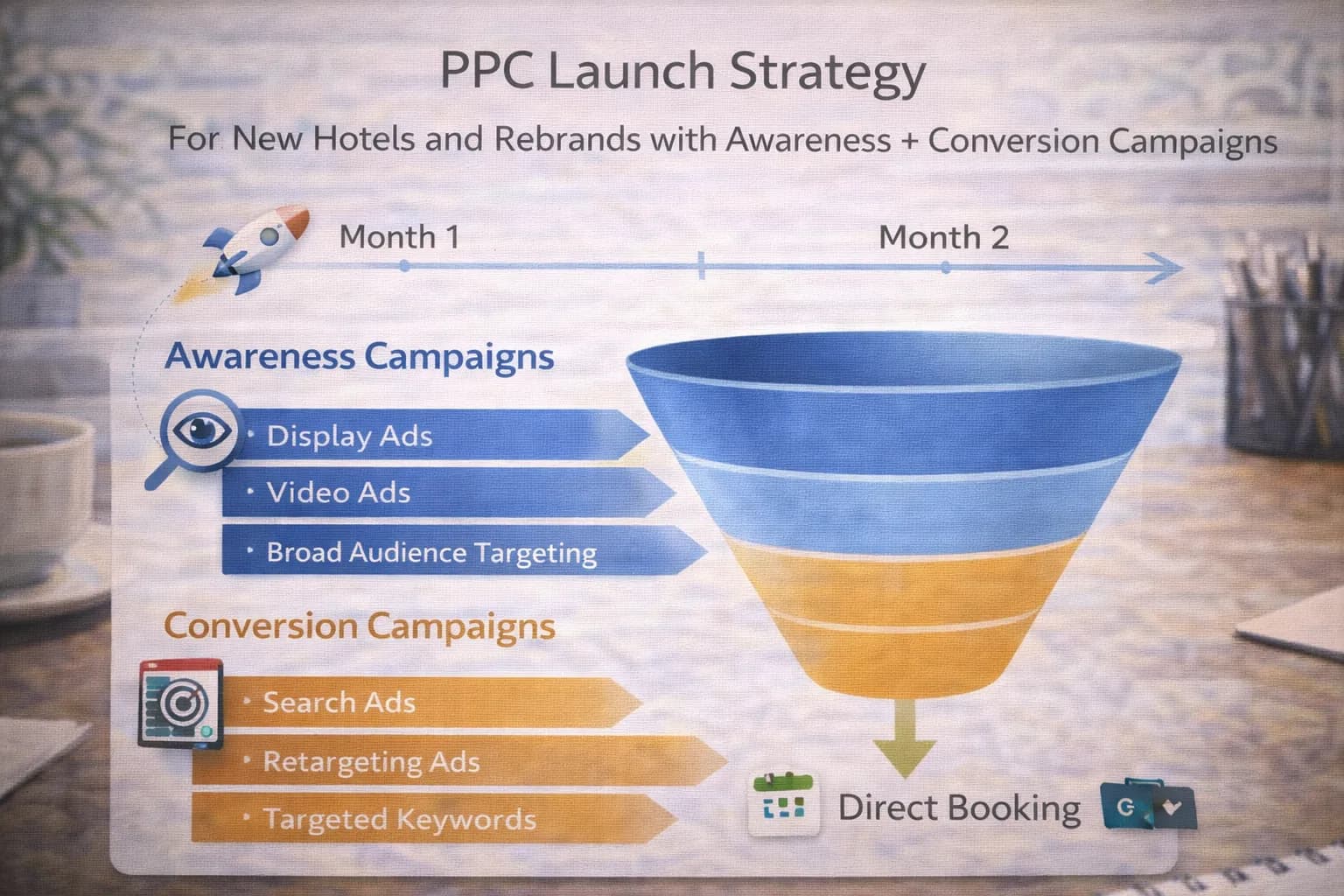
Opening a new hotel—or relaunching a brand—is the most demanding PPC moment you’ll face. You need awareness and conversion, clean tracking into a fresh booking engine, and guardrails that stop spend from running away while pricing, parity, and ops settle in.
This playbook gives you a 90-day PPC launch you can run with confidence: timelines, campaign structure, creative and landing assets, budget pacing, and the measurement stack finance will trust.
1) Timeline Overview: T-60 → T+30
- T-60 to T-30 (Foundation & Tease): tracking, cross-domain, Search Console/GBP, landing pages, teaser capture.
- T-30 to T-7 (Build & Book): start non-brand search, light video/social awareness, collect waitlist, test booking flow.
- T-7 to T+7 (Launch Window): brand defence live, offers & availability deep links, remarketing, radius “last-minute” for soft opening.
- T+7 to T+30 (Stabilise & Scale): prune queries, expand profitable themes, add Hotel Ads pilot if feed-ready.
Related guides: Hotel PPC Strategy and Tracking Direct Bookings from PPC.
2) Measurement First (or nothing else matters)
Wire tracking before any spend:
- GA4 purchase event with value, currency, transaction_id; cross-domain from site → engine.
See GA4 conversions. - Referral exclusions for your engine domain; preserve UTMs/gclid.
- Link Google Ads ↔ GA4 and choose one primary conversion source to avoid duplicates.
- Speed & UX checks (Core Web Vitals) so paid traffic can convert. Read web.dev Core Web Vitals.
Helpful tools: Website Speed Tool and SERP Tracker.
3) Account Structure Built for Launch
Create clean intent layers so Smart Bidding learns fast:
Brand (Launch Day − Always On)
[hotel name],[hotel] + city, misspellings. Exact/Phrase.- RSAs with direct-booking perks (if policy-true), sitelinks: Rooms, Offers, Parking, Location.
- Keep a small, ring-fenced budget.
Destination + Qualifier (T-30)
- “hotel in [city]”, “spa hotel [city]”, “family hotel near [attraction]”.
- Start with Phrase/Exact, strict negatives (hostel, voucher, jobs).
Amenity/Experience (T-30)
- “pet friendly hotel [city]”, “hotel with parking [city]”, “near station/airport”.
Late Deals / Soft Opening (T-7)
- “opening offer”, “intro rate”, “weekend breaks [city]” with date windows.
MICE/Spa/Restaurant (if relevant)
- Separate budget and goals to avoid CPA distortion.
Keep Performance Max isolated (brand-excluded) and judge on incremental bookings, not impressions. Smart Bidding overview: Google Ads.
4) Bidding & Budgets (Guardrails)
- Brand: Maximise Clicks with CPC cap or low Target CPA.
- Non-brand: start Target CPA; graduate to Target ROAS after stable revenue.
Target ROAS reference: Google Ads. - Seasonal spikes / launch week: use seasonality adjustments to prevent over-reaction.
Guidance: seasonality adjustments. - Pacing sheet: daily budget, spend, bookings, CPA/ROAS, impression share by intent layer.
5) Creative System: Tease → Prove → Convert
Tease (T-60 to T-30)
- Video (6–15 sec): arrival, lobby, room reveal, breakfast, local views.
- Copy: “Opening soon in [Neighbourhood]. Join the list for launch offers.”
Prove (T-30 to T-7)
- RSAs: location proof, proximity (“5 minutes from [Station]”), real perks (parking, flexible terms if true).
- Display/YouTube: carousels of rooms/amenities, captions on video.
Convert (Launch week)
- Offers with clear inclusions and availability deep links (prefill dates when supported).
- Sitelinks: Rooms • Offers • Parking • Location • Contact.
For landing standards see Hotel Landing Page Blueprint.
6) Landing Pages You Need on Day One
- Property hub (map, neighbourhood cues, getting here).
- Rooms (each type; photos, capacity, amenities, direct benefits).
- Offers (intro rate, opening packages).
- Amenity pages (spa, parking, family).
- Location hub (top attractions, transport).
Deep link all ads to the most relevant page, never just the homepage.
7) Google Business Profile & Local Surfaces
- Verify GBP early; add name, category, address, phone, photos and attributes.
- Keep NAP consistent across site and citations (use GBP Consistency Tool).
- Post “Opening Soon” updates; monitor Q&A; add parking and accessibility details.
- GBP improvements support brand/navigational searches and Maps visibility.
For multi-property groups, ensure the brand vs property naming is unambiguous.
8) Hotel Ads Pilot (If Feed-Ready)
If your engine supports a clean rates & availability feed, pilot Google Hotel Ads for side-by-side price visibility in Search/Maps/Travel. Start conservative and verify deep links carry dates/guests. Compare cost/booking against Search; scale only when parity is stable. More context: Hotel Ads vs Traditional PPC.
9) Remarketing That Respects Intent
Lists to create on day one:
- Checkout started (7–30 days)
- Dates selected / availability searched (7–30)
- Room detail viewers (30–60)
- Exclusions: bookers 90–180 days; service/help pages
Use RLSA to bid up on non-brand for these lists and run responsive display with frequency caps (2–4/day). Full playbooks in Remarketing Campaigns.
10) Rebrands: Don’t Lose Existing Demand
If you’re renaming or repositioning:
- Run ads on old brand terms for 60–90 days with “formerly [Old Name]” messaging.
- Update GBP, site schema, and redirects; keep both names in copy during transition.
- Watch Auction Insights for rivals/OTAs exploiting the gap; increase brand coverage temporarily.
- Update all sitelinks and extensions to new destinations; validate tracking post-redirect.
11) 30/60/90-Day Plan
Days 0–30 (Launch & Stability)
- Keep budgets tight; expand only where CPA/ROAS hold for 2+ weeks.
- Fix search terms weekly; add negatives; promote winners to Exact.
- Speed QA after any CMS or engine change.
Days 31–60 (Scale & Shape)
- Add new destination/amenity themes; test Performance Max (brand-excluded).
- Begin Hotel Ads if feed-ready; compare cost/booking.
- Launch geo holdout (suppress non-brand in one feeder market for 1–2 weeks) to estimate incremental lift.
Days 61–90 (Optimise & Forecast)
- Build a property leaderboard and landing page revenue table.
- Shift budgets into profitable markets/themes; retire inefficient ad groups.
- Publish a 6-month forecast tied to content roadmap (see Combining SEO & PPC).
12) Common Pitfalls (and Fast Fixes)
- Everything shows as Direct/Unassigned → cross-domain/UTMs broken; retest from ad click to confirmation.
- High CPCs, few bookings → send to better pages, improve speed, tighten match types, add negatives.
- PMax cannibalises brand → exclude brand; isolate budget; judge on incremental bookings.
- OTA undercutting → address parity; highlight direct-only perks (policy-true); consider Hotel Ads to appear alongside OTAs.
- Thin creative → produce at least two RSA variants/ad group plus 4–6 display/video assets.
Internal links to reinforce learning
- Service: Services
- Tools: SERP Tracker • Website Speed Tool • GBP Consistency Tool
- Resource: Guides Library
- Siblings (PPC cluster):
Hotel PPC Strategy • Brand Bidding • Hotel Ads vs Traditional PPC • Common PPC Mistakes - Cross-pillar: Hotel Content (assets & creative) and Hotel Analytics
- Trust: Case Studies • About
Frequently Asked Questions
Conclusion
Successful launches are measured, paced, and practical: wire tracking first, structure campaigns by intent, ship truthful creative to fast, relevant pages, defend brand, and expand only where bookings justify it. Do that for 90 days and your new hotel—or rebrand—will build momentum with direct revenue you can prove.
Get My Launch Plan
Kiril Ivanov
Performance Marketing Specialist
Kiril Ivanov is a digital marketing specialist with experience managing local, national and international campaigns for businesses ranging from growing independent companies to major consumer brands. His background includes leading advertising automation work for Michael Kors and working on campaigns involving Canon, Dormeo, esure, DLG Group, Village Gym, Cameron House, Crerar Hotels, Cromlix Hotel, Harrison Fund and the Advertising Standards Authority. His experience spans paid search, paid social, advertising automation, SEO, conversion optimisation and wider digital strategy across hospitality, retail, financial services, professional services and other competitive sectors.
View author profile →Related Hotel Marketing Guides
Continue with related topics to build a complete strategy.