Hotel Email Deliverability Tips
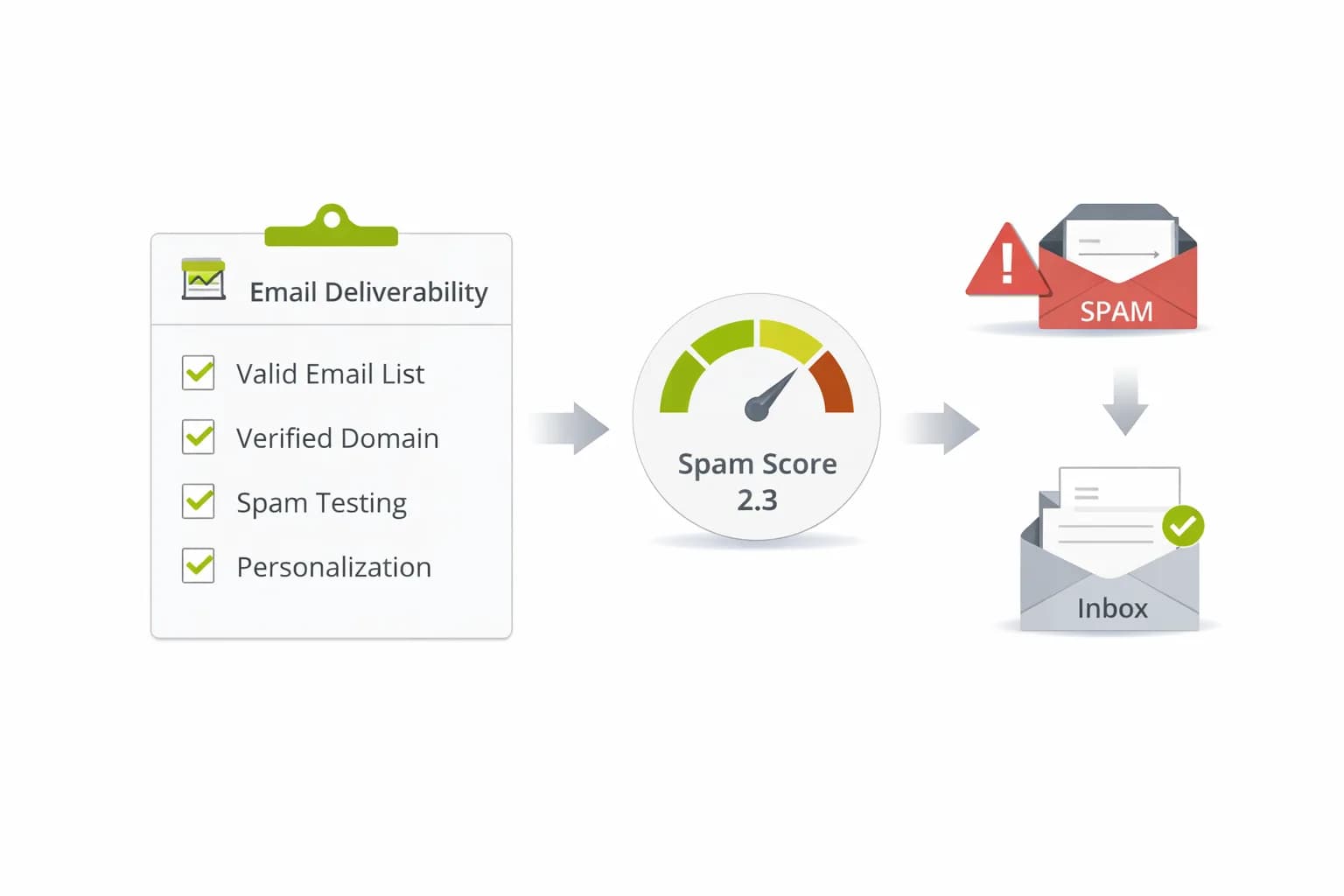
You can write the best email in the world—but if you land in spam, it won’t book rooms. This guide gives hotels a practical deliverability checklist for 2026: sender reputation, authentication, warm-up, list hygiene, content, and measurement.
It complements our lifecycle posts like Automation Essentials, Post-Stay Email Flows, and the overarching Hotel Email Strategy for 2026.
1) Authenticate Your Sending Domain (Non-negotiable)
Mailbox providers expect proper authentication. Without it, expect spam or blocks.
- SPF: Authorise your ESP/IP to send on your domain.
- DKIM: Cryptographic signature proving the message wasn’t altered.
- DMARC: Policy telling providers what to do if SPF/DKIM fail; enables domain alignment and reporting.
- Alignment: Use a branded From address on your domain (not @gmail/@outlook) and align Return-Path/From per DMARC.
Helpful references:
Hotel tip: Send brand newsletters and automations from [email protected] or [email protected]. Keep separate subdomains for marketing vs. transactional (e.g., news.yourhotel.com, book.yourhotel.com) to isolate risk.
2) Warm Up & Protect Reputation
ISPs judge recent behaviour. Ramp volumes sensibly.
- Start with your most engaged segment; increase daily volume gradually.
- Keep complaints < 0.1%, hard bounces near zero, and unsubscribe clearly visible.
- Avoid sending to dormant lists you haven’t emailed in months—re-permission first.
- Separate IPs/subdomains for high-risk sends (e.g., big promos).
3) List Hygiene & Consent (Deliverability = Trust)
Bad data = spam folder.
- Never purchase lists.
- Use double opt-in for cold website sign-ups; single opt-in is reasonable on booking confirmation (document the rationale).
- Deduplicate contacts across PMS/CRM/ESP to avoid duplicates.
- Remove hard bounces immediately; suppress chronic non-openers (e.g., 90–120 days).
- Log consent source, timestamp, and channel; link to your Privacy Policy in all emails.
If you capture on Wi-Fi or front desk, store the consent flag and source tag so you can segment and defend your practices.
4) Content Signals ISPs Like (Plain, Fast, Helpful)
Inbox placement improves when your emails look and behave like useful messages.
- One goal per email. Short paragraphs (≤3 sentences), clear CTA.
- Use live text over text-in-images; compress images; add ALT text.
- Keep HTML lean; avoid spammy phrases (“FREE!!!”, “URGENT”), excessive punctuation, and misleading subject lines.
- Link to fast, mobile pages. Validate with Website Speed and Core Web Vitals guidance.
- Add a plain-text version and correct
List-Unsubscribeheader (one-click where supported).
For assistant-readable landing pages, structure FAQs and entities per Google’s structured data guidance.
5) Frequency, Segmentation & Suppression
Relevance beats volume.
- Cap to 1–2 marketing sends/month per segment unless users ask for more.
- Suppress promo sends during service recovery windows (low NPS/complaint).
- Segment by intent (couples/family/business), geography (domestic/international), and recency/value; see Newsletter Content That People Actually Read for block ideas.
- Pause sends to emails with repeated “soft bounces” or no opens for 90–120 days (sunset policy).
6) Templates & From Names That Build Trust
- Use a recognisable From name (“[Hotel Name] Team” or “GM, [Hotel]”).
- Subject lines: truthful + specific (“Your spring weekend in [City]”).
- Preview text: 40–90 characters, not a repeat of the subject.
- Minimal header images, generous line spacing, tappable buttons.
If you need conversion-ready landing pages, follow the Hotel Landing Page Blueprint.
7) Technical Checks Most Hotels Miss
- Reverse DNS (rDNS/PTR) set correctly for sending IPs.
- TLS enforced; fix mixed-content warnings on linked pages.
- 404/redirect chains: avoid broken or long chains in links. Validate crawlability with Crawlability and visibility with Indexed Pages.
- Set a custom tracking domain in your ESP to avoid generic click domains that sometimes trigger filters.
- Ensure favicon/brand and consistent footer details (address or contact route).
8) Measuring Deliverability (Beyond Open Rates)
Opens are noisy; measure outcomes and health.
In GA4 (with cross-domain set up):
- Bookings, voucher sales, and upsell purchases as key events (GA4 conversions).
- Channel/medium attribution with
utm_source=email. - Content assist: use event-led reports to see which email blocks led to bookings.
In ESP/CRM:
- Inbox rate (if available), bounce types, complaint rate, spam trap hits (via DMARC reports), engagement by segment.
Search lift: After campaigns, monitor brand search with SERP Tracker for 24–72 hours to confirm incremental demand.
For the broader analytics view, see our Analytics Dashboard.
9) 30-Day Deliverability Fix Plan
Week 1 – Audit & Authenticate
- Verify SPF/DKIM/DMARC alignment; add DMARC
rua=for aggregate reports. - Set branded From and tracking domain; confirm rDNS.
Week 2 – Clean & Segment
- Remove bounces/inactives; build engaged-only seed segment.
- Document consent sources; connect PMS/CRM tags.
Week 3 – Warm & Send
- Ramp volume to engaged users first; cap daily sends.
- Ship a plain, helpful email to each core segment (no heavy images).
Week 4 – Measure & Iterate
- Review GA4 revenue, ESP complaints/bounces; adjust frequency.
- Test subject/preview, CTA placement, and landing-page speed.
FAQ
Frequently Asked Questions
Conclusion
Deliverability is engineering + editorial discipline. Authenticate your domain, send to people who actually want your emails, keep messages light and helpful, and measure success in bookings and revenue—not just opens. With the steps above, your emails are far more likely to reach the inbox and convert.
Get a deliverability & tracking audit
Kiril Ivanov
Performance Marketing Specialist
Kiril Ivanov is a digital marketing specialist with experience managing local, national and international campaigns for businesses ranging from growing independent companies to major consumer brands. His background includes leading advertising automation work for Michael Kors and working on campaigns involving Canon, Dormeo, esure, DLG Group, Village Gym, Cameron House, Crerar Hotels, Cromlix Hotel, Harrison Fund and the Advertising Standards Authority. His experience spans paid search, paid social, advertising automation, SEO, conversion optimisation and wider digital strategy across hospitality, retail, financial services, professional services and other competitive sectors.
View author profile →Related Hotel Marketing Guides
Continue with related topics to build a complete strategy.