How to Align Hotel Email, SEO and PPC
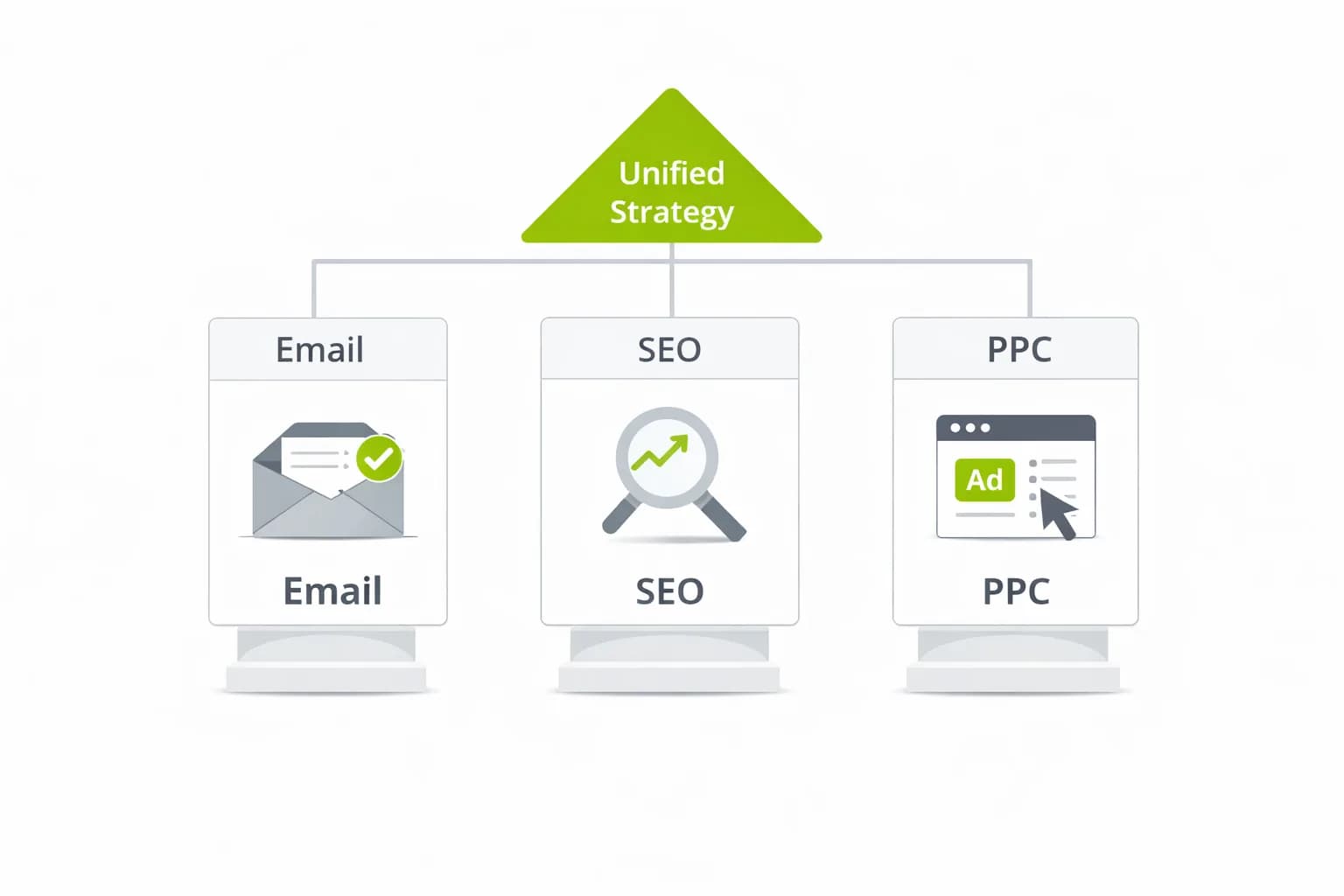
When email, SEO and PPC run in silos, hotels pay twice for the same click and still lose guests to OTAs. When they’re aligned, each channel amplifies the other: email warms demand, SEO captures intent, and PPC closes gaps—together they grow profitable direct bookings.
This guide gives hotels a clear framework to plan, execute and measure channel alignment in 2026.
1) The Alignment Model (One Calendar, Three Roles)
Give each channel a job, then plan together on one calendar.
-
Email = demand shaping & loyalty
Warm audiences with helpful content and value-led offers. Connect with your Hotel Email Marketing strategy and use playbooks like Newsletter content and Seasonal campaigns. -
SEO = capture & assist
Build fast, helpful pages that answer queries and nudge to booking. See Hotel SEO services and Landing page blueprint. -
PPC = fill demand & test
Cover brand and high-intent gaps, test new angles quickly, and support launches. For paid strategy, align with Hotel PPC services.
One calendar avoids clashes (e.g., email push when SEO needs technical maintenance, or PPC budget spikes with no matching content).
2) Shared Building Blocks (So Pages and Ads Convert)
Channels fail when the destination page is weak. Standardise a shared page kit:
- Above-the-fold: date picker, trust bullets (parking, flexibility), CTA.
- Proof: review score snippet, awards, map for reassurance.
- FAQ: short answers (cancellation, parking, family rooms).
- Speed & mobile: validate with Website Speed and Mobile-Friendly. See also Core Web Vitals guidance.
Make content assistant-friendly (AEO) with clear headings and entities; review AEO/GEO tool and Google’s structured data documentation.
3) One Brief = Three Outputs (Email, Organic, Ads)
Use a single campaign brief with:
- Audience (couples, families, business, international).
- Offer & perks (value-led, not blanket discount).
- Landing page URL (owned hub + variant URL parameters).
- Keywords & angles (from Keyword Research).
- Creative (hero, copy blocks, short hooks for ads).
From the same brief, produce:
- Newsletter block + automation touch (e.g., post-stay segment).
- Optimised page for SEO (entity-rich, fast, internal links to related guides).
- PPC assets: RSAs, sitelinks, images/video; match messaging to page.
4) Brand Protection & SERP Control
Own your brand space first:
- SEO: ensure brand page is fast, complete, and shows direct-value benefits above the fold.
- PPC: run brand campaigns with exact match + variants; control sitelinks to key offers and FAQs.
- Email: time drops to coincide with availability and rate plans you can actually honour.
For PPC set-up and when to bid on your own name, see Brand Bidding for Hotels and Hotel PPC Strategy. Review Google Ads best practices in Google Ads Help.
5) Playbooks That Prove Alignment
Tie common hotel scenarios across channels.
A) Valentine’s / Romantic Breaks
- Email: couples segment, two dates, dining add-on, book-by window.
- SEO: “romantic breaks in [City]” landing page, internal links to dining and rooms.
- PPC: romance keywords + brand; image extensions; countdown in ad copy.
B) Family Half-Term
- Email: family segment; parking + breakfast bundle; itinerary link.
- SEO: family hub page + “48-hour plan” guide.
- PPC: family + location keywords; sitelinks to rooms that sleep 3–5.
C) New Spa Package
- Email: loyalty/VIP first, then wider list; limited slots.
- SEO: spa package page with FAQ and upsell CTA in pre-stay flow.
- PPC: brand + non-brand spa terms; local radius targeting.
6) Tracking & Attribution (Decisions You Can Defend)
Plan measurement first so you can prove alignment works.
GA4 set-up
- Cross-domain with booking engine (GA4 cross-domain guidance).
- Mark bookings and add-ons as key events (GA4 conversions).
- Use UTMs consistently:
- Email:
utm_source=email&utm_medium=email&utm_campaign=valentines-2026 - PPC:
utm_source=google&utm_medium=cpc&utm_campaign=valentines-2026 - SEO needs no UTMs, but ensure internal links are clean.
- Email:
Complementary metrics
- Brand search lift 24–72h after sends/drops with SERP Tracker.
- Page quality & indexation with Crawlability and Indexed Pages.
- Assisted conversions from content (model comparison, path exploration).
Reporting
- Channel blend dashboard (weekly): revenue, bookings, CPA/COS, assisted conversions by campaign.
- Campaign debrief (monthly): which email blocks, keywords, and ad assets drove the most bookings.
7) Avoiding Cannibalisation & Waste
- Query mapping: lock which intents each channel owns (e.g., generic “hotel in [City]” = SEO + PPC; no email-only pushes without landing page).
- Frequency caps: if email goes heavy this week, reduce prospecting PPC budgets; keep brand budgets stable.
- Negative keywords: block OTA brand terms if irrelevant; ensure close variants don’t bleed.
- Geo rules: email locals about dining; PPC focuses on travellers in feeder markets; SEO covers all.
8) CRO Rules So Clicks Turn Into Bookings
Shared CRO checklist for all campaigns:
- Speed: LCP under ~2.5s (see web.dev).
- Clarity: date picker visible, perks above the fold, cancellation terms clear.
- Trust: map, transport info, review snippet.
- Structure: H1 matches intent; internal links to relevant guides within your content strategy.
When technical debt blocks speed or indexation, loop in Technical SEO.
9) 30-Day Alignment Sprint (Template)
Week 1 — Plan
- Choose one seasonal/theme. Fill the shared brief (audience, offer, page, keywords, creatives).
- Build the page kit; validate with Website Speed and AEO/GEO.
Week 2 — Produce
- Write the newsletter block + automation step.
- Publish optimised landing page; interlink from relevant guides.
- Build PPC assets (RSAs, sitelinks, images; align to page copy).
Week 3 — Launch
- Turn on PPC (brand + non-brand); ship the email; ensure site is indexed (Indexed Pages).
- Monitor search terms; adjust negatives; keep budgets within CPA guardrails.
Week 4 — Measure & iterate
- Review GA4 bookings, assisted conversions, brand search lift via SERP Tracker.
- Keep what worked; change what didn’t; document learnings in Resources.
FAQ
Frequently Asked Questions
Conclusion
Alignment is a discipline: one calendar, shared page kit, clear roles, and a measurement model everyone trusts. With this in place, email warms demand, SEO captures it, and PPC fills gaps—so more guests book direct at a sustainable cost.
Align your channels for direct growth
Kiril Ivanov
Performance Marketing Specialist
Kiril Ivanov is a digital marketing specialist with experience managing local, national and international campaigns for businesses ranging from growing independent companies to major consumer brands. His background includes leading advertising automation work for Michael Kors and working on campaigns involving Canon, Dormeo, esure, DLG Group, Village Gym, Cameron House, Crerar Hotels, Cromlix Hotel, Harrison Fund and the Advertising Standards Authority. His experience spans paid search, paid social, advertising automation, SEO, conversion optimisation and wider digital strategy across hospitality, retail, financial services, professional services and other competitive sectors.
View author profile →Related Hotel Marketing Guides
Continue with related topics to build a complete strategy.