Recovering from Bad Hotel Link Building in the Past
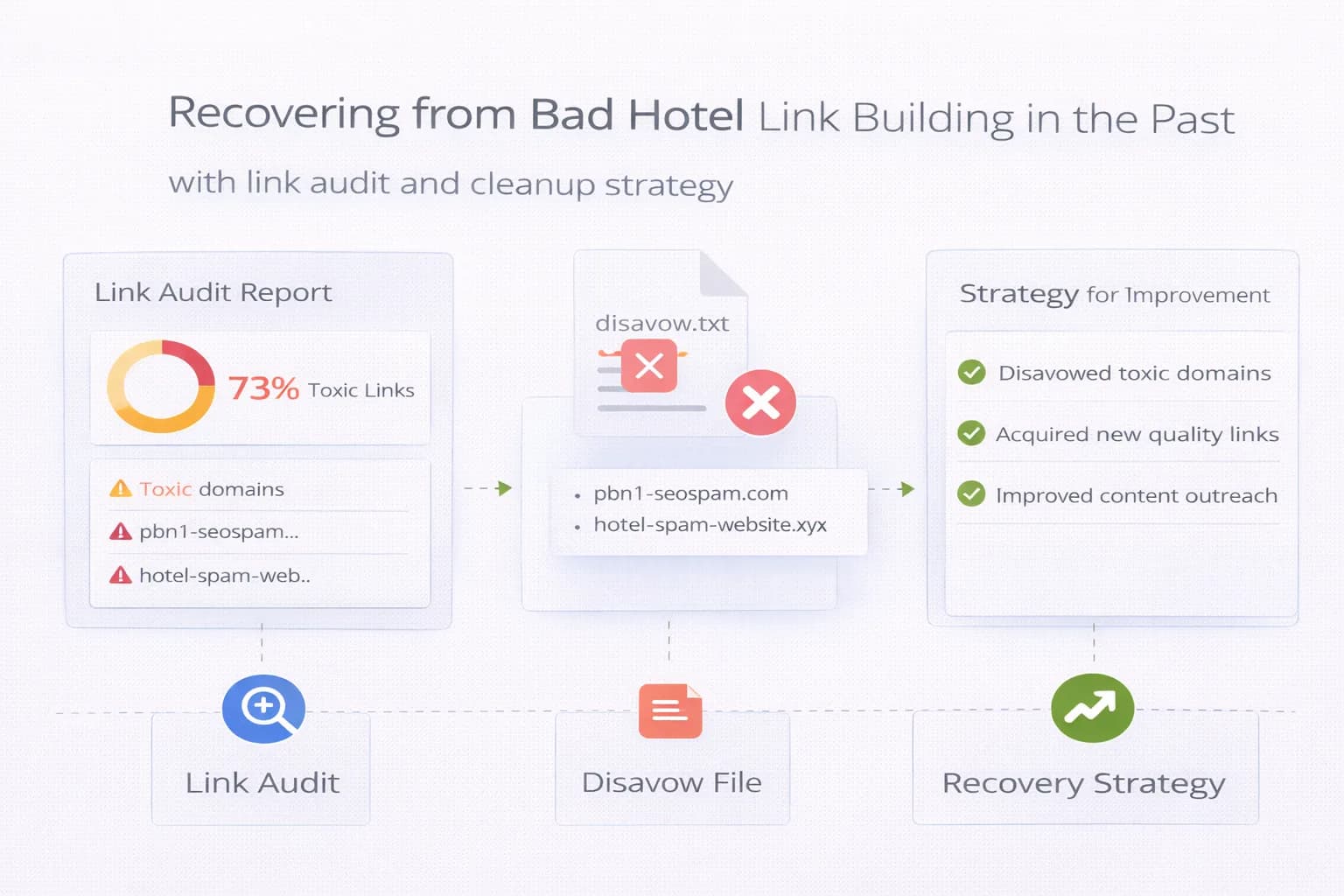
Old directory blasts, spun guest posts, and paid placements can weigh your site down for years. The good news: with a structured audit, careful cleanup, and useful, local content, hotels can rebuild safe authority and protect direct bookings.
This guide gives you a step-by-step recovery plan—from diagnosing issues to removing/discounting harmful links, then replacing them with assets journalists and partners actually want to cite.
1) How to know you have a link problem
Look for a pattern, not a single metric.
- Traffic & rankings: gradual decline after link campaigns, or drops clustered around algorithm updates.
- Search Console signals: “Manual actions” notice or unusual link patterns in Links report.
- Profile symptoms: many low-quality directories, irrelevant foreign sites, exact-match anchors, sitewide footer links.
Useful references:
Validate your pages are still technically sound with Crawlability and Indexed Pages before blaming links alone.
2) Audit the link profile (fast, structured, repeatable)
Create three buckets: Keep, Review, Remove/Disavow.
- Keep: real press, local institutions, partners, tourism boards, universities, venues.
- Review: niche blogs of unclear quality, “resources” pages, old sponsorships.
- Remove/Disavow: paid directories, spun guest posts, hacked sites, casino/porn/loan overlaps, sitewide widgets.
What to log:
- Source URL & domain, anchor text, landing URL, link type (follow/nofollow), topical & local relevance, notes on how it was obtained.
- Mark anything that could be cleaned at source (email the webmaster, remove old widgets, update partner pages).
Cross-check progress in Search Console’s Links report and track target queries with SERP Tracker.
3) Removal before disavow (safer, documented)
Start by removing what you control.
- Kill legacy widgets/badges and auto-generated footers.
- Ask old vendors/partners to switch to brand or URL anchors, or remove the link if irrelevant today.
- Replace spun guest posts with a short “this page is deprecated” note or request deletion.
Keep a log (date, contact, outcome). If you ever need a reconsideration request, this history helps.
4) When (and when not) to use the disavow file
Disavow is a precision tool, not a reset button.
- Use only for links you cannot remove and that are clearly manipulative or unsafe.
- Prefer domain-level disavow for networks or sites with many toxic URLs.
- Keep the file small, reviewed, and commented.
Official guidance:
If you have a manual action, submit a reconsideration request after removal + disavow with a concise explanation and evidence of outreach.
5) Anchor text risk: fix the “exact match” habit
Hotels often over-optimise with “best hotel in [city]”.
- Aim for brand, URL, or natural phrases journalists actually write.
- Diversify internal anchors too; your own site should model natural linking.
- Update partner pages to reflect brand anchors and on-brand destinations (e.g., your location guide, not a thin coupon page).
6) Replace toxic links with useful, local assets
You won’t recover by just removing—rebuild with value.
- Publish assistant-ready location guides, walkable maps, accessibility pages, and venue day guides.
- Use the playbooks in Digital PR Ideas for Hotels and Building Local Links for Hotels.
- Tie assets into your architecture from Creating Location Guides That Support SEO & AEO.
Outreach priorities: local press, DMOs, venues, universities, councils, and relevant creators—quality over volume.
7) Recovery timeline: what to expect
Every profile and market is different, but a realistic sequence looks like:
- Weeks 1–2: Audit + quick removals; prepare disavow (if needed).
- Weeks 3–4: Submit disavow/reconsideration (if manual action) and publish first linkable asset.
- Month 2: Secure first editorial links; stabilise rankings on core brand/non-brand terms.
- Month 3+: Compounding gains from content + PR; continue cleanup and new assets quarterly.
Focus on pages that actually convert—rooms, offers, parking, location hubs.
8) Measurement: prove you’re moving forward
Track recovery beyond vanity metrics.
In GA4 (with cross-domain set up):
- Bookings and voucher sales as key events (GA4 conversions).
- Revenue per 1k sessions from content entrances on new assets.
- Assisted conversions from content that earned coverage.
In Search Console:
- Manual action status, indexing health, and top linking sites improvements.
- Query movement for location/brand terms; annotate the disavow date.
With tools:
- Track target keywords and brand demand via SERP Tracker.
- Ensure new pages are crawlable & indexed with Crawlability and Indexed Pages.
9) Governance: stop the problem returning
- No paid link placements or scaled guest posts; if there’s value exchange, request rel="sponsored".
- Publish a house policy for partners and PR: brand/URL anchors, link to helpful pages, no auto-insert widgets.
- Quarterly link review; refresh location/venue assets so they stay citation-worthy.
For broader visibility and risk control, align with our Hotel SEO services and keep site speed in shape (see Core Web Vitals guidance).
10) 30-day hotel link-recovery sprint
Week 1 — Diagnose & plan
- Export all links; bucket by Keep/Review/Remove.
- Remove what you control; draft outreach messages.
- Build a first linkable asset (e.g., Stadium Day Guide).
Week 2 — Clean & publish
- Send removal requests; document attempts.
- Publish the asset with fast UX and a small media kit.
- Prepare a tight disavow (only if warranted).
Week 3 — Submit & pitch
- Upload disavow; submit reconsideration if manual action.
- Pitch 15–30 high-fit contacts (local press, DMO, venues).
Week 4 — Measure & iterate
- Track new referring domains and GA4 revenue/1k sessions.
- Plan the next quarterly asset; update the audit log.
FAQ
Frequently Asked Questions
Conclusion
Recovery is a two-track job: clean up manipulative links and replace them with useful, local assets that earn coverage on merit. Follow Google’s guidelines, document your actions, and measure progress in GA4 and Search Console. Done well, you’ll protect visibility, strengthen brand trust, and grow direct bookings sustainably.
Run a clean, guest-first link strategy
Kiril Ivanov
Performance Marketing Specialist
Kiril Ivanov is a digital marketing specialist with experience managing local, national and international campaigns for businesses ranging from growing independent companies to major consumer brands. His background includes leading advertising automation work for Michael Kors and working on campaigns involving Canon, Dormeo, esure, DLG Group, Village Gym, Cameron House, Crerar Hotels, Cromlix Hotel, Harrison Fund and the Advertising Standards Authority. His experience spans paid search, paid social, advertising automation, SEO, conversion optimisation and wider digital strategy across hospitality, retail, financial services, professional services and other competitive sectors.
View author profile →Related Hotel Marketing Guides
Continue with related topics to build a complete strategy.