Measuring Hotel SEO Success: KPIs and Metrics That Matter
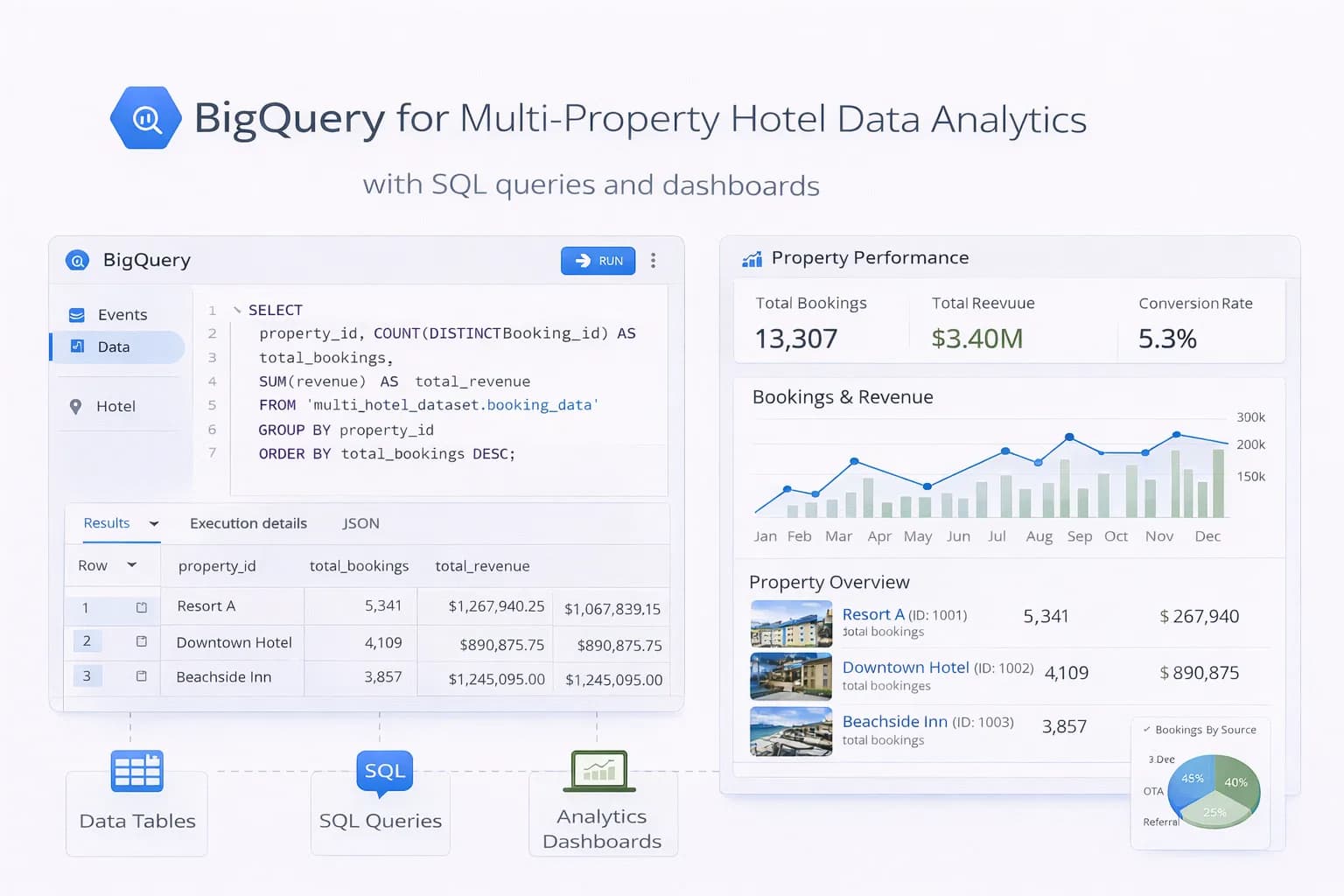
Tracking rankings alone tells you nothing about revenue. Hotels need a measurement framework that connects organic visibility to booking value—so you can prove ROI and prioritise the work that actually moves the needle.
This guide covers the KPIs that matter, how to set them up in GA4, and how to build reports that stakeholders trust.
1) The metrics hierarchy for hotel SEO
Not all metrics are equal. Organise them in tiers:
Tier 1: Revenue metrics (business outcomes)
- Organic revenue — total booking value from organic sessions (GA4
purchaseevent). - Organic bookings — conversion count from organic traffic.
- Revenue per 1,000 organic sessions — normalises growth against traffic.
- Organic share of total revenue — tracks channel health over time.
Tier 2: Conversion metrics (user behaviour)
- Organic conversion rate — bookings ÷ organic sessions.
- Booking engine arrivals from organic — mid-funnel signal.
- Assisted conversions — organic touchpoints in multi-session journeys.
Tier 3: Visibility metrics (leading indicators)
- Organic sessions — GA4, segmented by landing page.
- Impressions and clicks — Google Search Console.
- Average position — tracked for priority keyword clusters.
- Indexed pages — use Indexed Pages Checker.
For cross-domain booking attribution, see Cross-Domain Booking Setup.
2) Setting up GA4 for hotel SEO measurement
Enable enhanced ecommerce
Your booking engine must fire purchase events with:
transaction_idvalueandcurrencyitems[]array with room type, rate plan
Most engines (SynXis, Triptease, Profitroom) support this—coordinate with your vendor.
Create organic-specific explorations
Build a Free-form exploration with:
- Rows: Landing page, Session source/medium
- Values: Sessions, Conversions, Revenue
- Filter: Source = google, Medium = organic
Track booking engine arrivals
Fire a custom event (begin_checkout or view_booking_engine) when users click "Check Availability". This captures mid-funnel intent even if they don't complete.
For GA4 setup patterns, see Hotel Analytics Playbook.
3) Google Search Console: what to track
Performance metrics
- Total clicks and impressions — weekly trend.
- Average CTR — identify pages with high impressions but low clicks (title/meta opportunity).
- Average position — tracked for branded vs non-branded queries.
Query segmentation
Create filters for:
- Branded queries — hotel name, variations.
- Location queries — "[city] hotel", "hotels near [landmark]".
- Intent queries — "book [hotel name]", "[hotel] rooms", "[hotel] offers".
Page-level analysis
Identify top landing pages and track:
- Position changes over time.
- CTR vs position (underperforming pages need better titles).
- New queries driving traffic.
Use SERP Tracker to monitor priority keywords.
4) Building an SEO dashboard
Weekly snapshot
| Metric | This week | vs Last week | vs Same week LY | |--------|-----------|--------------|-----------------| | Organic sessions | 12,450 | +4.2% | +18.7% | | Organic revenue | £47,200 | +6.1% | +22.3% | | Organic CVR | 2.1% | +0.1pp | +0.3pp | | Avg position (target KWs) | 8.4 | −0.6 | −3.2 |
Monthly deep-dive
- Top 10 landing pages by revenue contribution.
- New keywords ranking in top 20.
- Technical health — Core Web Vitals, indexation issues.
- Backlink growth — new referring domains (Backlink Analyser).
Quarterly review
- Revenue attribution by content type (rooms, offers, blog).
- SEO vs paid efficiency (cost per acquisition comparison).
- Roadmap progress (technical fixes, content shipped).
5) Attribution: giving SEO proper credit
The multi-touch reality
Hotel bookings often span:
- Discovery — organic search for "boutique hotels [city]".
- Research — direct visits, review sites, social.
- Conversion — branded search or direct.
GA4's data-driven attribution assigns fractional credit across touchpoints. Check:
- Model comparison report — see how SEO contribution changes by model.
- Conversion paths — trace organic's role in journeys.
Incrementality signals
- Branded search volume growth — SEO content drives awareness.
- Direct traffic growth — often includes unattributed organic.
- New user share — organic typically brings more new visitors.
6) Proving ROI to stakeholders
Calculate organic value
Monthly organic revenue: £180,000
Equivalent paid media cost (if bought via Google Ads): £54,000
SEO investment: £8,000/month
ROI: (£180,000 − £8,000) ÷ £8,000 = 21.5x
Frame the narrative
- "Organic delivers 38% of direct bookings at 15% of the cost of paid."
- "SEO content generated 2,400 new email subscribers this quarter."
- "Technical improvements lifted Core Web Vitals from 'Needs Improvement' to 'Good', correlating with +12% organic CVR."
Benchmark against industry
- Average hotel organic CVR: 1.5–2.5%.
- Organic share of direct bookings: 25–40%.
- Revenue per 1,000 organic sessions: £3,000–£6,000 (varies by ADR).
7) Common measurement mistakes
Tracking rankings without context
Position 1 for "[hotel name] booking" matters. Position 1 for "what is a boutique hotel" may not.
Fix: Segment keywords by intent (transactional, informational, navigational) and weight accordingly.
Ignoring assisted conversions
SEO often starts journeys that paid or direct closes. Looking only at last-click understates organic's value.
Fix: Use data-driven attribution and track conversion paths.
Vanity metrics
Traffic growth is meaningless if conversion rate tanks. 100,000 sessions at 0.5% CVR < 50,000 sessions at 2%.
Fix: Always pair volume metrics with efficiency metrics.
No baseline period
Claiming "SEO grew revenue 20%" without a clear baseline or controlled comparison is weak evidence.
Fix: Establish measurement windows, account for seasonality, use year-over-year comparisons.
8) Tools for hotel SEO measurement
| Tool | Use case | |------|----------| | GA4 | Revenue attribution, user behaviour, conversions | | Google Search Console | Visibility, CTR, query performance | | Looker Studio | Custom dashboards, automated reporting | | BigQuery | Large-scale analysis, data warehouse (BigQuery guide) | | Website Speed | Core Web Vitals tracking | | SERP Tracker | Keyword position monitoring |
Action checklist
- Audit your GA4 setup — verify ecommerce events fire correctly across domains.
- Build a weekly dashboard — organic sessions, revenue, CVR, position for priority keywords.
- Segment GSC data — branded vs non-branded, location vs intent queries.
- Review attribution — compare last-click to data-driven to understand organic's full contribution.
- Set quarterly targets — specific, measurable, tied to revenue outcomes.
- Schedule a free audit — we'll benchmark your current setup and identify gaps.

Kiril Ivanov
Performance Marketing Specialist
Kiril Ivanov is a digital marketing specialist with experience managing local, national and international campaigns for businesses ranging from growing independent companies to major consumer brands. His background includes leading advertising automation work for Michael Kors and working on campaigns involving Canon, Dormeo, esure, DLG Group, Village Gym, Cameron House, Crerar Hotels, Cromlix Hotel, Harrison Fund and the Advertising Standards Authority. His experience spans paid search, paid social, advertising automation, SEO, conversion optimisation and wider digital strategy across hospitality, retail, financial services, professional services and other competitive sectors.
View author profile →Related Hotel Marketing Guides
Continue with related topics to build a complete strategy.