Improving Hotel Map Pack Rankings: Local SEO Tactics
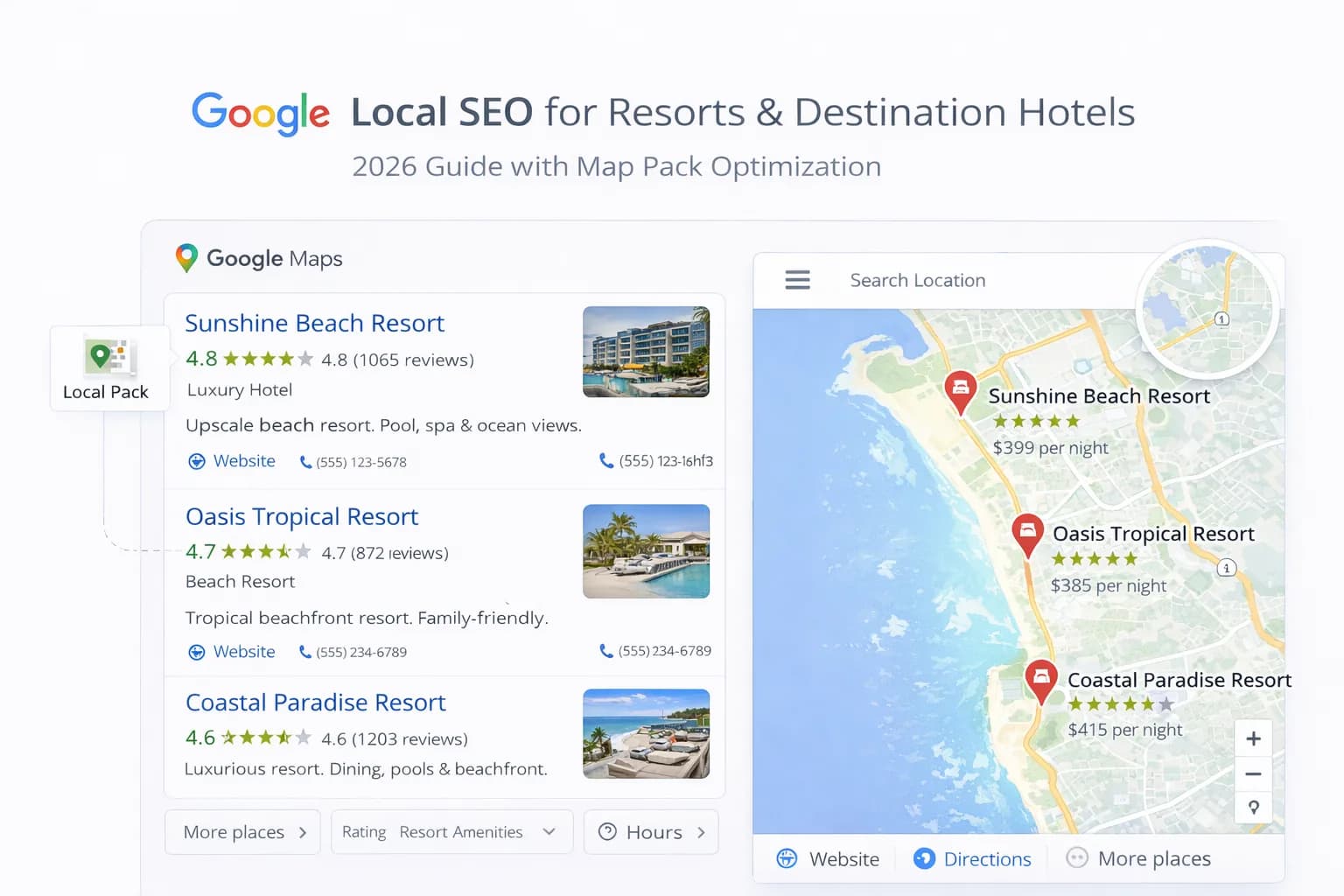
The Google Map Pack (the 3-listing local results with the map) captures significant visibility for hotel searches. Ranking here means appearing when travellers search "hotels in [destination]" or "hotels near [landmark]."
This guide covers the key ranking factors and tactics to improve your hotel's map pack position.
How map pack rankings work
Google ranks local results based on three primary factors:
- Relevance — how well your listing matches the search query.
- Distance — proximity to the searcher or specified location.
- Prominence — how well-known and trusted your business is online.
You can't control distance, but you can heavily influence relevance and prominence.
Tactics to improve rankings
Optimise your Google Business Profile
A complete, accurate GBP is foundational:
- Correct categories (Hotel as primary).
- All attributes filled (amenities, accessibility, etc.).
- Quality photos updated regularly.
- Accurate NAP (Name, Address, Phone).
See GBP Optimisation Guide for full details.
Build and manage reviews
Reviews are a major prominence signal:
- Quantity — more reviews signal popularity.
- Quality — higher ratings improve trust.
- Recency — fresh reviews show ongoing activity.
- Responses — reply to all reviews professionally.
Ensure NAP consistency
Your business name, address, and phone must match exactly across:
- GBP
- Website
- Directory listings
- Social profiles
Inconsistencies confuse Google and hurt rankings. Use our GBP Consistency Tool.
Build local citations
Get listed on relevant directories:
- Travel sites (TripAdvisor, Yelp).
- Local business directories.
- Tourism board websites.
- Chamber of commerce.
Earn local backlinks
Links from local businesses, tourism sites, and news outlets boost prominence:
- Partner with local attractions.
- Sponsor local events.
- Get featured in local press.
See Building Local Links.
On-site local optimisation
Your website should reinforce local relevance:
- Location in title tags and H1s.
- Local schema markup.
- Location-specific content (area guides, directions).
- Embedded Google Map.
Tracking progress
Monitor your map pack rankings with:
- SERP Tracker for local keywords.
- GBP Insights for profile performance.
- Third-party local rank trackers for grid-based results.
Summary
Map pack rankings depend on a strong GBP, consistent NAP, quality reviews, and local authority signals. Focus on these fundamentals and you'll improve visibility over time.
Action Plan for Hotel Teams
If you want `Improving Hotel Map Pack Rankings: Local SEO Tactics` to produce measurable revenue impact, move from ideas to a fixed execution cadence. The biggest wins usually come when this work is treated as an operating system, not a one-off campaign. For most hotel teams, a practical cadence is to align weekly execution with monthly commercial review, then re-prioritise based on booking and margin impact.
30-60-90 day rollout
- Days 1-30: Establish baselines for traffic quality, conversion rate, booking value and channel mix. Document current performance by device and market, not only in aggregate.
- Days 31-60: Implement the highest-impact fixes from this guide and track movement weekly. Prioritise changes closest to booking intent first.
- Days 61-90: Consolidate winners, retire low-impact work, and scale what improves direct booking contribution or lowers paid acquisition pressure.
KPI framework for Local SEO
- Commercial KPIs: direct bookings, direct revenue share, net contribution after media/commission costs.
- Performance KPIs: conversion rate, engaged sessions, revenue per 1,000 sessions, assisted bookings.
- Quality KPIs: page speed, crawl/index health, content freshness, and UX friction in booking steps.
Governance checklist
- Create one owner for delivery and one owner for measurement so decisions are accountable.
- Record every release with date, hypothesis and expected impact to avoid attribution confusion.
- Review outcomes monthly and re-map next actions to revenue impact, not publishing volume.
- Keep this guide connected with related resources such as /resources/statistics, /resources/guides, and /case-studies so strategy and execution stay aligned.
Common failure points
Teams usually underperform when they run too many initiatives at once, measure vanity metrics instead of commercial outcomes, or fail to maintain a repeatable review cycle. A narrower focus with disciplined reporting almost always beats a larger but fragmented roadmap.

Kiril Ivanov
Performance Marketing Specialist
Kiril Ivanov is a digital marketing specialist with experience managing local, national and international campaigns for businesses ranging from growing independent companies to major consumer brands. His background includes leading advertising automation work for Michael Kors and working on campaigns involving Canon, Dormeo, esure, DLG Group, Village Gym, Cameron House, Crerar Hotels, Cromlix Hotel, Harrison Fund and the Advertising Standards Authority. His experience spans paid search, paid social, advertising automation, SEO, conversion optimisation and wider digital strategy across hospitality, retail, financial services, professional services and other competitive sectors.
View author profile →Related Hotel Marketing Guides
Continue with related topics to build a complete strategy.