CRO Tools for Hotels: Essential Software for Conversion Optimisation
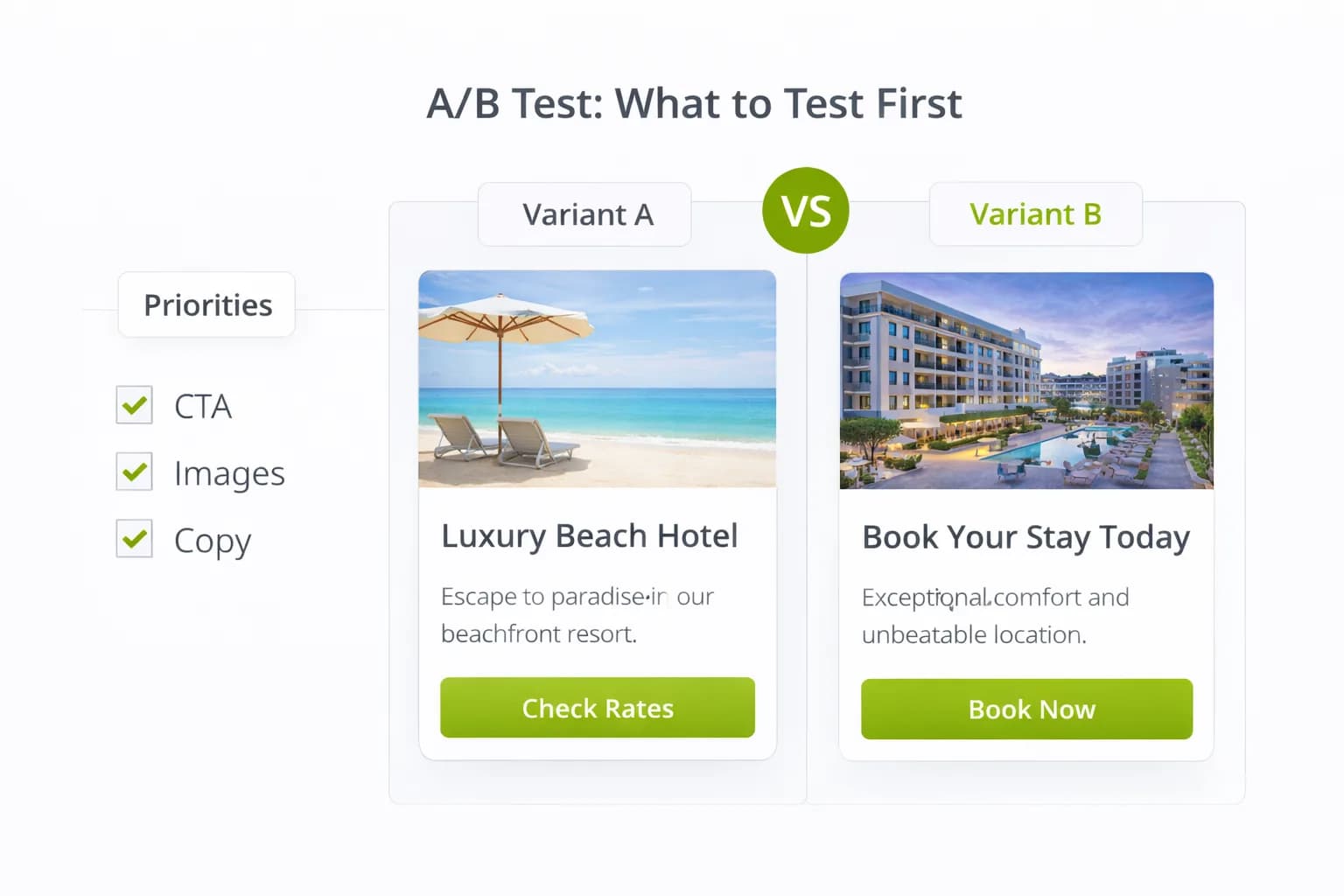
Conversion rate optimisation requires data. The right tools help you understand where guests drop off, what they engage with, and which changes actually improve bookings.
This guide covers the essential CRO tools hotels should consider, organised by function.
Heatmaps and session recordings
Visual tools that show how users interact with your pages.
- Hotjar — heatmaps, recordings, and surveys. Good free tier.
- Microsoft Clarity — free heatmaps and session recordings.
- Lucky Orange — real-time visitor tracking and chat integration.
Use these to identify where users click, scroll, and abandon. See Heatmaps & Scrollmaps for implementation guidance.
A/B testing platforms
Test variations of pages, headlines, and CTAs to find what converts.
- Google Optimize (sunset, but alternatives exist).
- VWO — visual editor and advanced targeting.
- Optimizely — enterprise-grade experimentation.
- Convert — privacy-focused testing platform.
Start with high-impact pages like your homepage hero and booking form. See A/B Testing for Hotels.
Form analytics
Understand where guests abandon your booking form.
- Hotjar Forms — field-level analytics.
- Formisimo — dedicated form analytics.
- Zuko — enterprise form optimisation.
For form best practices, see Optimising Booking Forms.
Analytics and attribution
Measure what drives bookings and calculate ROI.
- GA4 — free, essential for any hotel. See GA4 Setup.
- Mixpanel — event-based analytics.
- Amplitude — product analytics for digital experiences.
Getting started
- Start with free tools — Clarity and GA4 cover the basics.
- Add heatmaps — understand behaviour before testing.
- Run one test at a time — avoid conflicting experiments.
- Document learnings — build institutional knowledge.
Summary
CRO tools help you make data-driven improvements to your hotel website. Start with heatmaps and analytics, then graduate to A/B testing as you build hypotheses from the data.
Action Plan for Hotel Teams
If you want `CRO Tools for Hotels: Essential Software for Conversion Optimisation` to produce measurable revenue impact, move from ideas to a fixed execution cadence. The biggest wins usually come when this work is treated as an operating system, not a one-off campaign. For most hotel teams, a practical cadence is to align weekly execution with monthly commercial review, then re-prioritise based on booking and margin impact.
30-60-90 day rollout
- Days 1-30: Establish baselines for traffic quality, conversion rate, booking value and channel mix. Document current performance by device and market, not only in aggregate.
- Days 31-60: Implement the highest-impact fixes from this guide and track movement weekly. Prioritise changes closest to booking intent first.
- Days 61-90: Consolidate winners, retire low-impact work, and scale what improves direct booking contribution or lowers paid acquisition pressure.
KPI framework for CRO
- Commercial KPIs: direct bookings, direct revenue share, net contribution after media/commission costs.
- Performance KPIs: conversion rate, engaged sessions, revenue per 1,000 sessions, assisted bookings.
- Quality KPIs: page speed, crawl/index health, content freshness, and UX friction in booking steps.
Governance checklist
- Create one owner for delivery and one owner for measurement so decisions are accountable.
- Record every release with date, hypothesis and expected impact to avoid attribution confusion.
- Review outcomes monthly and re-map next actions to revenue impact, not publishing volume.
- Keep this guide connected with related resources such as /resources/statistics, /resources/guides, and /case-studies so strategy and execution stay aligned.
Common failure points
Teams usually underperform when they run too many initiatives at once, measure vanity metrics instead of commercial outcomes, or fail to maintain a repeatable review cycle. A narrower focus with disciplined reporting almost always beats a larger but fragmented roadmap.
Final implementation note
Before scaling this work, validate outcomes in one market or property cluster first, then replicate only what improves booking quality and revenue contribution. Keep a monthly retrospective with clear keep / improve / stop decisions so execution remains commercially focused.

Kiril Ivanov
Performance Marketing Specialist
Kiril Ivanov is a digital marketing specialist with experience managing local, national and international campaigns for businesses ranging from growing independent companies to major consumer brands. His background includes leading advertising automation work for Michael Kors and working on campaigns involving Canon, Dormeo, esure, DLG Group, Village Gym, Cameron House, Crerar Hotels, Cromlix Hotel, Harrison Fund and the Advertising Standards Authority. His experience spans paid search, paid social, advertising automation, SEO, conversion optimisation and wider digital strategy across hospitality, retail, financial services, professional services and other competitive sectors.
View author profile →Related Hotel Marketing Guides
Continue with related topics to build a complete strategy.