Display & Programmatic Ads for Hotels
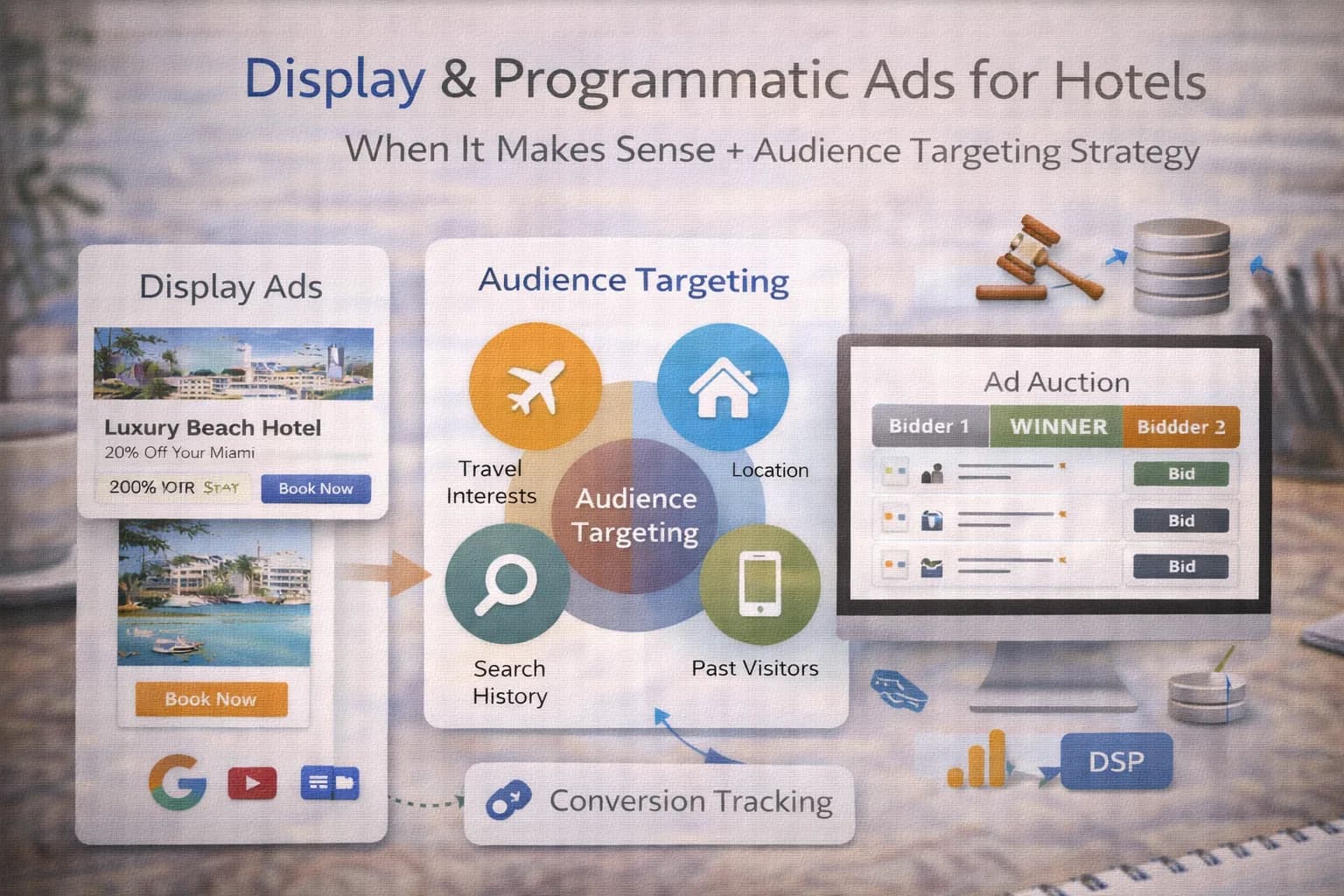
Display and programmatic are often misunderstood in hotel marketing. Many properties either overspend on broad awareness or avoid display entirely because the ROI feels unclear. Used properly, display can create demand, nurture planners, and support remarketing, but only when paired with strict controls, clear goals, and accurate tracking.
This guide shows when display and programmatic channels genuinely help hotels—and when they don’t.
1) What display and programmatic actually do for hotels
Display does three jobs well:
- Top-of-funnel awareness in feeder markets (when timed early enough).
- Nurturing mid-intent travellers engaging with destination and amenity content.
- Remarketing—still the most reliable use case for hotels.
Programmatic layers on automation: real-time bidding, third-party data, better placements, and brand-safe inventory controls. But without guardrails, it can spend aggressively on impressions that never convert.
See Hotel PPC Strategy for channel context and Remarketing Campaigns for the more reliable mid-funnel use case.
2) When display does not make sense
Avoid display or limit budgets if:
- You are below 65–70% occupancy for most date bands (Search/PPC will outperform).
- Your tracking is unreliable or revenue is not being captured.
- Your markets have short booking windows where mid-funnel nurturing adds little.
- You do not have enough creative assets (images, video, room visuals).
- You cannot manage frequency caps properly.
Only run display when the operational conditions improve.
3) When display does make sense
Display and programmatic add value when:
- You have strong organic demand and need to grow the top of funnel.
- Your resort or region has a long lead time (e.g., ski, long-haul, wellness).
- You want to warm up new feeder markets ahead of season.
- You have enough creative to support 4–6 active variants.
- You already run Search and Brand PPC efficiently and want a second layer of growth.
Pair this strategy with Seasonal PPC Planning for timing guidance.
4) Audience strategy: the part most hotels skip
Display only works if your audiences are precise.
Use a three-layer model:
A) Prospecting (top-of-funnel)
Build audiences based on:
- In-market travel signals (Google Display & Video 360, some DV360 partner segments).
- Feeder markets from last year’s PMS data.
- Affinity categories (luxury, family travel, beach, spa).
- Lookalikes from bookers, not all visitors.
Rule: Keep budgets small, test 2–3 audience clusters per market.
B) Consideration (mid-funnel)
Target “warm” audiences:
- Location hub readers (30–90 days).
- Room detail or amenity viewers (spa, family rooms).
- Video viewers (50–75%+) from YouTube or Meta.
Rule: This is usually where display performs best for hotels.
C) Remarketing (bottom-of-funnel)
The most profitable audience layer:
- Dates selected.
- Room/offer selected.
- Checkout started.
Rule: Cap frequency (2–4/day) and refresh creative monthly.
See Remarketing Campaigns for detailed instructions.
5) Creative: keep it simple, local and real
Display creative should help guests imagine the stay, not overwhelm them. Prioritise:
- Real room photos and spa/amenity visuals.
- Clear, factual value: “Spa Access Included”, “Beachfront”, “Free Parking”, “Near the Lifts”.
- Seasonal cues (winter/summer/holiday periods).
- Short copy with direct-booking perks (only if policy-true).
- Include your brand name and consistent colours/fonts.
For premium placements (e.g., programmatic video), use short 6–15 sec edits.
Tie visual quality back to content marketing.
6) Placements: where your ads should run
Google Display Network (GDN)
- Easy to launch, good reach, lower CPMs.
- Works well for mid-funnel and remarketing.
- Avoid overly broad “Optimised targeting” until data is stable.
Programmatic via DV360 or partner DSPs
- Access to premium inventory (publisher sites, travel content).
- Better brand safety, geo-targeting, and frequency control.
- Stronger for awareness campaigns targeting high-value markets.
YouTube (as part of programmatic or Google Ads)
- Best for large feeder markets and seasonal storytelling.
- Use in-stream or short vertical ads.
Avoid Audience Network (Meta) or unknown exchanges with low viewability.
7) Budgeting: the 15–20% rule
For most independent hotels:
- Spend 70–85% of paid media on Search/PPC + remarketing.
- Spend 15–20% (max) on display/programmatic.
- For resorts with long lead windows, increase display to 25–35% during pre-season.
- During peak season, reduce display and push budgets into intent-driven search.
Keep display budgets segmented by funnel so Smart Bidding doesn’t mix prospecting with remarketing.
8) Frequency caps: protect guest experience
Hotels often over-serve ads without realising it.
Best-practice caps:
- Prospecting: 1–2/day
- Consideration: 2–4/day
- Remarketing: 2–4/day (never unlimited)
Check frequency by audience, market and device weekly.
9) Landing pages that make display profitable
Send traffic to context-relevant destinations:
- Resort overview → resort hub page.
- Amenity creative → spa / family rooms page.
- Offer creative → offer detail page.
- Late-deal creative → availability deep links (dates pre-filled where possible).
Speed-test these pages with our Website Speed Tool and review Core Web Vitals guidance via web.dev.
10) How to measure display without over-crediting it
Avoid vanity metrics (impressions, view-throughs). Measure:
- Landing page views (real traffic).
- Assisted conversions (GA4 Attribution → Conversion paths).
- Direct bookings where applicable (for remarketing).
- Post-view lift tests (YouTube, DV360 experiments).
- Geo splits—show ads in Market A, suppress in Market B for 2–4 weeks.
Always reconcile with PMS/CRM booking totals. Accept a small variance band.
Cross-pillar: see Analytics Dashboard for reporting frameworks.
11) Common pitfalls and fast fixes
- Running only prospecting → Add mid-funnel and remarketing immediately.
- Zero frequency caps → Add caps or the channel will over-reach.
- Sending traffic to homepage → Deep link to relevant pages.
- High CPM, low engagement → Refresh creative; add travel-specific placements; refine geos.
- Display cannibalising Search → Reduce broad prospecting; separate budgets; tighten exclusions.
Internal links to reinforce learning
- Service: Services
- Tool: SERP Tracker • Website Speed Tool
- Resource: Marketing Tips
- Siblings (PPC cluster):
Hotel PPC Strategy • Remarketing Campaigns • YouTube Ads for Hotels - Cross-pillar: Content Marketing & Analytics Dashboard
- Trust: About • Contact
Frequently Asked Questions
Conclusion
Display and programmatic can absolutely work for hotels—but only with clear goals, strong creative, frequency control, and correct measurement. Use them to build awareness, nurture planners, and support remarketing, not to replace high-intent Search. Done well, display becomes a predictable lever for lifting direct bookings across seasons.
Plan My Display Strategy
Stephen Colenn
Digital Marketing & Paid Media Specialist
Stephen Colenn is a digital marketing professional with over a decade of experience across search marketing, paid search (PPC), and programmatic advertising. He holds an MSc in Marketing from The University of Edinburgh and industry certifications across Google Ads and Meta Blueprint. At HotelsSEO, Stephen contributes practical insights on hotel paid search strategy, brand bidding defense, remarketing funnels, and tracking direct booking ROI.
View author profile →Related Hotel Marketing Guides
Continue with related topics to build a complete strategy.