Building a Hotel Brand That Converts Online
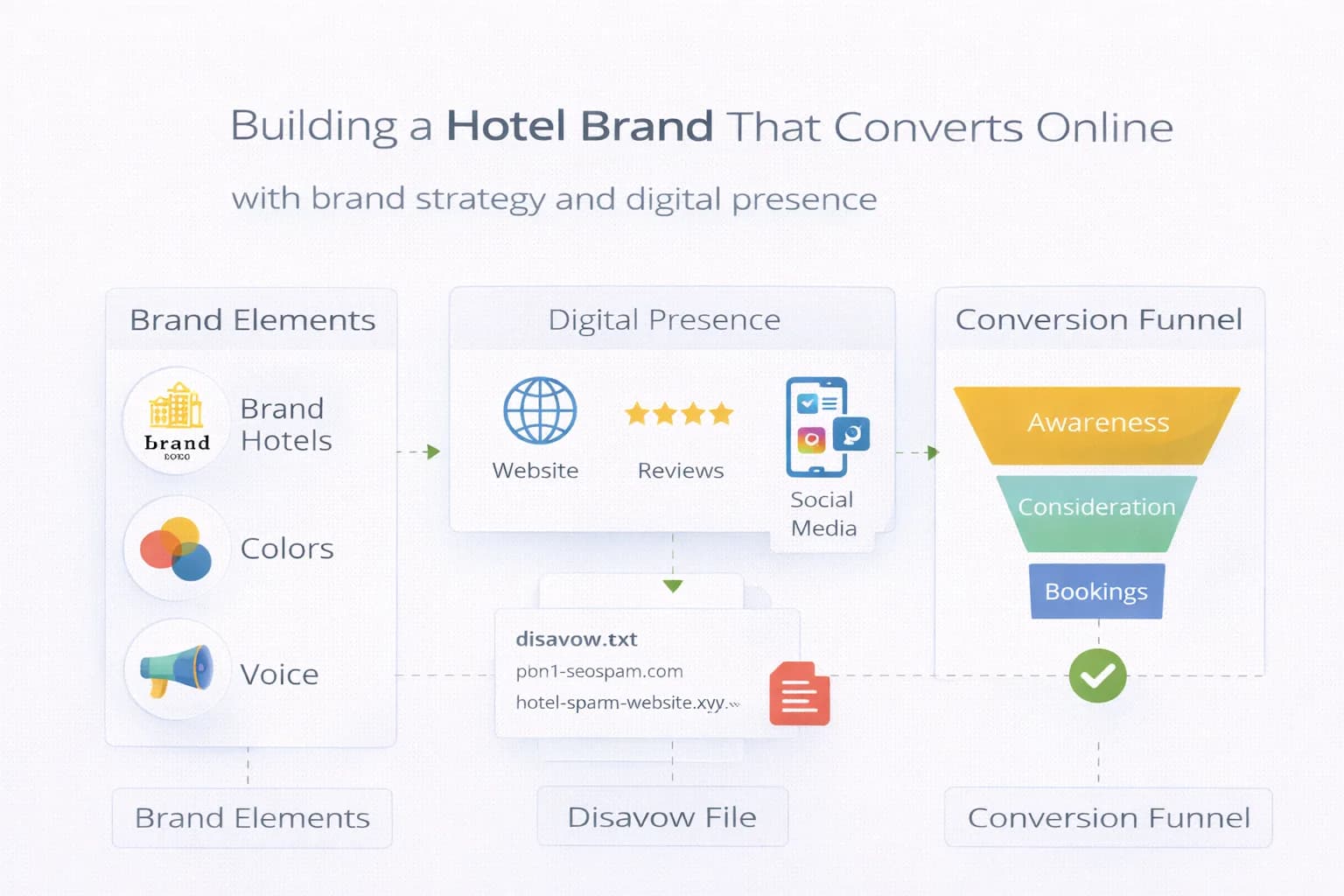
A hotel "brand" that wins online is more than a logo. It's a clear promise, consistent proof, and a website journey that helps guests finish their decision fast—especially on mobile.
This playbook turns brand theory into bookings: positioning, messaging, visuals, information architecture (IA), trust, content patterns, and measurement you can defend to finance.
1) Define your brand to solve a guest problem (not a mood board)
A strong brand starts with a positioning sentence guests instantly understand:
For [who], [Hotel/Brand] is the [category] in [location] that provides [core value], because [credible proof].
- Who: families, business travellers, couples, spa/weekenders.
- Core value: walkable location, parking & EV, spa/relax, meeting rooms, pet-friendly.
- Proof: awards, review score, certifications, partnerships.
Keep it on the homepage above the fold in one line. Reinforce in page H1s and CTAs, then reflect it in your Hotel SEO structure.
2) Turn positioning into a messaging grid (so every page stays on-brand)
Create a simple grid you will reuse site-wide:
- Headline formula: [Location + primary value] (e.g., "Riverside hotel with parking & family rooms").
- Key facts: parking (cost/height/EV), breakfast times, check-in/out, accessibility, walking times.
- Proof: aggregate review badge, award/year, partner logos.
- Direct benefits: price match, flexibility, onsite perks.
Use this grid on Home, Rooms, Offers and Location. It is also the scaffold for assistant-ready content; see Structuring Hotel Content for AI Assistants.
3) Visual identity that helps decisions (not just aesthetics)
Good visuals reduce uncertainty and speed up choices.
- Photography: show layouts, bathrooms, views, and scale; include accessibility shots.
- Video: 20–40s "walkthroughs" for rooms/spa; keep files compressed.
- Design tokens: consistent colour/contrast, 1–2 fonts max, clear H1/H2 hierarchy.
- Iconography with labels: parking, EV chargers, pets, gym, spa—always with text, not icons alone.
Deep dive visual standards in Visual Identity & UX: How Guests Perceive Trust and content capture in Hotel Photography & Video for SEO & PPC.
4) IA (information architecture): brand to property to location to action
Brand power fails if guests cannot find things.
- Top nav: Rooms, Offers, Dining/Spa (if relevant), Location, Parking, FAQ, Contact.
- Hubs: brand hub to property hub(s) to location/parking guides to rooms/offers.
- Quick links near the top: Rooms, Offers, Parking, Location—especially on mobile.
- Breadcrumbs + schema: follow the hub-spoke model from Hotel Information Architecture.
See Google's general quality guidance for structure and clarity:
Google Search Essentials.
5) Trust stack: social proof, policies, and clarity
Brand = promises kept + transparent policies.
- Review badge (aggregate) and 2–3 specific quotes with date/source.
- Fee transparency near CTAs: resort/parking fees, deposits, cancellation.
- Safety & accessibility highlights: step-free routes, lift size, quiet rooms.
- GBP consistency for map-pack trust; align NAP with your site.
- About/values page tied from Home footer; see About HotelsSEO for trust format ideas.
Useful references:
Google Business Profile Help and Core Web Vitals (web.dev)
6) Brand voice: plain, specific, repeatable
Write for B1–B2 English. Short sentences. No cliches.
- Do: "3-minute walk to the station. EV chargers on site. Breakfast 7–10am."
- Don't: "Unparalleled experiences in the heart of…"
- Keep micro-FAQs near CTAs (3–5 Qs). Mark up FAQ schema only if genuine and helpful (see FAQPage).
7) Branding across channels (where bookings actually start)
Guests meet your brand in many places before the site:
- SERP and AI surfaces: align page titles/meta with your positioning. Audit with Meta Tags.
- GBP: photos, categories, attributes; keep descriptions consistent with site.
- Email and CRM: mirror tone and key facts in Hotel Email Strategy 2026 and Automation Essentials.
- PPC: carry the same headline/benefit into ads and landing pages; see Hotel PPC services.
8) Measuring brand impact (beyond vanity)
Pair brand signals with commercial outcomes.
| Metric | Tool / Source | Target | |--------|---------------|--------| | Branded search volume | GSC, Semrush | Up YoY | | Direct revenue share | GA4/PMS | More than 40% | | Avg. booking value | PMS | Compare branded vs. non-branded | | Scroll depth on brand pages | GA4 | More than 60% to CTA | | Review sentiment | Trustpilot/GBP | 4.5+ avg |
Track using the methods in Measuring ROI of Hotel SEO.
9) Quick-start checklist
- Write your positioning sentence (above-the-fold ready).
- Build the messaging grid: headline, key facts, proof, benefits.
- Audit photography: layouts, scale, accessibility shots.
- Map IA: Home to Rooms/Offers to Location/Parking to FAQ/Contact.
- Add trust stack: review badge, fee transparency, policies.
- Align SERP titles: use Meta Tags tool.
- Sync GBP: photos, attributes, description.
- Set baseline metrics in GA4 and GSC.
Key takeaways
- Positioning comes first: decide who you serve and what problem you solve before design.
- Consistency = trust: same messaging across site, GBP, email, ads.
- IA makes or breaks conversion: if guests cannot find info, brand appeal is wasted.
- Measure brand commercially: tie brand metrics to direct revenue and booking value.
Related posts

Kiril Ivanov
Performance Marketing Specialist
Kiril Ivanov is a digital marketing specialist with experience managing local, national and international campaigns for businesses ranging from growing independent companies to major consumer brands. His background includes leading advertising automation work for Michael Kors and working on campaigns involving Canon, Dormeo, esure, DLG Group, Village Gym, Cameron House, Crerar Hotels, Cromlix Hotel, Harrison Fund and the Advertising Standards Authority. His experience spans paid search, paid social, advertising automation, SEO, conversion optimisation and wider digital strategy across hospitality, retail, financial services, professional services and other competitive sectors.
View author profile →Related Hotel Marketing Guides
Continue with related topics to build a complete strategy.