Hotel Conversion Rate Optimisation: 2026 Insights
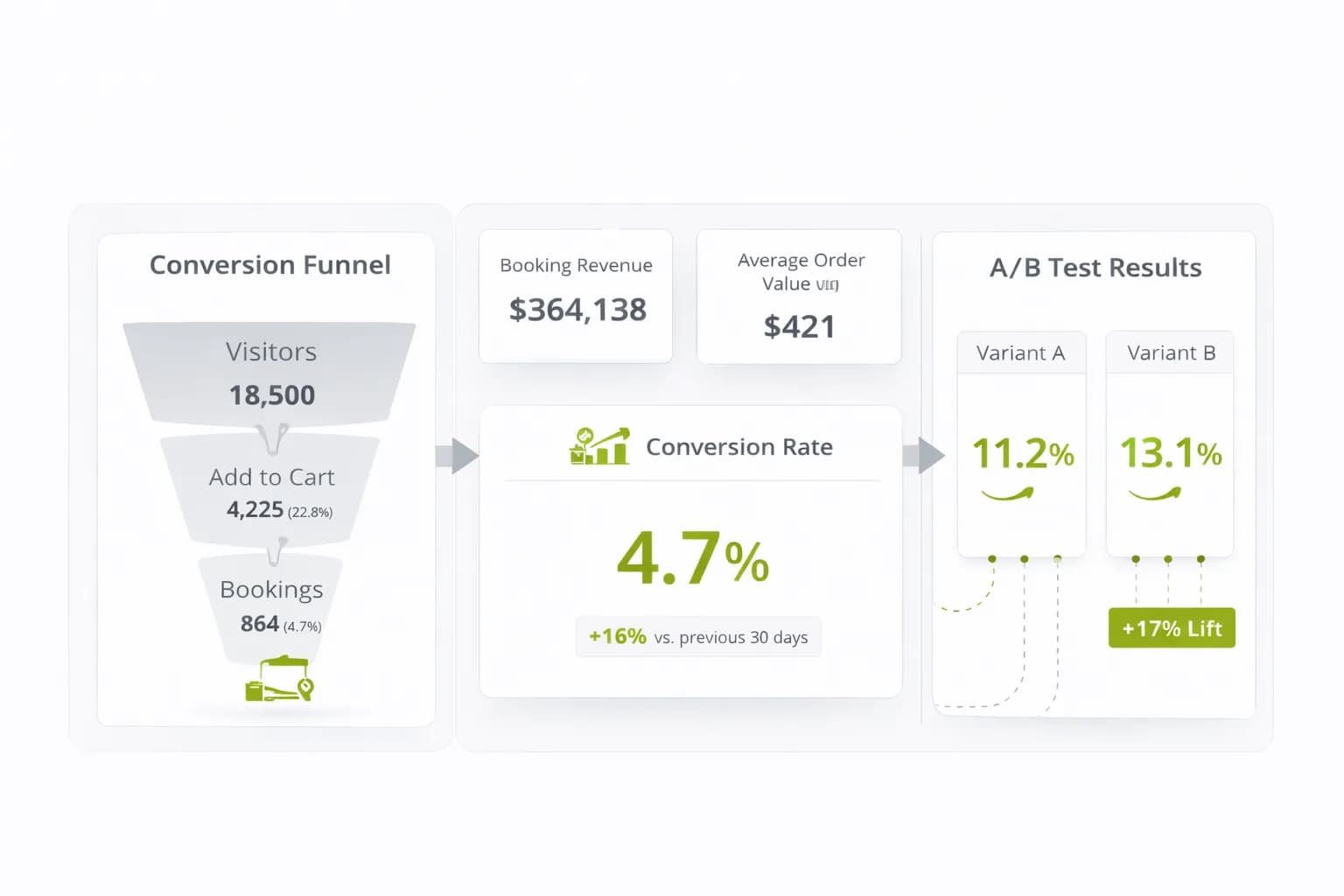
Most hotel websites leak demand in the last mile: slow mobile pages, crowded hero sections, unclear fees, and booking engines that restart sessions. In 2026, the hotels that win CRO do five things well: speed, mobile clarity, assistant-ready facts, friction-free forms, and evidence-based tests.
This guide lays out what to fix, how to prioritise, and how to prove impact in GA4—so CRO becomes a repeatable booking lift, not guesswork.
1) The 2026 CRO baseline for hotels
Before experiments, stabilise the foundations:
- Speed: LCP under ~2.5s on mobile; CLS stable. Validate with Website Speed and see web.dev’s Core Web Vitals guide.
- Cross-domain: one continuous session from site → engine → confirmation. Use our playbook in Cross-Domain Bookings.
- Measurement:
purchaseas the primary conversion; revenue in the right currency; annotate releases (see GA4 conversions). - Assistant-ready content: short, factual blocks for parking, breakfast, accessibility; see assistant-ready content.
2) What’s changed since 2025 (and why it matters)
- Mobile first, truly: More than 70% of discovery sessions are mobile for many destinations; last-minute bookers expect near-instant loads.
- AI/answer surfaces: Guests skim facts then click to finish on a clear page; thin copy and hidden fees fail.
- Privacy & consent: Missing Consent Mode/attribution inflates “Direct”; CRO wins must still show revenue lift in GA4. See Consent Mode.
3) Page patterns that convert (copy these)
Use these patterns for home, rooms, and offer pages. Keep paragraphs ≤3 sentences.
A) Homepage (decision assist, not a brochure)
- Headline: location + value (“Riverside hotel, family rooms & parking”).
- Key facts: 5 bullets (check-in/out, parking, breakfast, transport times, accessibility).
- Primary CTA: availability widget above the fold.
- Proof: review snippet or award strip.
- Navigate: quick links to Rooms, Offers, Parking, Location guide.
B) Room page (clarity beats adjectives)
- First screen: occupancy, bed, bathroom, accessibility flags, cancellation terms.
- Secondary: gallery, inclusions/exclusions, “good for” (family/couples).
- CTA persistent; price messaging simple; no carousel-only info.
C) Offer page (no surprises)
- Dates, what’s included, eligibility, cancellation, blackout dates.
- Add “who this suits”, and a mini FAQ.
- Add schema where relevant (see Entity Optimisation and Google structured data).
4) The four biggest CRO leaks (and fixes)
-
Slow first screen
- Optimise images; defer non-critical JS; serve modern formats. Track LCP/CLS with Website Speed.
-
Crowded hero & weak hierarchy
- Remove sliders; keep one H1; one primary CTA; add “key facts” block. See Hero Section Mistakes.
-
Form friction on engine
- Fewer steps; visible progress; sensible defaults; auto-fill for guests returning from pre-stay email. For detail, see Optimising Booking Forms.
-
Unclear fees & policies
- Plain language for resort/parking fees; show total at each step; short refund text near the CTA. Add FAQs (3–5 concise answers).
5) Mobile UX check (15-minute audit)
Open your site on a real phone and audit:
- Thumb reach: is the CTA reachable without scroll gymnastics?
- Tap targets: min 44×44 px; remove accidental taps.
- Sticky CTA: visible but not hiding content.
- Keyboard types: numeric for postcode/phone; email keyboard for email.
- Map & directions: a single tap from the room/offer page.
Validate on Mobile-Friendly and retest after each change.
6) Make “facts” machine-and-human friendly
CRO gains come from answering key questions fast:
- Parking: where, cost, height limit, EV chargers.
- Breakfast: times, type, dietary info.
- Accessibility: step-free routes, lift size, accessible bathrooms, quiet rooms.
- Transport: walking times; link official last-train info.
- Direct benefits: late checkout, flexibility, onsite perks.
Use the assistant-ready pattern from this guide and keep GBP details aligned (GBP Help).
7) Testing roadmap (no guesswork)
Run one meaningful test at a time; measure bookings and revenue/1k sessions (not just CTR).
High-impact test themes
- Key facts block above the fold (vs none).
- Sticky CTA on rooms/offers (vs static).
- Fee transparency module near CTA (vs hidden until checkout).
- Shorter form on engine (group fields; fewer steps).
- Social proof position (above vs below CTA).
Use a simple framework:
- Hypothesis → Metric → Target page → Variant → Run window → Stop rule.
- Avoid weeks with major rate/yield changes if you can.
For tooling and session insights, see Heatmaps & Scrollmaps and CRO Tools for Hotels.
8) Email and pre-stay: CRO outside the website
CRO isn’t only on your site. Use email to finish decisions:
- Pre-stay inserts: parking map, breakfast times, upsell offers.
- Abandoners: audiences of began checkout but no purchase (see GA4 audiences for remarketing).
- Newsletter modules: “Know before you go” facts linking back to entity pages.
Pair with Automation Essentials for flow templates.
9) How to measure CRO success (bookings first)
In GA4 (cross-domain on):
- Primary conversions:
purchaseonly; voucherpurchasedistinct category. - Scoreboard: revenue/1k sessions by variant and entrance page.
- Funnel: Home → Rooms/Offers → Begin Checkout → Purchase.
In Search Console:
- URL-level clicks/impressions for pages under test; annotate significant changes (Search Console).
Operational:
- Direct vs OTA share in PMS/CRM monthly.
- Map pack engagement if local pages were part of the change.
10) 30-day hotel CRO sprint (repeat quarterly)
Week 1 — Stabilise
- Fix LCP/CLS errors; verify cross-domain; set
purchaseas primary conversion. - Baseline dashboard using Analytics Dashboard.
Week 2 — Ship clarity
- Add “key facts” blocks to Home, Rooms, Offers; unify CTAs.
- Tighten forms on the engine (labels, errors, keyboard types).
Week 3 — Test one thing
- Pick a high-impact page; run A/B on sticky CTA or fee transparency.
- Monitor revenue/1k sessions and funnel drop-offs.
Week 4 — Review & roll
- Ship winner to all relevant pages.
- Document learnings in Resources; pick next test.
11) Common pitfalls (and fixes)
- Testing during rate upheavals → either pause or segment results by rate plan/ADR.
- Counting micro goals → keep conversions to purchases/leads only.
- Hero sliders & heavy JS → remove or lazy-load; measure LCP after change.
- Engine design mismatch → coordinate with your vendor; share your room/offer patterns so the engine mirrors clarity.
FAQ
Frequently Asked Questions
Conclusion
CRO in 2026 rewards clarity and speed. Stabilise performance, present facts plainly, align the engine flow, and test one meaningful change at a time. Prove wins in GA4 with bookings and revenue/1k sessions. Repeat quarterly and you’ll compound direct bookings—without guesswork.
Make CRO a revenue habit
Kiril Ivanov
Специалист по дигитален маркетинг
Кирил Иванов е специалист по дигитален маркетинг с опит в управлението на локални, национални и международни кампании за широк спектър от бизнеси — от независими компании до водещи потребителски марки. Неговият професионален опит включва ръководене на проекти за автоматизация на рекламата за Michael Kors и работа по кампании за Canon, Dormeo, esure, DLG Group, Village Gym, Cameron House, Crerar Hotels, Cromlix Hotel, Harrison Fund и Advertising Standards Authority (ASA). Опитът му обхваща платено търсене (PPC), платени социални мрежи, автоматизация на рекламата, SEO, оптимизация на процента на конверсия (CRO) и цялостна дигитална стратегия в хотелиерството, ритейла, финансовите и професионалните услуги.
Виж профила на автора →Свързани ръководства за хотелски маркетинг
Продължете със свързани теми, за да изградите пълна стратегия.