A/B Testing for Hotels: What to Test First
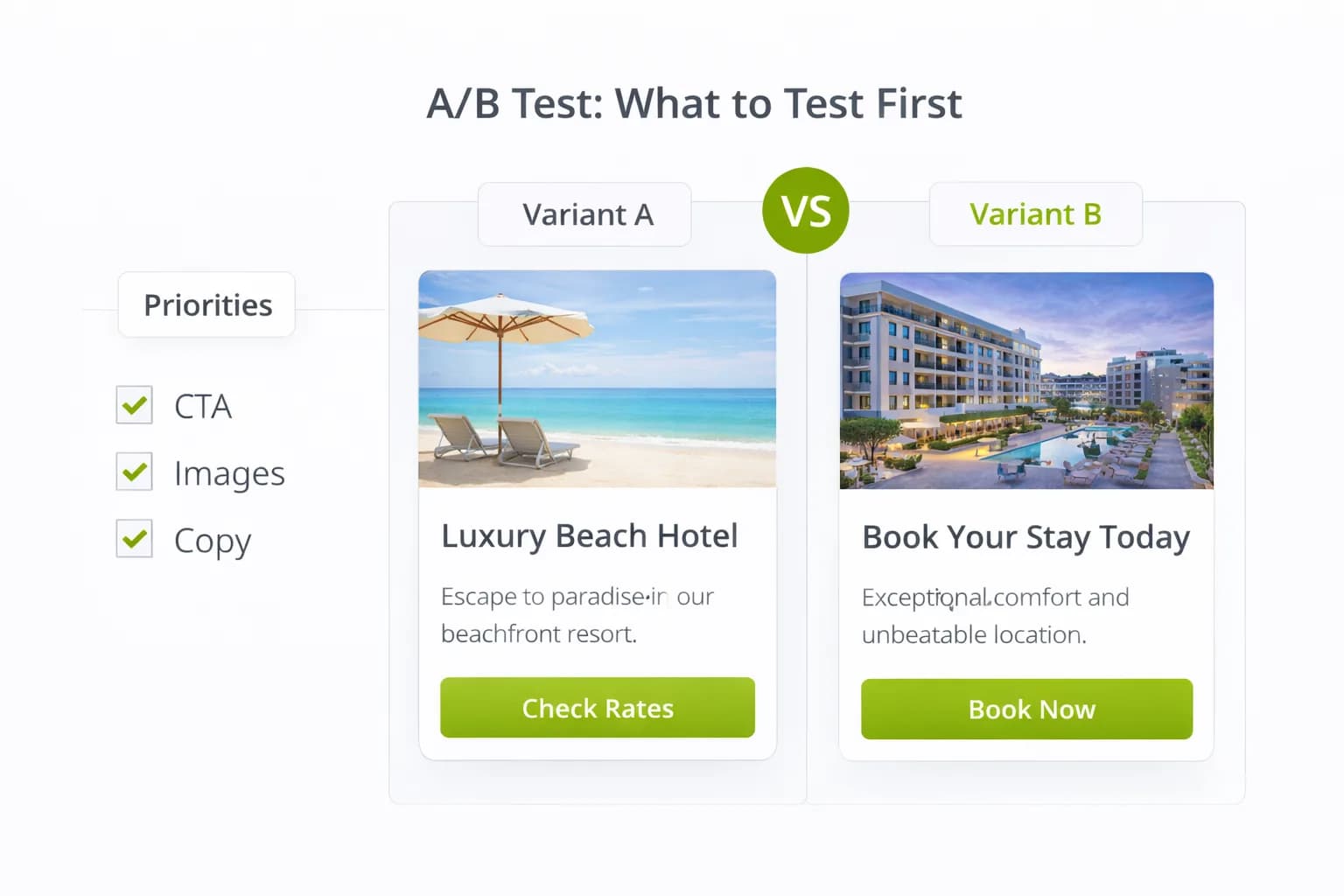
A/B testing only works when the basics are stable—fast pages, clear funnels, and reliable cross-domain tracking to your booking engine. Once you have that, small, focused experiments can lift booking rate and revenue per 1,000 sessions without redesigning the whole site.
This guide shows exactly what to test first, how to avoid noisy results, and how to measure in GA4 so your decisions hold up in the boardroom.
1) Before you test: stabilise the ground truth
Run tests only after these are in place:
- Cross-domain continuity from site → engine → confirmation (see cross-domain booking setup).
- Primary conversion is
purchasewith value/currency in GA4 (GA4 conversions). - Speed: healthy Core Web Vitals on mobile; validate with Website Speed and web.dev guidance.
- Consent Mode v2 configured where required (Consent Mode).
For testing ideas and heuristics, skim Hotel CRO: 2026 Insights first.
2) What to test first (highest impact, lowest risk)
Prioritise changes that remove friction above the fold and near the booking action.
-
Key Facts block on Home & Rooms
- Bullets for parking (cost/height/EV), breakfast times, check-in/out, accessibility, transport walking times.
- Variant: “with Key Facts” vs “no Key Facts”.
-
Sticky Availability CTA on Room & Offer pages
- Variant: sticky CTA (mobile) vs static CTA.
-
Fee transparency near CTA
- Show total price guidance and clear cancellation terms.
- Variant: fee note visible vs hidden until engine.
-
Hero simplification
- Replace sliders with single image + headline + CTA.
- Variant: single hero vs carousel.
-
Form friction on engine
- Fewer steps, better labels, correct keyboards (numeric/email).
- Variant: condensed step vs original flow (coordinate with vendor).
For context patterns, see Hero Section Mistakes and Optimising Booking Forms.
3) Experiment design (keep it clean)
- One hypothesis at a time. “Showing key facts will increase booking rate by +X%.”
- Primary metric:
purchase(bookings) and revenue/1k sessions for the tested pages. - Guardrails: LCP/CLS (don’t win by slowing pages); bounce rate on variant.
- Run length: at least one full booking cycle (e.g., 2–3 weeks) to cover weekend/weekday mix.
- Stop rule: pre-decide minimum visitors and minimum detectable effect.
If you test ad copy/landing pages via paid traffic, use campaign Experiments in Google Ads for split traffic (Google Ads experiments) and keep the web test isolated.
4) Targeting, traffic split, and seasonality
- 50/50 split unless you’re risk-averse on booking pages (then 90/10 for the first 24–48h).
- Avoid launching during major rate changes or website releases.
- Segment by device (mobile first) and country (if you run geo-targeted offers).
- Keep one variant per page type (e.g., all room pages share the same variant) to reach sample size faster.
5) Measurement setup in GA4 (simple & reliable)
You don’t need fancy testing software to start—just consistent tracking.
- Fire a page-level variant dimension (e.g.,
ab_variant = A|B) via GTM dataLayer; attach to all hit events for that page. - Report Bookings and Revenue/1k sessions by
ab_variantfor the tested page group. - Build a simple BI view for A/B reports — see our Analytics Dashboard.
- Annotate start/stop dates in GA4 notes.
Docs to bookmark:
6) Interpreting results (don’t chase noise)
- Look at absolute bookings and revenue/1k sessions, not just CTR.
- Sanity check that traffic sources and rates were similar across variants.
- Re-run if a public event (concert, weather, strikes) skewed a weekend.
- If results are small and unstable, treat the variant as an incremental improvement and roll only to the top markets.
7) Mobile-first checklist for tests
- Sticky CTA never occludes content; accessible size/tap targets.
- Cards and CTAs within thumb reach; no JS that blocks scroll.
- Images optimised; no new layout shifts (watch CLS).
- Validate with Mobile-Friendly and Website Speed after each publish.
8) Governance: stay safe while you experiment
- Experiment registry: hypothesis → owner → pages → metric → dates → outcome → next action (store in Resources).
- Roll-forward plan: if B wins, ship to all relevant pages within 7 days.
- Roll-back plan: keep feature flags or versioned components.
- Access control in GTM; use workspaces and publish notes for every change. See GTM basics for hotels.
9) Common pitfalls (and fixes)
- Counting micro-goals → Keep conversions to
purchase(and genuine leads). - Double
purchaseon refresh → use unique confirmation condition and blocking triggers. - Variant slows LCP → remove heavy scripts; compress media; retest.
- Mixed messages between site and engine → align copy/fees across both.
10) 30-day A/B launch plan (copy this)
Week 1 — Prep
- Baseline speed and booking rate; wire
ab_variantand dashboard. - Choose one of the “first tests” from Section 2.
Week 2 — Live
- Launch 50/50 (or 90/10 for 48h), monitor Realtime and DebugView.
- Confirm cross-domain continuity and purchase de-dupe.
Week 3 — Assess
- Review revenue/1k sessions, bookings, device split, and LCP/CLS guardrails.
- If promising, extend 7 more days to cover another weekend.
Week 4 — Decide
- Roll winner to all eligible pages and document learning.
- Queue next test (e.g., Sticky CTA → Fee Transparency → Hero Simplification).
FAQ
Frequently Asked Questions
Conclusion
Start with clarity and speed tests that sit closest to the booking action: key facts, sticky CTAs, fee transparency, and hero simplification. Measure wins with GA4 purchases and revenue/1k sessions, protect speed, and keep a simple governance loop. Repeat monthly and you’ll stack reliable lifts in direct bookings.
Run A/B tests that move bookings
Kiril Ivanov
Специалист по дигитален маркетинг
Кирил Иванов е специалист по дигитален маркетинг с опит в управлението на локални, национални и международни кампании за широк спектър от бизнеси — от независими компании до водещи потребителски марки. Неговият професионален опит включва ръководене на проекти за автоматизация на рекламата за Michael Kors и работа по кампании за Canon, Dormeo, esure, DLG Group, Village Gym, Cameron House, Crerar Hotels, Cromlix Hotel, Harrison Fund и Advertising Standards Authority (ASA). Опитът му обхваща платено търсене (PPC), платени социални мрежи, автоматизация на рекламата, SEO, оптимизация на процента на конверсия (CRO) и цялостна дигитална стратегия в хотелиерството, ритейла, финансовите и професионалните услуги.
Виж профила на автора →Свързани ръководства за хотелски маркетинг
Продължете със свързани теми, за да изградите пълна стратегия.