Hotel Hero Section Mistakes That Kill Conversions
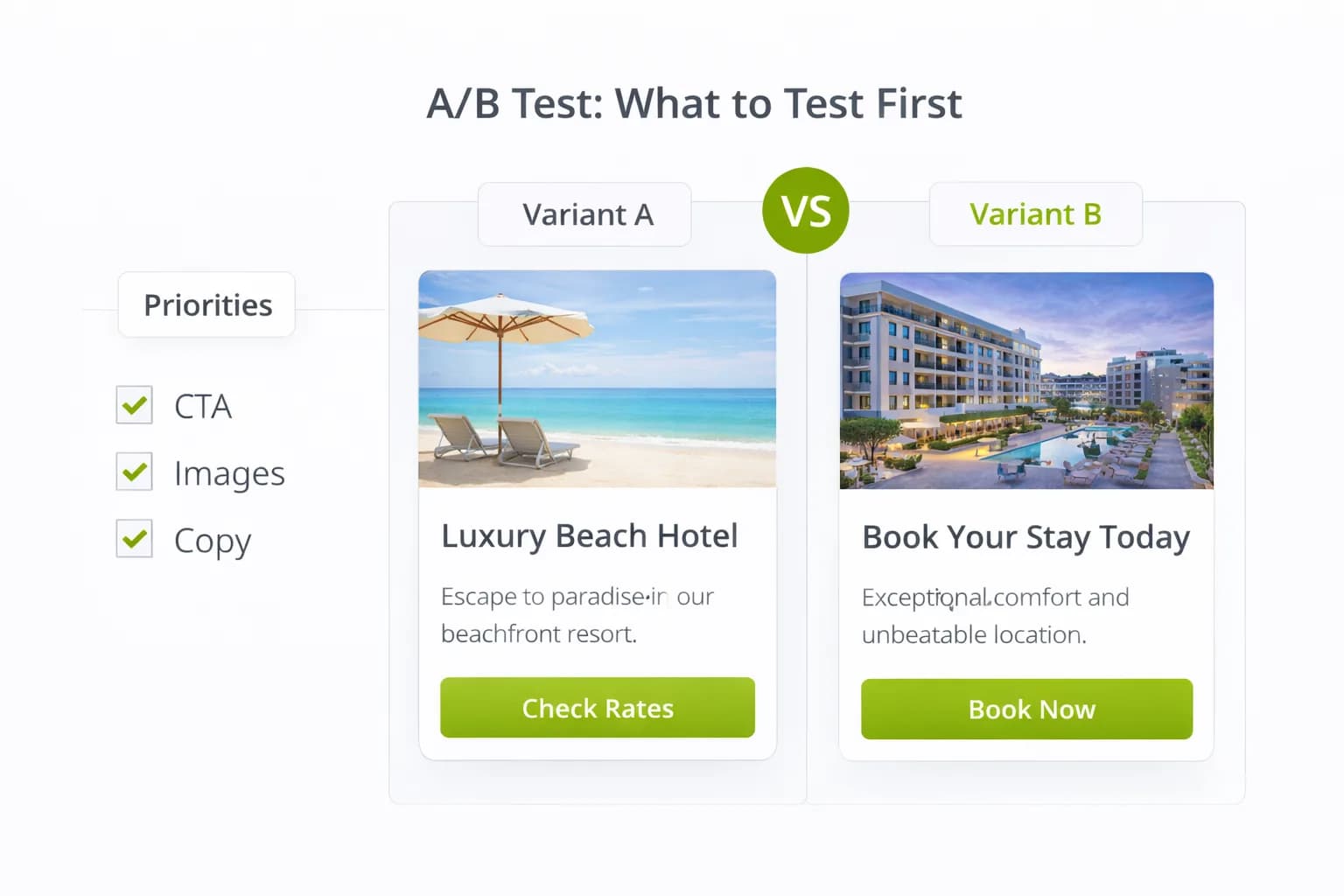
Your hero section is the most valuable real estate on your hotel website. It's what guests see first, and it sets expectations for their entire booking journey. Yet many hotels waste this space with slow sliders, vague messaging, and buried CTAs.
This guide covers the most common hero section mistakes and how to fix them.
Mistake 1: Auto-rotating sliders
The problem: Sliders are slow, distracting, and rarely seen past the first slide. They hurt Core Web Vitals (especially LCP) and dilute your message.
The fix: Use a single, high-impact static image or video background. One clear message beats five rotating ones.
Mistake 2: No clear value proposition
The problem: Generic headlines like "Welcome to [Hotel Name]" or "Your Perfect Stay" say nothing about what makes your property special.
The fix: Lead with what differentiates you. "Beachfront luxury with private balconies" beats "Welcome" every time.
Mistake 3: Hidden or weak CTAs
The problem: The booking button blends into the background, is too small, or uses weak copy like "Learn More."
The fix: Make CTAs prominent, high-contrast, and action-oriented. "Check Availability" or "Book Direct & Save" works better.
Mistake 4: Slow-loading images
The problem: Unoptimised hero images delay page load and hurt both UX and SEO.
The fix:
- Use WebP or AVIF formats.
- Implement responsive images with
srcset. - Consider lazy loading below-fold content (but not the hero itself).
See Core Web Vitals Guide for more.
Mistake 5: No booking widget
The problem: Guests have to scroll or click to find how to book.
The fix: Include a date picker or search widget in or immediately below the hero. Reduce friction to conversion.
Mistake 6: Too much text
The problem: Walls of text in the hero compete with visuals and overwhelm visitors.
The fix: Keep hero copy to a headline (5-10 words) and optional subhead. Save details for below the fold.
What a good hero includes
- Single compelling image — your property's best visual.
- Clear headline — what makes you unique.
- Prominent CTA — high-contrast, action-oriented.
- Booking widget — reduce clicks to conversion.
- Fast loading — optimised images, minimal scripts.
For broader UX guidance, see Reduce Bounce Rate and CRO 2026 Insights.
Summary
Your hero section should load fast, communicate your unique value, and make booking effortless. Audit your current hero against these mistakes and prioritise fixes based on impact.
Action Plan for Hotel Teams
If you want `Hotel Hero Section Mistakes That Kill Conversions` to produce measurable revenue impact, move from ideas to a fixed execution cadence. The biggest wins usually come when this work is treated as an operating system, not a one-off campaign. For most hotel teams, a practical cadence is to align weekly execution with monthly commercial review, then re-prioritise based on booking and margin impact.
30-60-90 day rollout
- Days 1-30: Establish baselines for traffic quality, conversion rate, booking value and channel mix. Document current performance by device and market, not only in aggregate.
- Days 31-60: Implement the highest-impact fixes from this guide and track movement weekly. Prioritise changes closest to booking intent first.
- Days 61-90: Consolidate winners, retire low-impact work, and scale what improves direct booking contribution or lowers paid acquisition pressure.
KPI framework for CRO
- Commercial KPIs: direct bookings, direct revenue share, net contribution after media/commission costs.
- Performance KPIs: conversion rate, engaged sessions, revenue per 1,000 sessions, assisted bookings.
- Quality KPIs: page speed, crawl/index health, content freshness, and UX friction in booking steps.
Governance checklist
- Create one owner for delivery and one owner for measurement so decisions are accountable.
- Record every release with date, hypothesis and expected impact to avoid attribution confusion.
- Review outcomes monthly and re-map next actions to revenue impact, not publishing volume.
- Keep this guide connected with related resources such as /resources/statistics, /resources/guides, and /case-studies so strategy and execution stay aligned.
Common failure points
Teams usually underperform when they run too many initiatives at once, measure vanity metrics instead of commercial outcomes, or fail to maintain a repeatable review cycle. A narrower focus with disciplined reporting almost always beats a larger but fragmented roadmap.

Kiril Ivanov
Специалист по дигитален маркетинг
Кирил Иванов е специалист по дигитален маркетинг с опит в управлението на локални, национални и международни кампании за широк спектър от бизнеси — от независими компании до водещи потребителски марки. Неговият професионален опит включва ръководене на проекти за автоматизация на рекламата за Michael Kors и работа по кампании за Canon, Dormeo, esure, DLG Group, Village Gym, Cameron House, Crerar Hotels, Cromlix Hotel, Harrison Fund и Advertising Standards Authority (ASA). Опитът му обхваща платено търсене (PPC), платени социални мрежи, автоматизация на рекламата, SEO, оптимизация на процента на конверсия (CRO) и цялостна дигитална стратегия в хотелиерството, ритейла, финансовите и професионалните услуги.
Виж профила на автора →Свързани ръководства за хотелски маркетинг
Продължете със свързани теми, за да изградите пълна стратегия.