Meta Ads for Hotels: Full-Funnel Guide
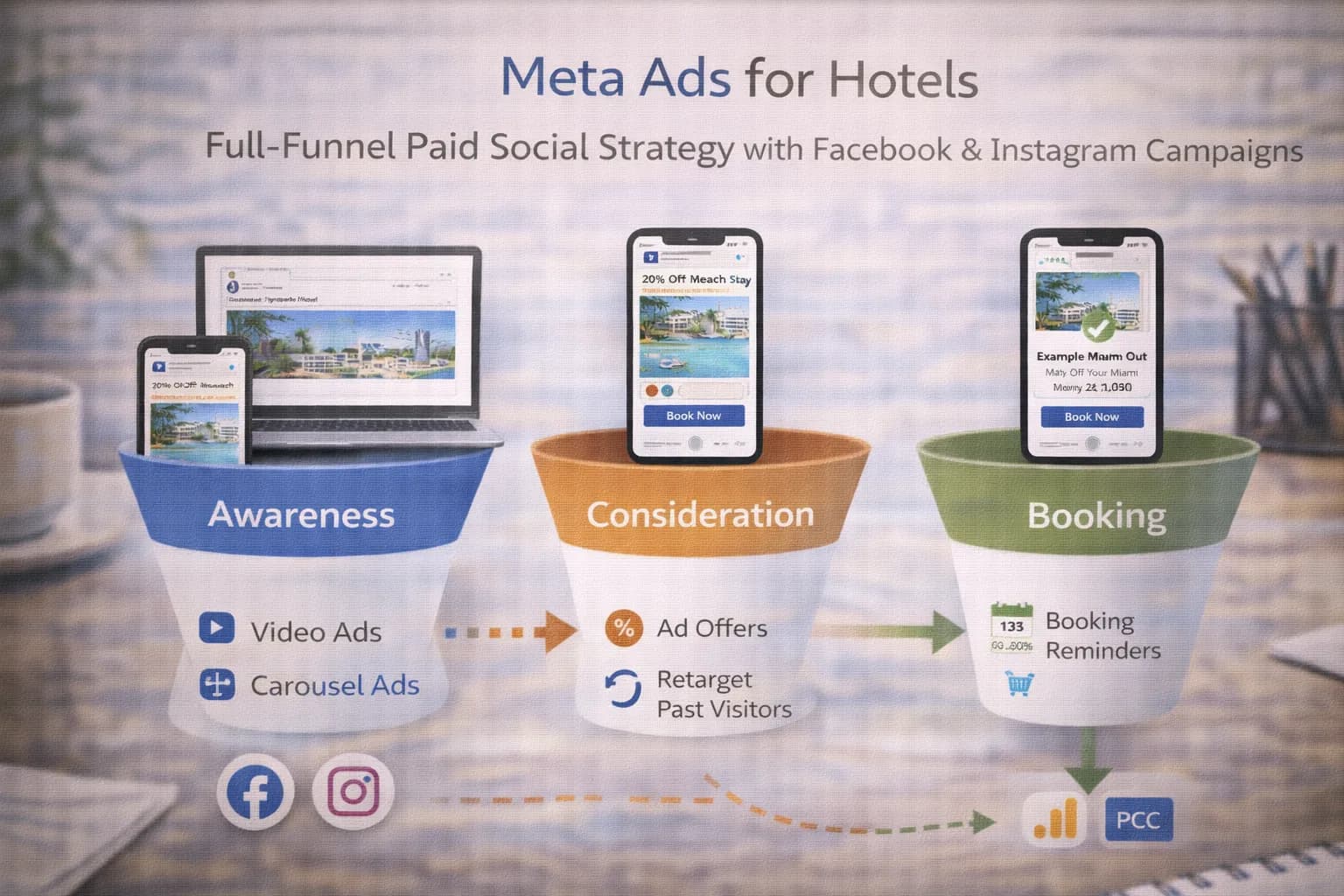
Meta (Facebook & Instagram) can do more than “likes”. With the right structure, it becomes a predictable engine for demand creation, mid-funnel nurturing, and last-mile conversion. This guide gives hotels a full-funnel plan—audiences, creatives, placements, budgets, and measurement—built for direct bookings, not vanity metrics.
1) Goals and guardrails (before you spend £1)
Decide what success looks like for each funnel stage:
- Awareness: reach in feeder markets, video views, engaged view-through rate.
- Consideration: landing page views, add-to-itinerary actions (save, share), message replies.
- Conversion: bookings, enquiry forms (MICE/spa), calls.
- Loyalty/retention: repeat bookings, upsells (spa, dining).
Guardrails:
- Only bid for conversion when your site + booking engine tracking is correct.
- Keep brand-safe creative and accurate claims.
- Use seasonal windows and stock availability to avoid promoting sold-out dates.
Helpful context: reinforce the site foundations first—see Hotel Landing Page Blueprint and Core Web Vitals for Hotels.
2) Account structure: map campaigns to the funnel
Create a simple, stable structure:
Campaign A — Awareness (Video/Photo)
- Objective: Awareness or Video views.
- Target: lookalikes from high-value guests + interest & behaviour stacks (travel, frequent travellers, luxury/spa/family).
- Placements: Advantage+ placements (exclude Audience Network if quality drops).
Campaign B — Consideration (Traffic/Engagement)
- Objective: Engagement or Traffic (Landing Page Views).
- Target: engagers from Campaign A + website visitors 30–90 days (exclude bookers).
- Creative: carousels with rooms, location highlights, amenities.
Campaign C — Conversion (Sales/Leads)
- Objective: Sales (Website) or Leads (for MICE/spa enquiries).
- Target: high-intent website audiences (availability searchers, checkout starters), CRM lists (loyalty), planners from video 75% viewers.
- Bidding: tCPA or tROAS (when revenue tracking is stable).
Campaign D — Retention/Upsell
- Objective: Sales or Engagement.
- Target: past guests (Customer Match) within 6–18 months.
- Creative: stay extensions, dining packages, spa deals.
Cross-reading: for channel mix, see Combining SEO and PPC for Maximum Direct Bookings.
3) Audiences that actually map to hotel intent
Build clean, layered audiences:
Website custom audiences
Checkout started(7–30 days) — exclude recent bookers.Dates selected / availability searched(7–30 days).Room detail viewers(30–60 days).Location hub readers(30–90 days).All site visitors(30–90 days) for gentle nurturing only.
Engagement audiences
- Video viewers (75%+) from Campaign A.
- Instagram profile engagers and post savers (30–90 days).
Customer Match (CRM)
- Past guests (permissioned).
- Newsletter/loyalty members.
- High-value guests (LTV tiered).
Lookalikes
- Seed from bookers, not all visitors. Test 1%, 2–3%, 5% sizes by market.
Exclude booked in last 90–180 days across all prospecting sets. Keep durations shorter in peak months.
4) Creatives: what to show at each stage
Meta is a creative-led platform. Plan assets like a menu:
Awareness
- 6–15 sec vertical videos (Reels/Stories) showing the feel: arrival, lobby, room reveal, breakfast, spa, views.
- Square carousels: 5–8 frames (Rooms • Spa • Dining • Neighbourhood • Offers).
- Copy: simple, sensory, location-anchored. CTA: “See rooms”, “Plan your stay”.
Consideration
- Carousels with room types and direct-only perks (parking, late checkout, breakfast credit where true).
- Short UGC-style clips (voiceover + captions).
- Copy: answer “Why this hotel?” + “Why book direct?”.
Conversion
- Offers with clear inclusions and date/lead-time hints.
- Deep links to availability or the specific room/offer (if your engine supports parameters).
- Copy: rate parity, flexible terms (if true), parking, proximity.
Retention/Upsell
- “Return & save” or “Add spa/dining” offers.
- Celebrate seasons and events (Christmas markets, festivals, summer).
Always include real photos/videos, short overlay text, and on-screen captions. Refresh monthly; rotate seasonals.
5) Placements and formats
- Start with Advantage+ placements and monitor breakdowns.
- Prioritise Reels/Stories for awareness; Feed and Reels for consideration; Feed (incl. IG Explore placements) for conversion.
- Exclude low-quality inventory if it drags ROAS (Audience Network).
- Use click-to-WhatsApp/Message only if you can reply within minutes.
6) Bidding and budgets (simple rules)
- Prospecting (A/B): maximise reach or conversions with a modest daily budget by market.
- Retargeting (C/D): start with tCPA; move to tROAS after stable revenue signals for 2–3 weeks.
- Keep retargeting budget proportionate to audience size (e.g., 20–40% of total).
- Use campaign budget optimisation (CBO) only when ad-set sizes are similar.
7) Landing pages and deep links
Send traffic to contextual destinations:
- Awareness → location hub or top property page with video hero.
- Consideration → room type or offers.
- Conversion → availability or checkout start (pre-filled if possible).
Ensure speed and mobile UX meet Core Web Vitals. Validate with our Website Speed Tool and see web.dev for what “good” looks like.
8) Measurement: prove value beyond likes
Track bookings, not reactions:
- GA4: e-commerce/booking events, cross-domain to the engine, channel-group mapping for Paid Social.
Useful docs: GA4 Conversions, Attribution, Explore. - Meta Ads Manager: use conversion lift tests where available; compare attribution windows (1-day click vs 7-day click).
- Holdouts: run geo splits (target Region A, suppress Region B) for 2–4 weeks to estimate incremental bookings.
- PMS/CRM: monitor direct share and booking lead time after Meta bursts.
Complement with the SEO ROI framework to keep finance on side.
9) Compliance and brand safety
- Honour consent mode and privacy settings.
- Avoid sensitive targeting; keep claims accurate.
- Ensure creative complies with platform advertising policies and your brand standards.
For local visibility, maintain your Google Business Profile—Meta demand often converts via search later.
10) 30-day rollout plan
Week 1 – Data & assets
- Fix tracking (GA4 + pixel), set events: view content, add to cart/checkout, purchase/book.
- Build audience stacks and exclusions.
- Produce 3 video cuts (6–15 sec) and 2 carousels.
Week 2 – Launch A (Awareness) & B (Consideration)
- 2–3 ad sets per campaign (lookalike vs interest).
- Daily checks: CPM, ThruPlays, LP views, bounce indicators.
Week 3 – Launch C (Conversion)
- Retarget: checkout + availability + room viewers; add CRM lists.
- Start tCPA; monitor cost/booking and ROAS.
Week 4 – Optimise & test
- Swap low-performing creatives.
- Add 1 geo holdout.
- Begin retention set (D) to upsell spa/dining.
11) Troubleshooting: quick fixes
- High CPMs → Refresh creatives; broaden interest stacks; try lookalikes from bookers.
- Low LP views → Switch to Landing Page Views objective; trim placement mix; improve page speed.
- Clicks, no bookings → Tighten audiences; move deeper in funnel; send to availability deep links; re-test offer clarity.
- Good ROAS, can’t scale → Add markets, expand lookalike size, increase creative variety; keep retargeting proportional.
Internal links to reinforce learning
- Service: Content & Creative Services
- Tool: Website Speed Tool (and optional SERP Tracker for cross-channel monitoring)
- Resource: Guides Library
- Sibling blogs (PPC cluster):
Hotel PPC Strategy • Hotel Remarketing Campaigns • YouTube Ads for Hotels - Cross-pillar: Hotel Content (creative quality) and Hotel Email Marketing (lifecycle synergy)
- Trust: About and Contact
Frequently Asked Questions
Conclusion
Meta Ads can be a dependable driver of hotel demand—if you respect the funnel. Build clean audiences, craft creative for each stage, link to the right pages, and prove incremental bookings with tests. Keep budgets controlled and rotate assets often; the result is steady direct revenue that doesn’t rely on OTAs.
Launch Your Meta Campaigns
Stephen Colenn
Специалист по платена реклама и дигитален маркетинг
Стивън Колен е специалист по дигитален маркетинг с над 10 години опит в платеното търсене (PPC), ремаркетинга и дигиталните стратегии. Притежава магистърска степен (MSc) по маркетинг от Единбургския университет.
Виж профила на автора →Свързани ръководства за хотелски маркетинг
Продължете със свързани теми, за да изградите пълна стратегия.