Rebranding a Hotel Without Losing SEO Equity
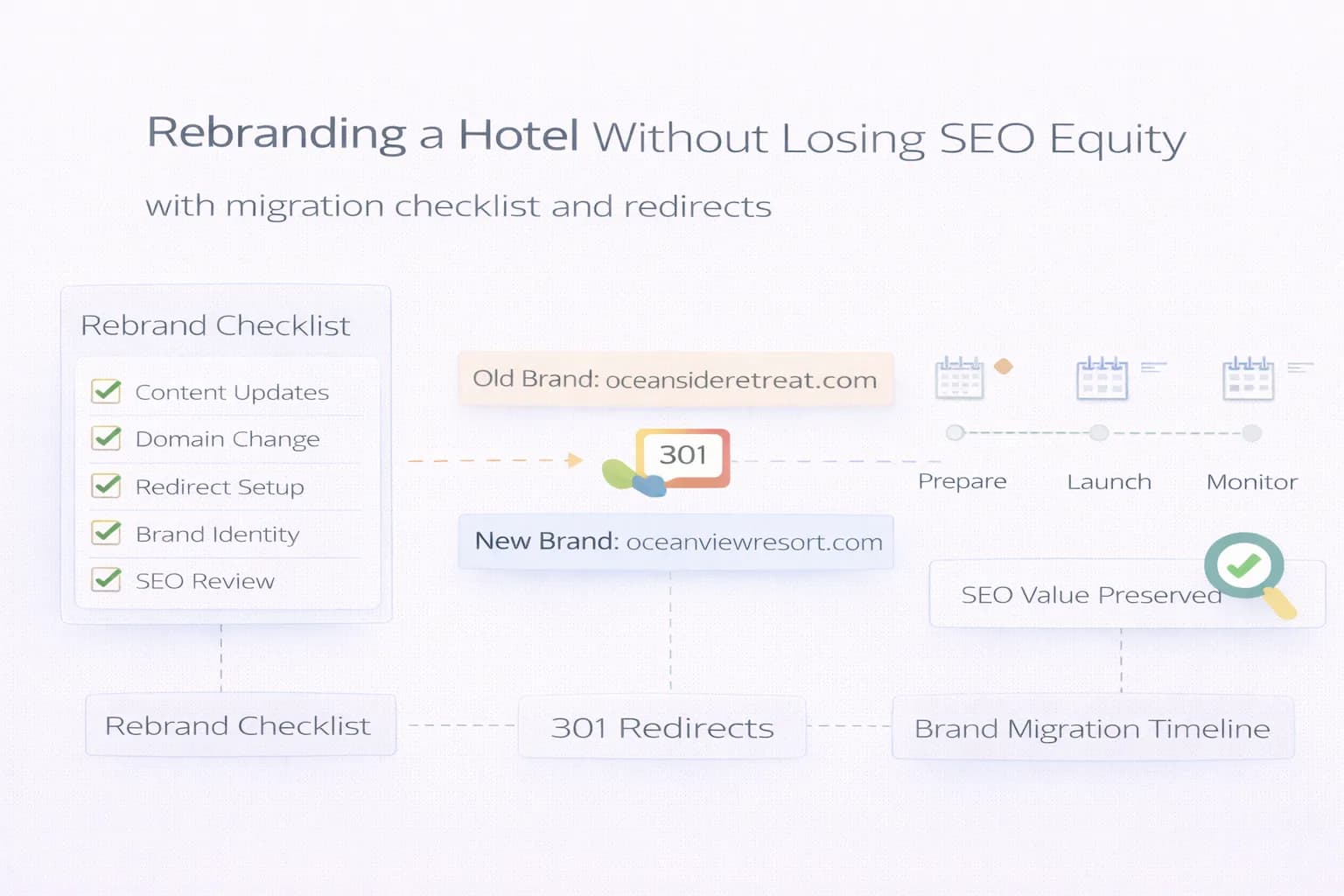
A hotel rebrand can refresh positioning, pricing power and guest perception—but it also risks lost rankings and broken funnels if you change names, domains or URLs without a plan.
This guide gives hotels a migration-safe rebrand: brand assets, IA, redirects, schema, GBP updates, analytics, and QA—so you keep your SEO equity and protect direct bookings.
1) Decide the scope of change (so risks are clear)
Rebrands vary. Confirm which of these apply and document them:
- Name change only (same domain).
- Domain change (brand rename or consolidation).
- URL structure change (new IA, room slugs, locale paths).
- Booking engine change (or subdomain switch).
- Design/system change (CMS, templates, components).
Higher scope = higher risk. Use Technical SEO to lead the migration and keep brand goals aligned with our Hotel SEO services.
2) Build the redirect map before design starts
Create a one-to-one redirect plan for every indexable URL.
- Crawl the old site with Crawlability and export the URL list.
- Map each old URL → new URL (same intent).
- Keep room/offer pages on stable slugs when possible.
- Avoid “many-to-one” redirects (they shed equity).
See Google’s guidance for site moves with URL changes and SEO site migrations.
3) Keep the same content intent (rename ≠ rewrite everything)
Searchers still want the same information:
- Room pages: occupancy, bed, bathroom, accessibility, cancellation terms—first screen.
- Offers: what’s included, dates, eligibility, mini-FAQ.
- Location/parking/breakfast guides: keep facts and structure; update brand mentions only.
- Keep hero media, headings and Key Facts blocks consistent with new brand voice.
For trust-first visual standards, see Visual Identity & UX and Brand That Converts.
4) IA that mirrors the old “shape”
Search engines follow patterns. Preserve the hub → spoke structure:
- Brand hub → property hubs → rooms, offers, location, parking, FAQ.
- Keep breadcrumbs and internal links.
- Use canonical URLs for variants (rate/offer filters).
Reference Hotel Information Architecture for the model.
5) Technical checklist (copy/paste)
- 301 redirects live at launch (no 302).
- Hreflang and canonicals updated to new paths.
- Robots.txt and sitemaps reflect new URLs.
- Schema (Organization, Hotel, FAQ, Breadcrumb, Offer/Price) updated with the new name and URLs.
- Page speed equal or better—validate with Website Speed and Core Web Vitals.
- Cross-domain tracking unchanged (site → engine → confirmation); see Cross-Domain Bookings.
6) Local SEO and citations (do this in week one)
- Update Google Business Profile (name, site URL, categories). Keep address/phone consistent (NAP). See GBP Help.
- Replace URLs and brand names on priority citations (chain/brand site, Tripadvisor, Booking.com/Expedia profiles, Apple Maps).
- Keep the same GBP (don’t create a new one) unless location legally changed.
Use our GBP Consistency tool to spot mismatches after launch.
7) Analytics & tagging (measure like-for-like)
- In GA4, maintain the same property and Measurement ID; update stream domain.
- Mark the day of rebrand with annotations. See GA4 conversions.
- Keep
purchaseas the primary conversion; confirm only one purchase fires. - Update Search Console (add new domain, verify, submit new sitemaps).
8) Pre-launch QA (72–24 hours before)
- Crawl staging and check: 200/301 status, canonicals, titles, headings, schema.
- Test top revenue pages on mobile for speed and CLS.
- Run booking flow end-to-end with DebugView (site → engine → confirmation).
- Check Open Graph (social shares) and emails (template links).
9) Launch-day runbook (hour-by-hour)
T–2h: Enable maintenance banner, back up DNS/TLS settings.
T–0: Deploy redirects + sitemaps; flush caches/CDN.
T+1h: Spot-check top 50 URLs; confirm 301s and canonical targets.
T+2h: Submit new sitemap(s) in Search Console; fetch & render the homepage and 5–10 key pages.
T+4h: Validate GA4 Realtime, DebugView, and booking tests.
T+24h: Check indexing coverage, self-referrals, and purchase de-duplication.
10) Post-launch monitoring (first 30 days)
Watch revenue-first metrics, not just rank:
- Revenue / 1k sessions by landing page type (Home, Rooms, Offers, Guides).
- Organic bookings vs prior comparable period.
- Search Console: coverage, crawl anomalies, query shifts.
- GBP: calls, direction requests, photo views.
- Brand vs non-brand split (expect brand fluctuations for 2–4 weeks).
Use SERP Tracker to monitor core terms and Indexed Pages to verify new URLs.
11) Comms plan (so guests and partners aren’t confused)
- Homepage banner and About section note the rename with dates.
- Email past guests (stay-friendly language; highlight direct benefits).
- Update rate parity notes with OTAs; align imagery and name across channels.
- Launch PR and local citations updates in week one.
12) Recovery playbook (if something drops)
- Rooms/Offers tanked → check if their redirects go to exact equivalents; fix weak many-to-one mappings.
- Self-referrals in GA4 → confirm cross-domain/linker and unwanted referrals settings.
- Coverage errors → resubmit sitemaps; fix blocked resources/robots.
- Slow LCP after redesign → compress hero images, remove carousels, defer heavy JS.
See Google’s docs for site moves and troubleshooting:
Site moves • Migration fundamentals
13) How to measure success (what to report)
Tie the rebrand to outcomes, not just rankings:
- Direct bookings & revenue/1k sessions stable or up by week 4.
- Index coverage stabilised; no orphan top pages.
- Brand query CTR improved (new titles/meta aligned with new name).
- GBP engagement steady or up (calls, directions).
- OTA vs Direct share moving in favour of Direct.
Build the rollout and scoreboard in Resources and align with the ROI approach in Measuring the ROI of Hotel SEO.
FAQ
Frequently Asked Questions
Conclusion
Rebrands don’t have to cost you traffic or bookings. Keep the same intent, map every URL, ship 301s at launch, update schema/GBP, and watch revenue-first metrics in GA4. With a clean runbook and the right tools, you can refresh the brand without losing SEO equity.
Ship your rebrand without losing rankings
Kiril Ivanov
Специалист по дигитален маркетинг
Кирил Иванов е специалист по дигитален маркетинг с опит в управлението на локални, национални и международни кампании за широк спектър от бизнеси — от независими компании до водещи потребителски марки. Неговият професионален опит включва ръководене на проекти за автоматизация на рекламата за Michael Kors и работа по кампании за Canon, Dormeo, esure, DLG Group, Village Gym, Cameron House, Crerar Hotels, Cromlix Hotel, Harrison Fund и Advertising Standards Authority (ASA). Опитът му обхваща платено търсене (PPC), платени социални мрежи, автоматизация на рекламата, SEO, оптимизация на процента на конверсия (CRO) и цялостна дигитална стратегия в хотелиерството, ритейла, финансовите и професионалните услуги.
Виж профила на автора →Свързани ръководства за хотелски маркетинг
Продължете със свързани теми, за да изградите пълна стратегия.