Automating Guest Feedback Collection
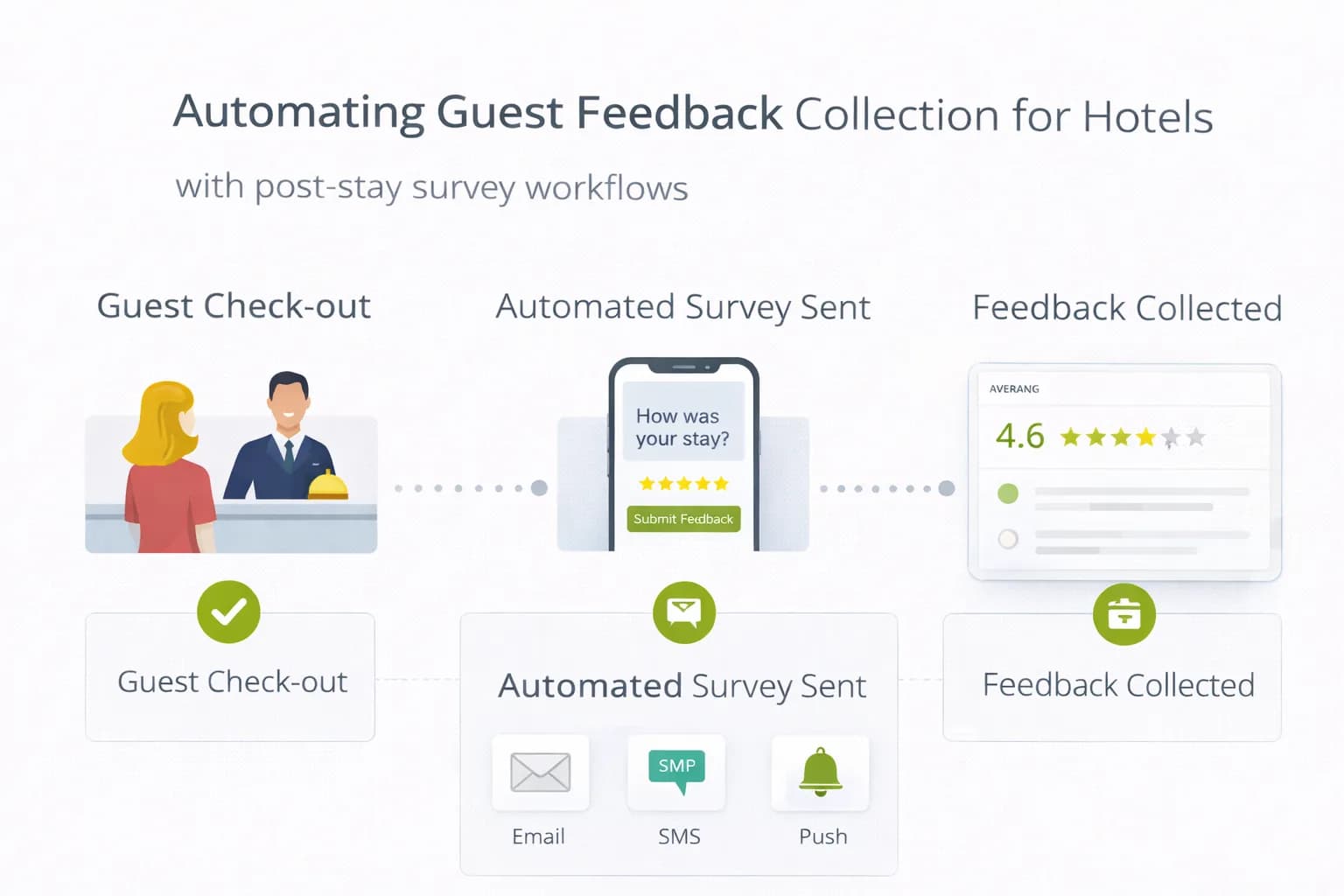
Manual surveys and ad-hoc emails miss critical moments. Hotels need a lightweight, automated feedback loop that spots issues during the stay and turns good stays into policy-safe Google reviews after checkout.
This guide shows you how to design a privacy-safe automation stack—timings, templates, routing, and measurement—so feedback actually improves ratings, CTR and bookings.
1) What a good hotel feedback system does (in plain terms)
- Catches problems while guests are still with you.
- Routes issues to the right team with ownership and a due date.
- Asks for public reviews only after service recovery, without incentives or gating.
- Measures outcomes in GA4 and your PMS/CRM, not just survey scores.
Pair this with your reputation playbooks: Increase Google Ratings and Handle Negative Reviews Professionally.
2) Compliance guardrails (keep it safe and simple)
- No incentives and no gating (don’t filter who can reach Google). See Google’s rules:
About reviews on Google and
Maps user-contributed content policy. - Lawful basis: for service messages and post-stay surveys, many hotels use legitimate interests with a clear opt-out. Read the UK ICO overview:
ICO: Legitimate interests. - Marketing vs service: if you add promotions, you’re in PECR/e-mail marketing territory—apply consent/soft-opt-in correctly.
ICO: PECR guidance. - Analytics: don’t send PII to GA4; track events/ids only.
GA4 collection guide.
3) The 3-stage feedback automation (copy this)
A) On-stay “Is everything OK?” message (no review ask)
- Trigger on night 1 for 2+ night stays at 18:00–19:30 local time.
- Channels: SMS/WhatsApp or email.
- CTA: a 1-question form (“Is everything OK?” Yes/No + comment).
- If No → auto-create a ticket for Duty Manager/Housekeeping/Maintenance.
B) Checkout-day satisfaction pulse
- Trigger 2 hours after checkout.
- 3–4 quick questions (staff, cleanliness, breakfast, room).
- If Positive → queue post-stay review ask for +24–48h.
- If Negative → open a case; suppress any review ask until resolved.
C) Post-stay Google review ask (24–48h later)
- Short, human copy; include your GBP review link.
- One reminder 4–6 days later to non-responders.
- Never incentivise. Keep reading level B1–B2.
Create/share review links from GBP: Share your profile & get reviews.
4) Routing logic that actually fixes things
- Themes: parking, breakfast, cleanliness, noise/temperature, maintenance, accessibility.
- Owners: Front Desk (general), Housekeeping, F&B, Maintenance, Duty Manager.
- SLA: on-stay issues acknowledged in 30 minutes, resolved within 12 hours.
- Escalation: unresolved cases ping Duty Manager and GM at +12h; add a make-right budget note.
- Close the loop: once resolved, send a short “Resolved?” message—no review ask until guest confirms they’re satisfied.
Document the workflow in your operations runbook and mirror the themes as on-site Key Facts and FAQ micro-cards (parking times, breakfast window, accessibility). See Trust-First UX and FAQ Content for Hotels.
5) Templates you can paste (edit names and contact)
On-stay (evening of night 1)
Hi [First name], it’s the team at [Hotel]. Is everything OK with your room?
[Yes, all good] / [No, there’s an issue] (tell us briefly)
Checkout-day pulse
Thank you for staying at [Hotel]. Quick feedback helps us improve.
How was your stay overall? ⭐⭐⭐⭐⭐ (tap to answer)
Optional comment:
Post-stay Google review ask
Thanks again for choosing [Hotel]. If you have a minute, would you share an honest review on Google? It helps other travellers and keeps us improving.
Leave a Google review → [link]
6) Where this lives on your website (and why it helps SEO)
- Add a Feedback link in the footer and a “Tell us how we did” card on the contact page; route to a simple form.
- After submission, the thank-you page can offer the Google review link (no gating—anyone can still reach it).
- Publish Key Facts on Rooms/Home to prevent friction; this also supports AEO (Answer Engine Optimisation). See Hotel SEO services and Structuring Content for AI Assistants.
7) Tooling stack (lean and fast)
- Feedback capture & routing: Feedback System (tags, owners, SLAs).
- Analytics & goals: GA4 with cross-domain purchase tracking (site → engine → confirmation). See Cross-Domain Bookings.
- Dashboards: Analytics Dashboard for revenue/1k sessions and reputation KPIs.
- Local presence: GBP Consistency to keep NAP and attributes aligned.
8) Content changes that cut complaints (and future negatives)
Turn frequent issues into visible answers:
- Parking: cost, height, EV bays, night access, map.
- Breakfast: hours, busy times, dietary options.
- Noise/temperature: quiet rooms, fans/duvets on request.
- Accessibility: lift sizes, step-free routes, bathroom rails, photos.
These edits reduce bounce and increase trust; see Reputation → Local SEO & CTR and Reduce Bounce Rate.
9) Measurement: tie feedback to money (not just stars)
GA4 (cross-domain on)
- Primary conversion =
purchase. - Create segments for Stayed & Gave Feedback, Stayed & Reviewed, Stayed & Complained.
- Scoreboard by landing page: revenue/1k sessions, purchase rate, refund rate.
- Event hooks (non-PII):
feedback_ok,feedback_issue,review_link_click.
Helpful docs: GA4 conversions.
Google Business Profile
- New reviews/month, average rating, owner response cadence, profile actions (calls, website clicks, directions).
GBP Help.
PMS/CRM
- Direct vs OTA share, repeat-stay rate for guests with resolved issues, complaint themes per 100 stays.
Report these alongside review volume and response quality improvements.
10) 30-day implementation plan
Week 1 — Design the flow
- Pick triggers (night 1 on-stay, checkout-day pulse, +24–48h review ask).
- Draft templates; set SLAs and owners; configure Feedback System.
Week 2 — Build & test
- Load forms, tags, and routing; test on 5–10 rooms.
- Add Feedback footer link + thank-you page with review link.
- Check GA4 events fire without PII.
Week 3 — Go live
- Enable automation on all stays; train front-desk for same-day fixes.
- Suppress review asks for open complaint cases.
Week 4 — Measure & iterate
- Compare complaints/100 stays, new reviews, average rating, GBP actions, and direct bookings.
- Ship content fixes (parking/breakfast/accessibility) based on themes.
11) Common pitfalls (and safer alternatives)
- Asking for reviews during a complaint thread → defer until resolved.
- Incentivising reviews → policy risk; improve timing and ease instead.
- Sending PII to GA4 → never; track anonymous events only.
- Heavy tools that slow pages → keep scripts tiny, load after consent, validate with Website Speed.
FAQ
Frequently Asked Questions
Conclusion
Automated feedback isn’t about more forms—it’s about timing and routing. Ask on-stay to fix problems fast, pulse after checkout, and request Google reviews only once issues are closed. Keep it policy-safe, publish Key Facts to prevent repeats, and measure everything against purchases and direct share. That’s how feedback turns into ratings, visibility and bookings.
Implement a feedback loop that lifts bookings
Kiril Ivanov
Специалист по дигитален маркетинг
Кирил Иванов е специалист по дигитален маркетинг с опит в управлението на локални, национални и международни кампании за широк спектър от бизнеси — от независими компании до водещи потребителски марки. Неговият професионален опит включва ръководене на проекти за автоматизация на рекламата за Michael Kors и работа по кампании за Canon, Dormeo, esure, DLG Group, Village Gym, Cameron House, Crerar Hotels, Cromlix Hotel, Harrison Fund и Advertising Standards Authority (ASA). Опитът му обхваща платено търсене (PPC), платени социални мрежи, автоматизация на рекламата, SEO, оптимизация на процента на конверсия (CRO) и цялостна дигитална стратегия в хотелиерството, ритейла, финансовите и професионалните услуги.
Виж профила на автора →Свързани ръководства за хотелски маркетинг
Продължете със свързани теми, за да изградите пълна стратегия.