Handling Negative Hotel Reviews Professionally
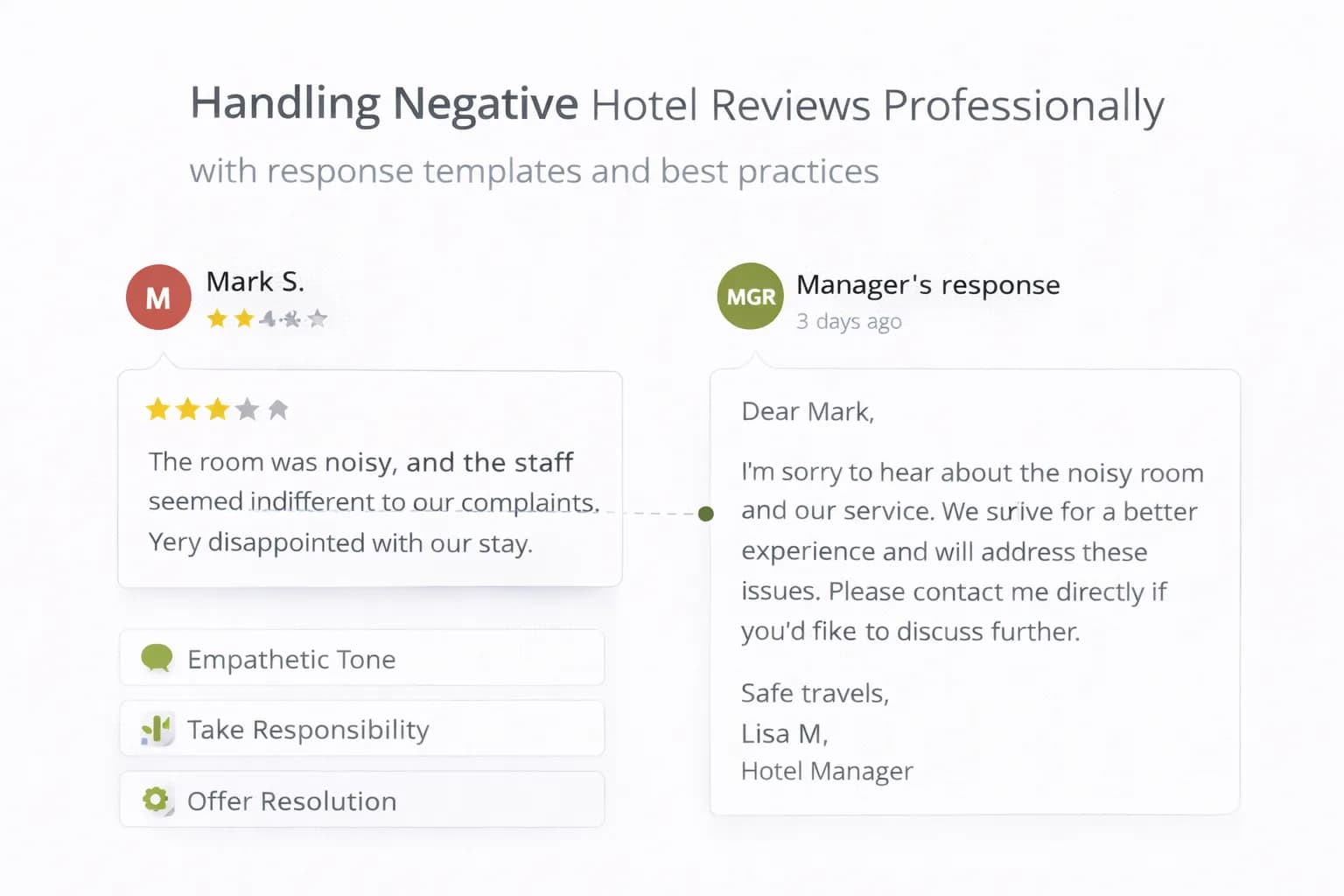
Negative reviews happen—even in great hotels. What matters is how you respond and what you fix. A calm, policy-aware reply and a quick internal action can turn a critical post into public proof of care.
This playbook gives hotels a step-by-step process: triage, response templates, when to request removal, on-stay recovery, and measurement that links reputation work to bookings.
1) First principles (what great responses share)
- Fast: reply within 72 hours (weekends included) with a named role.
- Specific: acknowledge the exact issue; avoid generic “We value feedback.”
- Action-oriented: state what changed or how you’ll make it right.
- Private details moved to DM: invite the guest to email the team (no booking info in public).
- Tone: plain B1–B2 English; never defensive or sarcastic.
Google’s official guidance on replying and policies for user content are your north star:
Reply to reviews (GBP Help) • Maps user-contributed content policy.
In the UK, keep claims fair and compliant: CMA advice on online reviews.
2) Triage: classify before you reply
Use a simple three-bucket system and route accordingly.
- A. Service failure (true experience): cleanliness, noise, staff, breakfast, parking clarity. → Public apology + fix + invite to DM.
- B. Policy or misunderstanding: deposits, check-in times, parking height limits. → Clarify clearly + link to policy, consider goodwill gesture if unclear on site.
- C. Policy-violating content: spam, off-topic, hate speech, personal info, review of the wrong place. → Flag for removal and add a neutral note if appropriate.
Create a shared sheet or ticket in your CRM; close the loop with a task owner and due date. For knowledge-base clarity, surface the same answers in on-site Key Facts and FAQ micro-cards (see trust-first UX and FAQ Content for Hotels).
3) Response templates (copy, then tailor)
Use these as a base; keep replies short (3–5 sentences).
A) Service failure (cleanliness/noise)
“Hi [Name], I’m [Role] at [Hotel]. I’m sorry for the issues you experienced with [issue]. We’ve [action taken—e.g., deep-cleaned the room type and updated the checklist], and our team can arrange [quiet-side room/amenity] on your next stay. If you’re open to it, please email [inbox] with your dates so we can follow up directly.”
B) Policy clarity (parking height, check-in)
“Hi [Name], thanks for the feedback. Our [policy] is [clear, factual statement], and we’ve now added this to our Key Facts on the website and pre-stay email to avoid surprises. If your plans bring you back, email [inbox]—we’ll help pick a room/arrival time that fits.”
C) Staff compliment + minor gripe
“Hi [Name], appreciate the kind words about [staff/area]. We’ve noted your point about [minor issue] and adjusted [process]. We hope to welcome you again—[direct benefit, e.g., flexible direct rate] is available on our site.”
D) Escalated complaint (multiple issues)
“Hi [Name], I’m [Role]. I’m sorry your stay fell short in [areas]. I’ve logged this with our [department lead] and we’re addressing [bullet fix]. Could you email [inbox] with your dates so we can review fully and propose a make-right?”
Keep PII out of replies. If the review contains personal info or violates policy, use Google’s tools to report it: Request review removal.
4) When and how to request removal (policy grounds only)
Ask for removal only when content violates policy—never because it’s negative.
Valid grounds examples:
- Off-topic / wrong hotel, spam or fake content.
- Hate speech, harassment, or personal information.
- Prohibited content (illegal, explicit).
Steps:
- Collect evidence (screens, booking logs if relevant).
- Flag in GBP and submit a formal request: Remove reviews from your Business Profile.
- If unresolved and clearly abusive/defamatory, consider legal advice—keep tone neutral publicly.
5) Turn common negatives into “Key Facts” and fixes
Most poor reviews repeat the same themes. Solve once, show publicly.
- Parking: add height/cost/EV bays and directions to Key Facts near CTAs; link from your parking page.
- Breakfast: show hours, queue times at peak, dietary options; keep items stocked.
- Noise: describe quiet rooms/floors; offer white-noise devices or fans on request.
- Temperature: provide extra duvets/fans; show thermostat tips.
- Accessibility: publish lift sizes, step-free routes, bathroom details; include photos.
Update pages and re-validate with Mobile-Friendly. For entity clarity in assistants, see Entity Optimisation for Hotels.
6) On-stay recovery (reduce future negatives)
- Daily manager rounds in public areas at peak times (breakfast/front desk).
- Same-day “Everything OK?” message for 2+ night stays (no review ask).
- Empower staff with a small goodwill budget to fix issues at first contact.
- Record fixes in your CRM so post-stay comms recognise the resolution (no tone-deaf requests).
If you automate feedback, keep it compliant and guest-friendly: Automating Guest Feedback Collection.
7) Governance: who replies, how fast, with what voice
- Owner: GM or designated duty manager; train a backup for weekends.
- SLA: respond within 72 hours; same day for 1–2★.
- Voice: factual, warm, specific; no clichés.
- Library: maintain a shared set of 10 adjustable replies + a log of learnings.
- Escalation: clearly define when to move to DM or involve legal/HR.
8) Local SEO impact: why this helps rankings and CTR
Fresh replies and visible fixes support map-pack trust. Consistent info between site and GBP prevents mismatches that cause friction (and more negatives). Keep NAP and attributes aligned using our GBP Consistency tool and learn the broader local play in How to Increase Google Ratings and How Reputation Affects Local SEO & CTR.
Official references worth bookmarking:
Google Business Profile Help • Google Search Essentials
9) Measurement: prove the process works
Tie reputation work to bookings, not only stars.
GBP (primary)
- New reviews/month, average rating, rating distribution.
- Profile actions: calls, website clicks, direction requests.
GA4 (with cross-domain on)
- Purchases attributed from local/GBP landings (see Cross-Domain Bookings).
- Revenue/1k sessions from landing pages improved by reputation-driven content fixes.
- Event to track clicks from review widgets on site (non-PII).
PMS/CRM
- Direct vs OTA share trend after response cadence improves.
- Repeat-stay rate for guests who complained and received a make-right.
Roll these into your Analytics Dashboard and monitor sentiment via GBP Consistency.
10) 14-day rapid response reset (copy this)
Days 1–3 — Audit & assign
- Export 90 days of reviews; tag by theme (parking, breakfast, room).
- Assign an owner; set 72h SLA; load templates into your library.
Days 4–6 — Publish fixes
- Update Key Facts on Rooms/Home; add micro-FAQs where confusion drives complaints.
- Align GBP attributes/photos; add parking/breakfast/accessibility images.
Days 7–10 — Reply & recover
- Respond to all open reviews; DM escalations.
- Introduce same-day “Everything OK?” for 2+ night stays.
Days 11–14 — Measure & iterate
- Track new reviews, rating average, GBP actions, purchases from local.
- Document learning and refresh templates.
FAQ
Frequently Asked Questions
Conclusion
Negative reviews are inevitable; professional replies and visible fixes are optional—and powerful. Classify the issue, respond clearly within 72 hours, request removal only on policy grounds, and publish the content and process changes that prevent repeats. Measure results in GBP, GA4 and PMS so your reputation work translates into map visibility, higher CTR, and more direct bookings.
Build a calm, compliant review response machine
Solene Capaldi
Специалист по гостоприемство и преживяване на гостите
Солен Капалди е специалист по хотелски операции и клиентско преживяване с над 17 години опит във Франция и Шотландия. Фокусира се върху комуникацията с гостите, управлението на отзиви и стандартите за обслужване.
Виж профила на автора →Свързани ръководства за хотелски маркетинг
Продължете със свързани теми, за да изградите пълна стратегия.