Structuring Hotel Content for AI Assistants
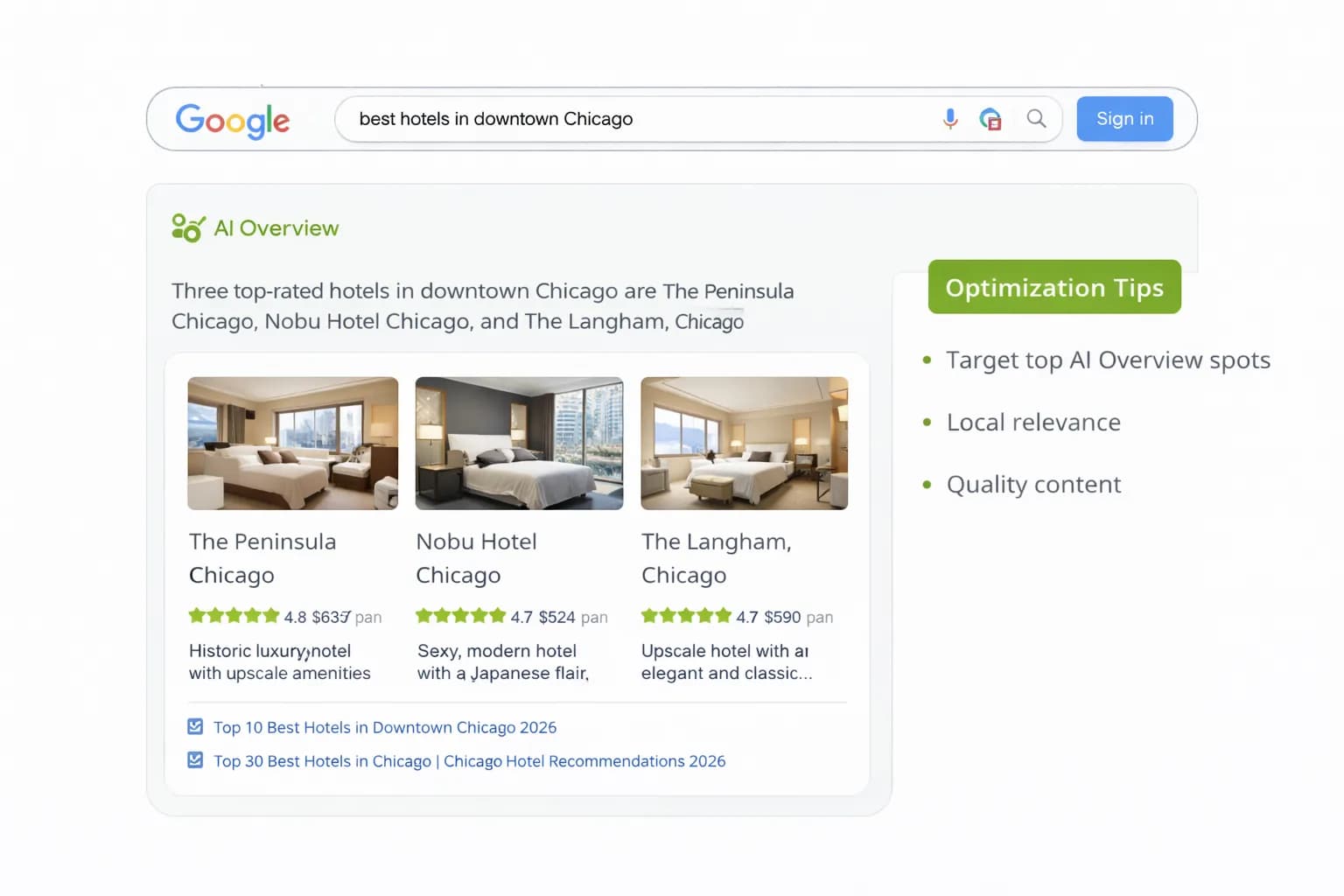
Search is changing fast, but the principle is simple: assistants can only reuse clear, consistent facts. Hotels that structure content around entities, tasks, and FAQs already see better visibility in AI answers, map packs, and rich results—and more direct bookings.
This playbook shows how to make your hotel site assistant-ready with page patterns, schema, editorial rules, and measurement.
1) What “assistant-ready” means (and what it’s not)
Assistant-ready content:
- States facts in plain English (times, fees, limits) near the top of the page.
- Maps clearly to entities (hotel, rooms, parking, spa, venues).
- Uses predictable sections and short FAQs that answer discrete tasks.
- Is fast on mobile and indexable.
It’s not:
- Bloated pages with image-only info or vague marketing copy.
- Ten duplicate FAQs scattered across the site.
- Unreliable details that contradict your Google Business Profile (GBP).
See Google Search Essentials and structured data guidance for fundamentals.
2) The assistant-ready page pattern (copy this)
Use this blueprint for property, amenity, and guide pages. Keep paragraphs ≤3 sentences.
-
Standfirst / key facts (bullet list)
- Check-in/out (with timezone), parking (spaces, height, EV type), breakfast times, accessibility highlights, contact route.
-
Primary action (CTA)
- Availability widget or relevant booking action above the fold.
-
Who this is for
- Couples/families/business; when it’s best (season, days).
-
Details module
- Sections for location (walking times), policies (cancel/change), inclusions/exclusions.
-
Short FAQ (3–5 Qs)
- Each answer: 1-sentence fact → 1 supporting line → 1 action link.
-
Nearby / related entities
- “5 places within 15 minutes’ walk” with official names + distances.
-
Proof
- Map, review snippet, awards, accessibility logos.
Keep the page lightweight; validate Core Web Vitals with web.dev and run your Website Speed and Mobile-Friendly checks after publishing.
3) Entities first: design your information architecture
Give each key entity one authoritative page and connect them:
- Brand → Property → Amenity (spa/parking/restaurant) → Offer → Venue/Location guide.
- Use descriptive anchors, not “click here”.
- Validate crawl/index paths with Crawlability and Indexed Pages.
For deeper theory, see Entity Optimisation for Hotels and the SEO services.
4) Schema: minimum viable markup for hotels
Use JSON-LD that matches visible content (no hidden claims):
- Organization on brand/about with
sameAslinks. - Hotel/LodgingBusiness on property pages (NAP, geo, amenities, check-in/out).
- Restaurant/Spa/ParkingFacility where relevant (hours, fees, accessibility).
- Offer/AggregateOffer on packages/rates pages when supported.
- FAQPage only where real Q&As exist.
- BreadcrumbList sitewide.
Docs worth bookmarking:
- schema.org/Hotel and LodgingBusiness
- GBP Help for categories/attributes
After publishing, sanity-check with AEO/GEO.
5) Write facts the way assistants read them
Place these near the top in short bullets or sentences:
- Parking: on-site/nearby, overnight fee, height limit, EV connector type/count.
- Family rooms: max occupancy, cot/sofa-bed policy, connecting availability.
- Accessibility: step-free entrance, lift size, accessible bathrooms, hearing loop.
- Breakfast: times, options, dietary notes.
- Transport: walking times to station/stadium; last trains (link official source).
- Direct benefits: flexible terms, parking, breakfast credit, upgrade waitlist.
These become FAQ answers and ad extensions; keep wording consistent across site and GBP.
6) Build assistant-ready location & venue guides
Your location hub should help assistants answer: “Where should I stay for X?” Use the model from Creating Location Guides That Support SEO & AEO and include:
- Neighbourhoods explained with who it suits.
- Two mini itineraries (48h couples / family).
- Stadium/event modules (gates, bag policy, last trains, family tips).
- Accessibility notes with links to official pages.
7) Governance: stop drift and duplication
Assistant-readiness fails when details drift.
- Single owner for property facts (marketing/revenue) and a monthly fact check loop with Ops.
- One canonical FAQ hub; page-level micro-FAQs reference it.
- Change log on each entity page (“Updated: 19 Jan 2026”).
- Sync critical fields with GBP (hours, amenities, categories).
- Reuse snippets/components so times/fees update everywhere at once.
8) Distribution: email & PPC use the same facts
Pull the same fact blocks into:
- Pre-Stay and On-Stay emails (parking, breakfast, spa slots). See Automation Essentials.
- PPC sitelinks/callouts (parking, flexible terms, breakfast times). Align with Hotel PPC services.
- Newsletters with city guides using newsletter content ideas.
9) Measure impact (Search Console, GA4, GBP)
Proof beats hope. Wire measurement before roll-out.
Search Console
- Track URL-level impressions/clicks for entity and guide pages; annotate updates.
- Watch for rich results eligibility on pages with FAQPage/Breadcrumb markup.
- Use the Links report to see who cites your guides.
GA4 (cross-domain with booking engine)
- Mark bookings and vouchers as key events (GA4 conversions).
- Report revenue/1k sessions from entity/guide entrances.
- Track availability widget views and time to first interaction.
Brand & local
- Use SERP Tracker to monitor brand search lift after publishing big guides.
- Check GBP insights (calls, website clicks, direction requests) after updates.
10) 21-day assistant-ready sprint (repeatable)
Week 1 — Inventory & gaps
- Audit property, amenity, parking, breakfast, and two top venues.
- List missing facts (fees, times, accessibility) and decide canonical URLs.
Week 2 — Build & mark up
- Update the 5 pages with the assistant-ready pattern and JSON-LD.
- Add a single FAQ hub and 2 micro-FAQ modules (rooms, parking).
- Validate speed/mobile with Website Speed and Mobile-Friendly.
Week 3 — Wire measurement & distribute
- Configure GA4 events; annotate in Search Console.
- Repurpose facts into pre-stay email and PPC sitelinks.
- Review results; schedule the next five pages.
FAQ
Frequently Asked Questions
Conclusion
Assistant-ready content turns your site into a trusted source of facts: clear entities, consistent details, tight FAQs, and fast pages. Structure once, govern it monthly, and measure with GA4 and Search Console. The payoff is better assistant answers, richer results, map visibility—and more direct bookings.
Ship assistant-ready content this quarter
Kiril Ivanov
Специалист по дигитален маркетинг
Кирил Иванов е специалист по дигитален маркетинг с опит в управлението на локални, национални и международни кампании за широк спектър от бизнеси — от независими компании до водещи потребителски марки. Неговият професионален опит включва ръководене на проекти за автоматизация на рекламата за Michael Kors и работа по кампании за Canon, Dormeo, esure, DLG Group, Village Gym, Cameron House, Crerar Hotels, Cromlix Hotel, Harrison Fund и Advertising Standards Authority (ASA). Опитът му обхваща платено търсене (PPC), платени социални мрежи, автоматизация на рекламата, SEO, оптимизация на процента на конверсия (CRO) и цялостна дигитална стратегия в хотелиерството, ритейла, финансовите и професионалните услуги.
Виж профила на автора →Свързани ръководства за хотелски маркетинг
Продължете със свързани теми, за да изградите пълна стратегия.