Reviews as a Ranking Signal for Hotels: What the Data Shows
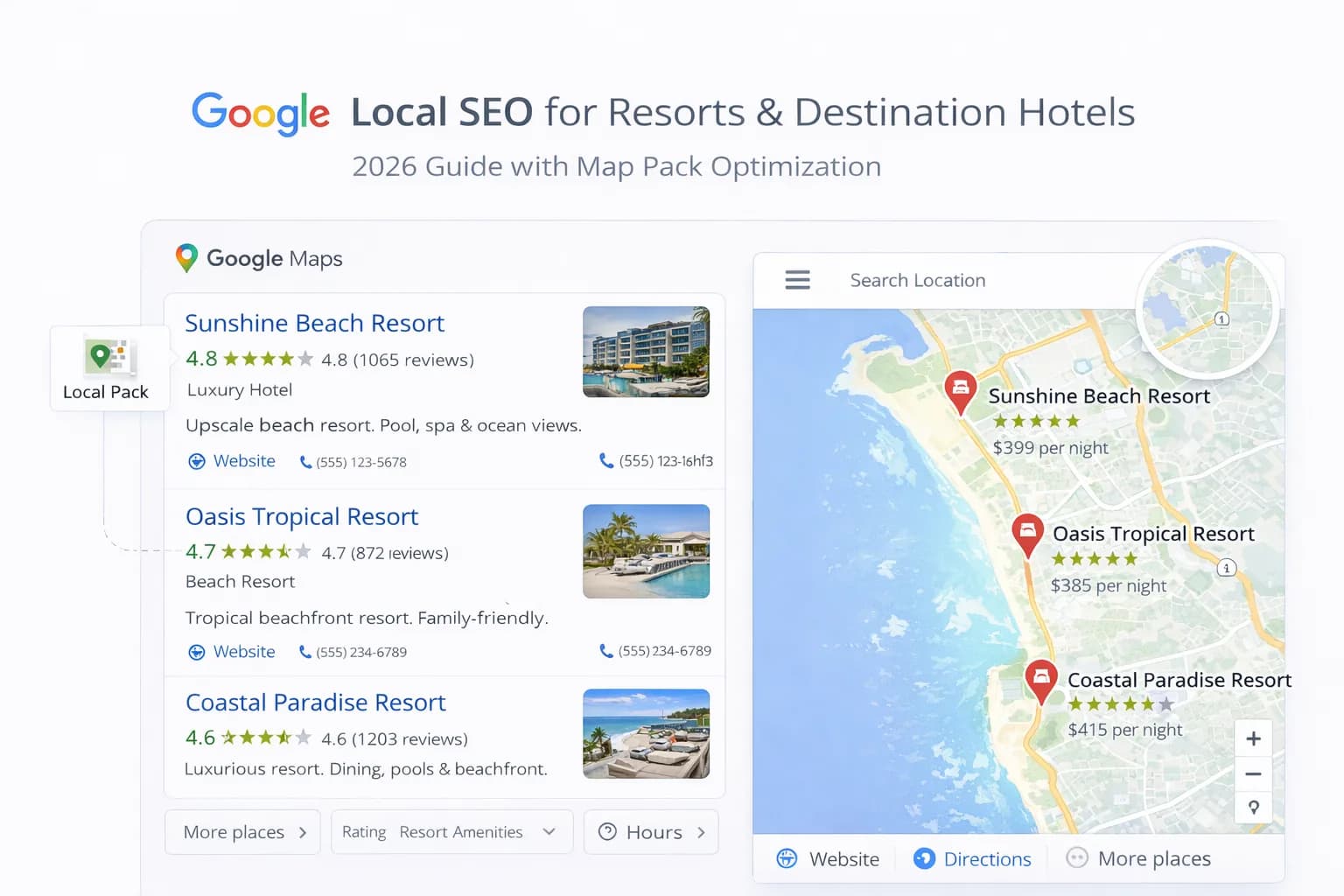
Google reviews are more than social proof — they're a confirmed ranking factor for local search. For hotels competing in the map pack and local results, understanding how reviews impact rankings is essential.
This guide covers what we know about reviews as a ranking signal and what hotels should prioritise.
Are reviews really a ranking factor?
Yes. Google has confirmed that reviews impact local rankings. Their documentation states:
"Google review count and review score factor into local search ranking. More reviews and positive ratings can improve your business' local ranking."
Multiple industry studies correlate review metrics with map pack rankings.
Which review factors matter?
Review quantity
More reviews signal popularity and trustworthiness. Hotels with 500 reviews typically outrank those with 50 (all else being equal).
Review rating
Higher average ratings correlate with better rankings. A 4.5-star hotel generally outranks a 3.5-star competitor.
Review recency
Recent reviews matter more than old ones. A steady flow of new reviews signals ongoing relevance.
Review velocity
The rate at which you acquire reviews. Sudden spikes can look suspicious; steady growth is better.
Review responses
Responding to reviews shows engagement and may be a minor ranking factor. It definitely improves conversion rates.
Review content
Reviews mentioning specific keywords (e.g., "rooftop pool," "business hotel") may help relevance for those terms.
What this means for hotels
Focus on getting more reviews
Volume matters. Make review requests a systematic part of your operations.
See How to Increase Google Reviews.
Maintain quality
Don't sacrifice rating for quantity. Focus on great guest experiences first.
Keep reviews flowing
A hotel with 200 reviews from 3 years ago looks stagnant. Aim for consistent monthly reviews.
Respond professionally
Reply to all reviews — positive and negative. It shows you care and encourages others to leave feedback.
Monitor competitors
Track competitor review counts and ratings. Use it as a benchmark.
Reviews across platforms
While Google reviews impact Google rankings, don't ignore:
- TripAdvisor — still influential for travel decisions.
- Booking.com — impacts OTA rankings.
- Facebook — social proof for direct bookers.
A strong review presence across platforms builds overall credibility.
For broader local SEO strategy, see GBP Optimisation and Map Pack Rankings.
Summary
Reviews are a proven local ranking factor. Hotels should focus on generating a steady flow of quality reviews, responding professionally, and maintaining high ratings. It's one of the most controllable ranking factors in local SEO.
Action Plan for Hotel Teams
If you want `Reviews as a Ranking Signal for Hotels: What the Data Shows` to produce measurable revenue impact, move from ideas to a fixed execution cadence. The biggest wins usually come when this work is treated as an operating system, not a one-off campaign. For most hotel teams, a practical cadence is to align weekly execution with monthly commercial review, then re-prioritise based on booking and margin impact.
30-60-90 day rollout
- Days 1-30: Establish baselines for traffic quality, conversion rate, booking value and channel mix. Document current performance by device and market, not only in aggregate.
- Days 31-60: Implement the highest-impact fixes from this guide and track movement weekly. Prioritise changes closest to booking intent first.
- Days 61-90: Consolidate winners, retire low-impact work, and scale what improves direct booking contribution or lowers paid acquisition pressure.
KPI framework for Local SEO
- Commercial KPIs: direct bookings, direct revenue share, net contribution after media/commission costs.
- Performance KPIs: conversion rate, engaged sessions, revenue per 1,000 sessions, assisted bookings.
- Quality KPIs: page speed, crawl/index health, content freshness, and UX friction in booking steps.
Governance checklist
- Create one owner for delivery and one owner for measurement so decisions are accountable.
- Record every release with date, hypothesis and expected impact to avoid attribution confusion.
- Review outcomes monthly and re-map next actions to revenue impact, not publishing volume.
- Keep this guide connected with related resources such as /resources/statistics, /resources/guides, and /case-studies so strategy and execution stay aligned.
Common failure points
Teams usually underperform when they run too many initiatives at once, measure vanity metrics instead of commercial outcomes, or fail to maintain a repeatable review cycle. A narrower focus with disciplined reporting almost always beats a larger but fragmented roadmap.

Solene Capaldi
Специалист по гостоприемство и преживяване на гостите
Солен Капалди е специалист по хотелски операции и клиентско преживяване с над 17 години опит във Франция и Шотландия. Фокусира се върху комуникацията с гостите, управлението на отзиви и стандартите за обслужване.
Виж профила на автора →Свързани ръководства за хотелски маркетинг
Продължете със свързани теми, за да изградите пълна стратегия.