OTA Traffic vs. Direct: What Hotels Should Actually Optimise For
“Direct is cheaper than OTA” is only half the story. OTAs (Online Travel Agencies) expand reach and fill low-demand periods; direct drives margin, data ownership, and lifetime value. To decide where to invest, hotels need a clean definition, accurate tracking, and a scoreboard that reports cost and revenue by source.
This guide explains OTA vs direct traffic in plain terms, how to attribute bookings correctly (site → engine → confirmation), and how to raise direct share without switching off profitable OTA volume.
1) Definitions that won’t break your reports
- OTA traffic: sessions and bookings originating from platforms like Booking.com, Expedia, Hotels.com, Trip.com, Airbnb (if applicable). Includes in-platform conversions and referrals landing on your site via meta/widgets.
- Direct traffic: bookings completed on your website + booking engine, sourced from Organic Search, Local/GBP, PPC/Meta, Email, Social, Referral—so long as checkout happens on your engine and is attributed to your site property.
- Meta/hotel ads (Google Hotel Ads, Trivago, Tripadvisor): treat as paid meta within Direct if the click lands on your engine and you pay CPC/CPA; if the user books inside the OTA, treat as OTA.
Why clarity matters: your commercial plan (pricing, pacing, parity) depends on true cost per booking and blended share across channels.
2) Clean attribution: track cross-domain properly
If your booking engine uses another domain/subdomain, set up cross-domain tracking so purchases are attributed to the original channel.
- GA4: use a single property and stream; ensure the engine domain is an allowed referral and configure cross-domain tagging.
Read: GA4 conversions & attribution and GA4 cross-domain measurement. - Booking engine: use linker or first-party parameters, keep the confirmation page consistent, and pass back
value+currency. - Test with Realtime + DebugView for a full site → engine → confirmation flow (no self-referrals).
Deep dive: How to Track Cross-Domain Bookings.
3) Build the OTA vs direct scoreboard (copy this)
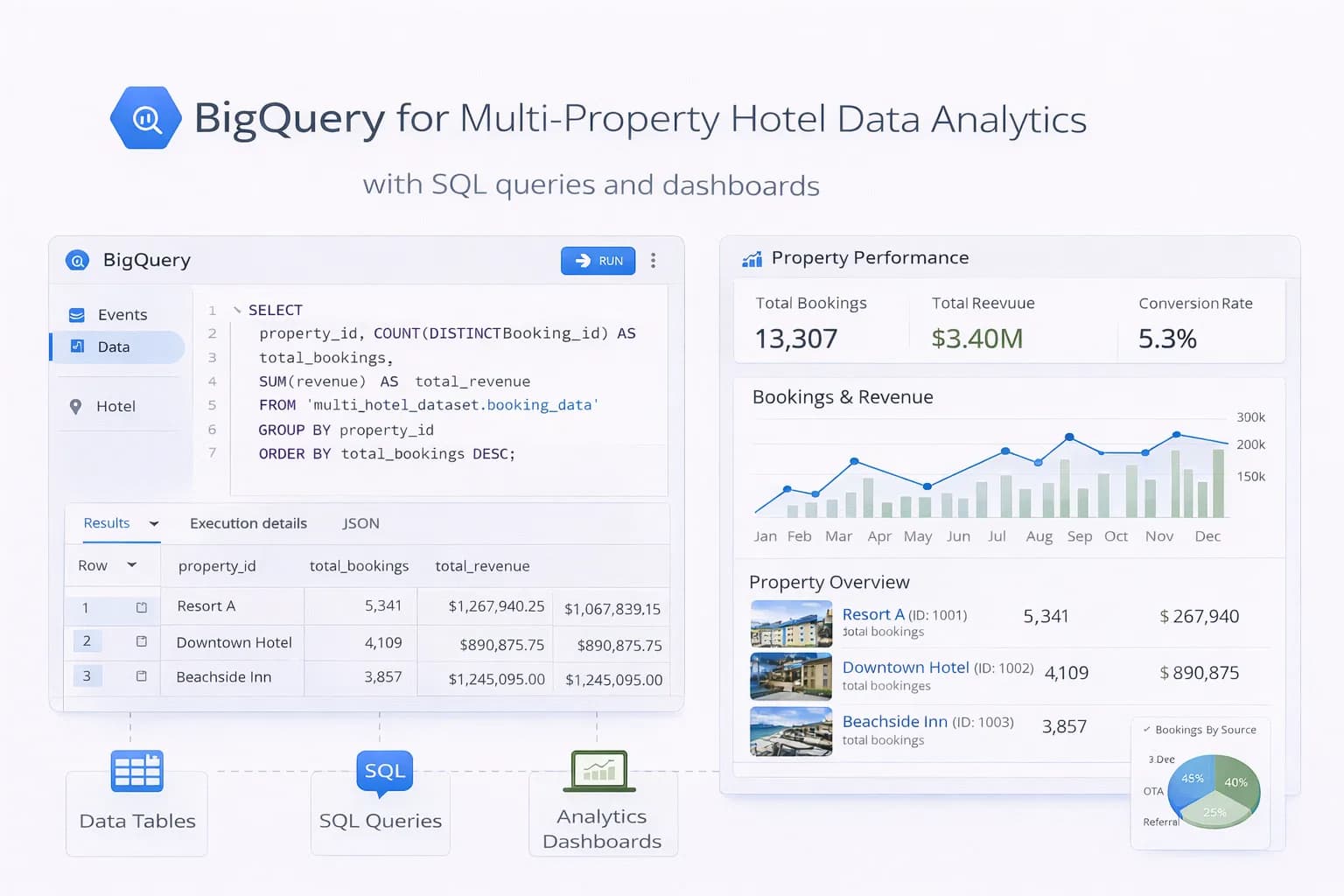
Create one simple table in your Analytics Dashboard:
- Source group: OTA / Direct (Organic, Local/GBP, PPC, Meta, Email, Social, Referral).
- Bookings and Revenue (tax inclusive/exclusive—pick one and stick to it).
- Media cost (PPC/Meta/Meta-hotel ads)/ Commission (OTA).
- CoS (cost of sale) = (Media cost or Commission) ÷ Revenue.
- Revenue/1k sessions and Purchase rate by landing template (Home/Rooms/Offers).
- ADR and Cancellation rate (if available from PMS).
Use consistent UTM naming for Direct campaigns; define which OTA partners map to OTA.
4) What OTAs are good at (and how to leverage them)
- Demand capture: huge audience, strong brand recall, excellent mobile UX.
- Geo expansion: international travellers who don’t know your brand.
- Low-season fill: visibility during shoulder periods.
- Review volume: social proof loops back into your brand demand.
How to use OTAs without overpaying:
- Manage parity: keep direct benefits (flexible rates, breakfast/parking bundles) clear on site.
- Ring-fence high-margin unique offers for your domain (see Landing Page Blueprint).
- Use retargeting to bring OTA browsers back to direct (see Retargeting OTA Visitors).
5) Why direct matters (beyond commission)
- Margin: no OTA commission on direct.
- Data & remarketing: you own consented emails for Hotel Email Marketing flows (strategy, automation).
- Brand control: consistent UX, upsells, and policies.
- Lifetime value: better repeat rate from owned audiences.
6) Common attribution pitfalls (and fixes)
- Self-referrals from the engine → enable cross-domain and unwanted referrals.
- Meta-hotel clicks credited to “Referral” → tag as Paid Meta and keep engine domain as allowed.
- Phone bookings after web research → add a tracked phone number and attribute to channel rules.
- Email remarketing credited to “Direct” → enforce UTMs on all links.
7) Raise direct share without killing profitable OTA volume
On-site clarity (GEO/CRO)
- Add Key Facts (parking cost/height/EV, breakfast times, check-in/out, accessibility) above the fold; fewer surprises, higher conversion.
- Speed: target Core Web Vitals budgets—validate with Website Speed and web.dev CWV guide.
Brand demand
- Strengthen Local SEO & GBP: photos, attributes, policy-safe reviews; see GBP Optimisation and Increase Google Ratings.
- Run Brand PPC where OTAs bid on your name; see Brand Bidding for Hotels.
Offer architecture
- Keep value adds (late checkout, breakfast/parking bundles) exclusive on your site.
- Surface location/parking/breakfast pages to beat OTA ambiguity; assistants reuse these facts (AEO). See FAQ Content for Hotels.
Remarketing & email
- Retarget site and OTA viewers with Rooms/Offers creatives; connect to a welcome/post-stay flow.
- Use Measuring Email’s Impact to close the loop.
8) Using meta/hotel ads the right way
Meta placements (Google Hotel Ads, etc.) sit between OTA and Direct. Treat them as paid direct if the click opens your engine:
- Ensure rate accuracy and landing deep links (matching room/offer).
- Track CPA/tROAS against Direct benchmarks.
- See: Google Hotel Ads vs Traditional PPC.
Official docs worth having handy:
Google Hotel Ads overview.
9) How to report this to stakeholders (simple view)
Every monthly deck should include:
- Direct share (% of total revenue) vs prior period and YoY.
- CoS by group: OTA commission, Paid Meta, PPC, Meta Ads, Organic/Local (zero-media).
- Revenue/1k sessions by landing template (Home/Rooms/Offers).
- Top 10 landing pages with purchases.
- OTA mix (which partners drive profitable volume).
Use Measuring the ROI of Hotel SEO for methodology.
10) Measurement setup (step-by-step)
- GA4: primary conversion =
purchasewithvalue¤cy. - Cross-domain: set engine domain; add unwanted referrals; test Realtime/DebugView.
- Channel rules: map OTAs to “OTA” group; tag brand/non-brand PPC; create “Paid Meta” channel.
- Dashboards: build the OTA vs Direct table in Analytics Dashboard.
- Search Console: verify site; track CTR per URL and brand vs non-brand queries.
Search Console. - GBP: watch website clicks, calls, directions as leading indicators.
GBP Help.
11) 30-day direct-share lift (practical plan)
Week 1 — Fix measurement
- Cross-domain attribution; unwanted referrals; confirm purchase events.
- Create OTA vs Direct scoreboard.
Week 2 — Lift conversion
- Add Key Facts to Home/Rooms; compress hero media; stabilise CLS.
- Build/refresh Parking, Breakfast, Location pages.
Week 3 — Shift demand
- Launch brand PPC with sitelinks to Rooms/Offers/Parking.
- Refresh GBP photos; start policy-safe review request.
Week 4 — Retain & remarket
- Add post-stay email asking for reviews (no incentives).
- Retarget abandoners with offer-specific landers.
FAQ
Frequently Asked Questions
Conclusion
You don’t have to choose OTA or direct. Get the definitions right, fix cross-domain tracking, and report CoS + revenue on one scoreboard. Then improve site clarity and speed, build local demand, and use meta/PPC intentionally. That’s how you raise direct share—without losing profitable OTA bookings.
Spin up your OTA vs direct dashboard
Angel Luis Almonte Perez
Специалист по ценообразуване и дистрибуция в хотелиерството
Анхел Луис Алмонте Перес е експерт по управление на приходите (Revenue Management) и динамично ценообразуване с 15 години опит във Венеция и Единбург.
Виж профила на автора →Свързани ръководства за хотелски маркетинг
Продължете със свързани теми, за да изградите пълна стратегия.