Google Hotel Ads vs Traditional PPC
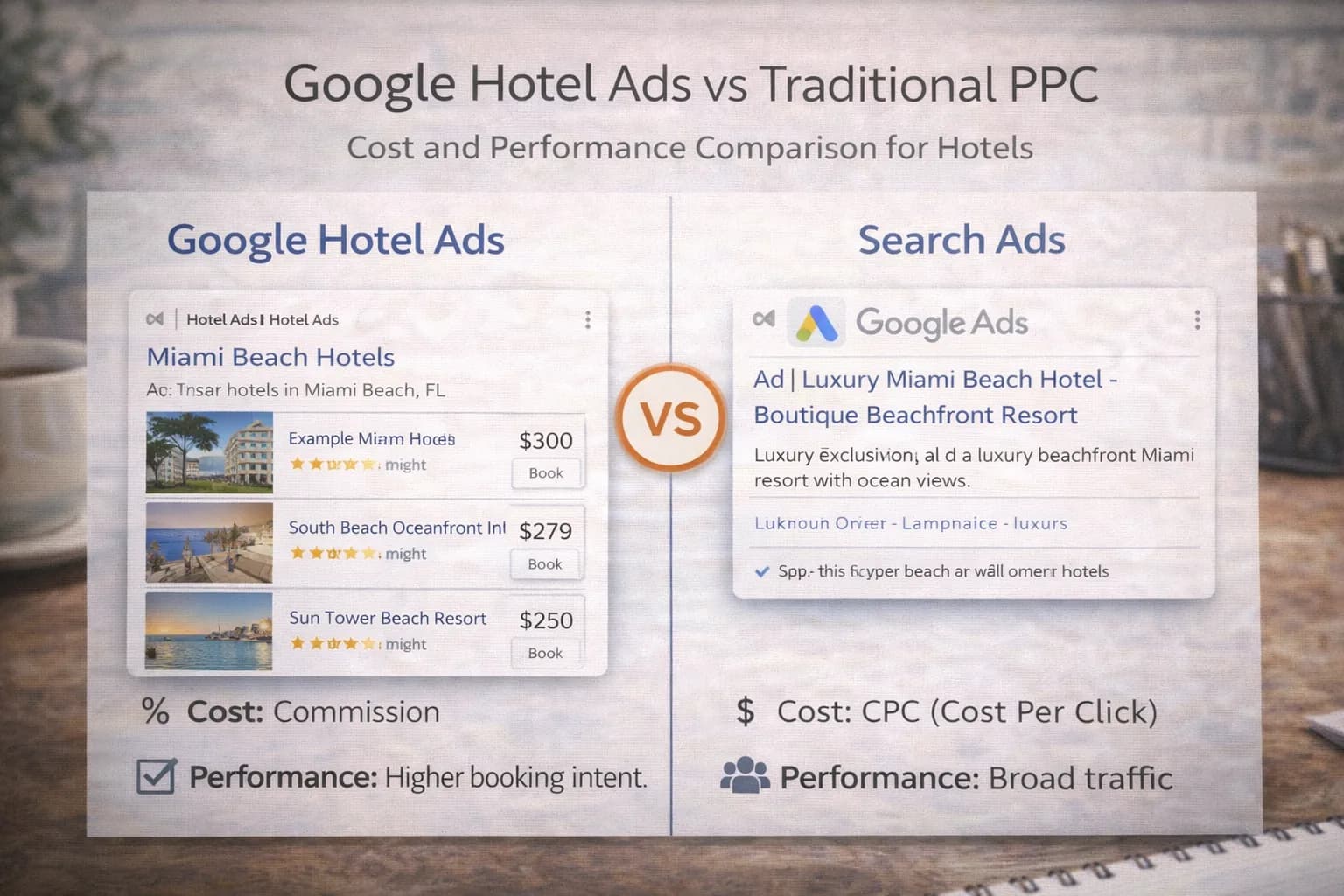
Hotel marketers often ask whether to put scarce budget into Google Hotel Ads or traditional PPC (Search/Display/YouTube). Both can drive direct bookings—but they work differently, require different inputs, and shine at different points in the guest journey. This guide explains the trade-offs so you can choose with confidence and report results your finance team will trust.
1) What Google Hotel Ads actually is
Google Hotel Ads (GHA) shows live prices and booking links inside Google’s hotel modules across Search, Maps, and the Travel surfaces. Your property appears with a “Book direct” link and rate alongside OTAs.
GHA leans on structured hotel data and real-time rates/availability from your booking engine via Google Hotel Center. It’s closest to metasearch, not standard keyword PPC.
By contrast, traditional PPC (Search/Display/YouTube) uses keyword or audience targeting and sends users to your landing pages. There’s no live price grid by default—your ad competes on copy, extensions, and landing-page quality.
Related reading: Hotel PPC Strategy and Brand Bidding for Hotels.
2) Eligibility & setup: who can run each channel
Google Hotel Ads
- A Hotel Center account linked to Google Ads.
- A rates & availability feed (from your booking engine/PMS/partner).
- Consistent hotel attributes (name, address, geo) that match your Google Business Profile (GBP).
- Deep links to your booking engine that preserve dates/occupancy where possible.
Traditional PPC
- A functional Google Ads account.
- Quality landing pages (see the Landing Page Blueprint).
- Conversion tracking (on-site engine or server-side events).
Tip: Use our GBP Consistency Tool to align names, addresses and phone numbers before pushing Hotel Ads.
3) Where each appears in the journey
- Hotel Ads win late-funnel: guests comparing prices and deciding where to book. Visibility is strongest on Maps, Travel and hotel-specific SERPs.
- Traditional Search PPC wins from mid to late funnel: destination + amenity queries (“spa hotel in Bath”), brand terms, and competitor defence.
- Display/YouTube/Meta (outside scope here) win upper to mid-funnel: demand creation and nurturing.
Bottom line: If you have stable rates/availability feeds, Hotel Ads captures “ready to book” intent you cannot reach with ad copy alone.
4) Data inputs: feed-driven vs keyword-driven
Hotel Ads (feed-driven)
- Live price and availability are mandatory.
- Room type, rate plans, taxes/fees clarity improve trust.
- Accurate landing deep links (dates/pre-selected guests) reduce friction.
Traditional PPC (keyword/audience-driven)
- Queries and negatives determine reach/cost.
- Creative (RSAs, assets) and landing-page experience drive conversion.
- You can operate without a price feed—handy for boutique engines or new builds.
If your engine can’t support a reliable feed yet, start with traditional PPC while you prepare Hotel Center.
5) Bidding & budgeting
Hotel Ads
- Bidding can be CPC or commission-style where eligible (pay per stay or pay per conversion, subject to policies/availability).
- Budgets scale with inventory quality and price competitiveness; weak parity against OTAs can hurt.
Traditional PPC
- Use Smart Bidding with guardrails: start tCPA for non-brand, graduate to tROAS with reliable revenue tracking; keep brand cheap and separate.
- Budget by intent layer (brand, destination, amenity) and defend against OTAs.
Pair both with a simple pacing sheet: spend, bookings, cost/booking, ROAS, impression share.
6) Creative & UX differences
Hotel Ads
- Creative is largely your listing and price; no long copy blocks.
- Your differentiators appear as rate inclusions (breakfast/parking), free-cancellation flags, taxes clarity, and brand “Book direct” presence.
Traditional PPC
- You control the message: direct-booking perks, proximity, seasonal offers.
- Landing page quality (speed, clarity, mobile UX) is decisive. Validate with our Website Speed Tool and see web.dev Core Web Vitals.
7) Competition with OTAs
Both channels face OTA pressure, but in different ways:
- Hotel Ads: you appear side-by-side with OTAs on the price grid. If OTAs undercut you, your click-through will fall. Sharpen rate parity and add direct-only perks (when policy-compliant) to stay competitive.
- Search PPC: OTAs bid on your brand name and generic destination terms. Run brand defence and non-brand where profitable, with tight match types and negatives. See Brand Bidding.
8) Measurement that finance will accept
Regardless of channel, measure bookings and revenue, not just clicks.
Shared must-haves
- Cross-domain tracking between site and engine.
- GA4 conversions with booking value.
- Google Ads ↔ GA4 linking for cost/ROAS.
Hotel Ads specifics
- Ensure the landing link preserves dates and guest count so sessions don’t fragment.
- Segment reporting by hotel property if you’re a group, and by market for price sensitivity.
Traditional PPC specifics
- Split brand vs non-brand reporting.
- Use audience overlays and RLSA to quantify assisted value.
For ROI framing and dashboards, use the model in Measuring the ROI of Hotel SEO and cross-check with PMS/CRM direct vs OTA share.
9) When to prioritise one over the other
Choose Hotel Ads first if:
- Your rate parity is strong and engine supports clean deep links.
- You’re losing late-funnel traffic to OTAs in Maps/Travel.
- You can operationalise feed monitoring (rates, availability, taxes).
Choose Traditional PPC first if:
- Your booking engine cannot reliably pass live rates/availability.
- You need to grow non-brand discovery (destination + amenity).
- Your brand terms are being hijacked by OTAs, and you need quick defence.
Most hotels should run both, but sequence them based on technical readiness and immediate commercial goals.
10) Common pitfalls (and quick fixes)
- Feed mismatches (price on ad ≠ price on landing) → Validate Hotel Center feed; align taxes/fees settings; test deep links with dates/guests.
- Poor GBP data (wrong phone/address) hurting trust → Fix via GBP Optimisation for Hotels and verify with the GBP Consistency Tool.
- PPC waste on broad terms → Default to Phrase/Exact; maintain a strong negative library (jobs, hostel, voucher, refund, etc.). See PPC Strategy.
- Counting clicks as bookings → Only use confirmed bookings (and valued micro-conversions clearly labelled).
- PMax cannibalising Search → Isolate budget, exclude brand, provide clear data signals (if you use it alongside).
11) 30-day rollout plan (practical)
Week 1 — Foundations
- Confirm GA4 e-commerce, cross-domain, and Ads linking.
- Audit GBP for accuracy and images; align names/addresses across brand and property pages.
- Prepare a simple pacing sheet.
Week 2 — Choose starting channel
- If feed-ready: set up Hotel Center connection and a single-property pilot.
- If not: deploy brand defence + top non-brand ad groups in Search with clean RSAs and sitelinks.
Week 3 — Ship & shape
- Hotel Ads: launch with conservative CPC/commission targets; test deep links.
- PPC: tighten negatives, check search terms, QA landing speed.
Week 4 — Measure & decide
- Compare cost/booking and ROAS by channel; run a small geo holdout where possible.
- Scale the winner; fix the weakest link (parity, link depth, page speed).
Internal links to reinforce learning
- Service: Services (paid media & performance)
- Tool: GBP Consistency Tool and SERP Tracker
- Resource: Guides Library
- Siblings (PPC cluster):
Hotel PPC Strategy • Brand Bidding • Remarketing Campaigns - Cross-pillar: Analytics Dashboard (measurement & dashboards)
- Trust: Case Studies and About
Frequently Asked Questions
Conclusion
Think of Google Hotel Ads as a precision tool for ready-to-book demand and traditional PPC as your controllable lever for discovery, defence, and demand capture. Most hotels benefit from both, sequenced by technical readiness and revenue impact. Measure bookings and ROAS by channel, keep parity tight, and maintain clean tracking—your direct share will rise, and OTA leakage will fall.
Let’s Choose the Right Mix
Kiril Ivanov
Специалист по дигитален маркетинг
Кирил Иванов е специалист по дигитален маркетинг с опит в управлението на локални, национални и международни кампании за широк спектър от бизнеси — от независими компании до водещи потребителски марки. Неговият професионален опит включва ръководене на проекти за автоматизация на рекламата за Michael Kors и работа по кампании за Canon, Dormeo, esure, DLG Group, Village Gym, Cameron House, Crerar Hotels, Cromlix Hotel, Harrison Fund и Advertising Standards Authority (ASA). Опитът му обхваща платено търсене (PPC), платени социални мрежи, автоматизация на рекламата, SEO, оптимизация на процента на конверсия (CRO) и цялостна дигитална стратегия в хотелиерството, ритейла, финансовите и професионалните услуги.
Виж профила на автора →Свързани ръководства за хотелски маркетинг
Продължете със свързани теми, за да изградите пълна стратегия.