Hotel PPC Strategy for Google Ads: Execution Playbook
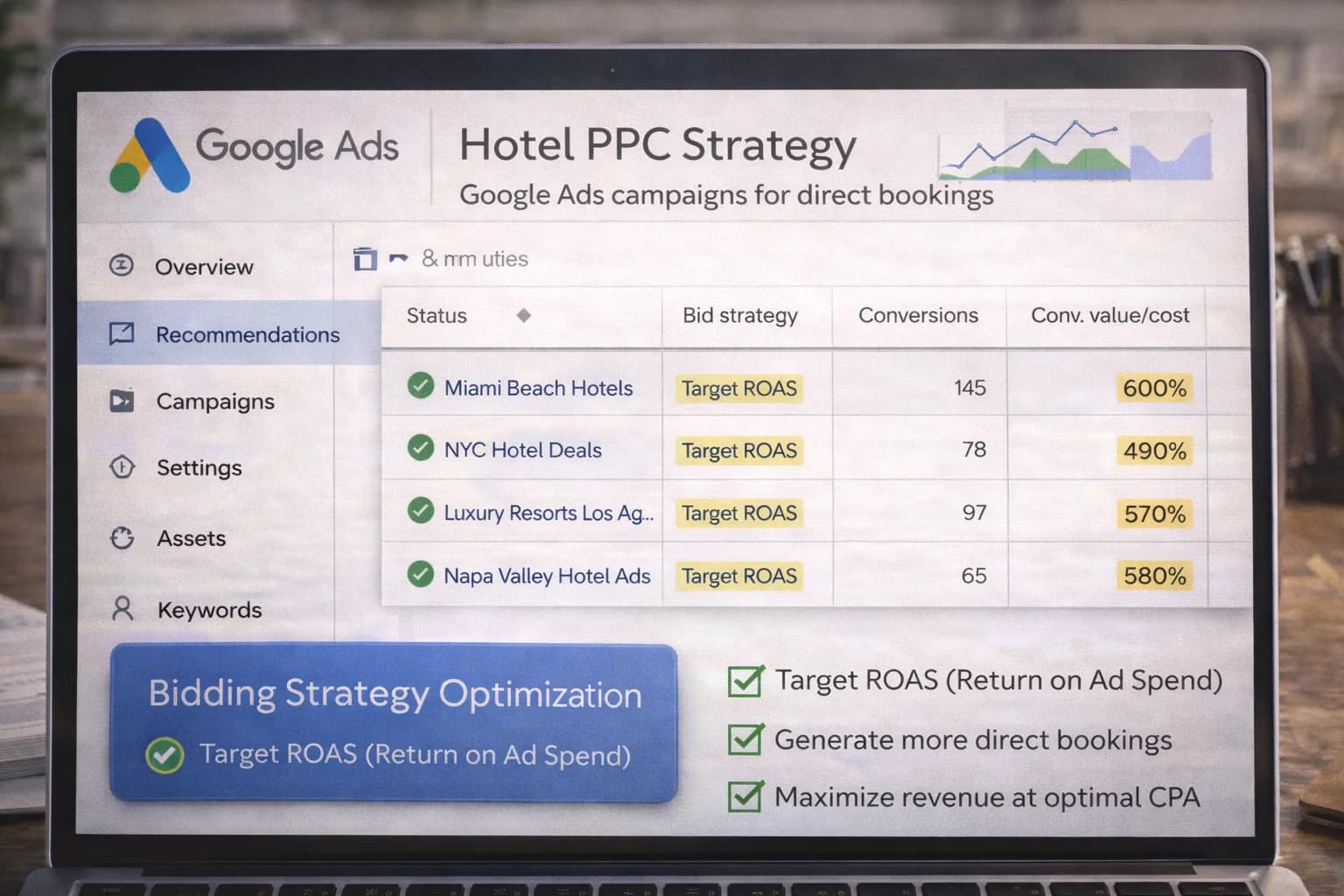
Most hotel PPC accounts bleed budget on broad queries, weak landing pages, and ungoverned Smart Bidding. This guide shows how to build a lean, resilient Google Ads programme for hotels that prioritises direct bookings without runaway spend.
You’ll get a step-by-step account structure, keyword frameworks, ad asset guidance, bidding tactics, and measurement rules that finance teams can trust.
If you are trying to choose between Google Hotel Ads and standard Search PPC, read Google Hotel Ads vs Traditional PPC first. This guide assumes you have already decided that search-led PPC deserves a defined operating model.
1) The principle: protect brand, earn non-brand, contain waste
Before anything else, choose what you’re optimising for: bookings and revenue, not clicks.
- Protect brand terms so OTAs don’t hijack high-intent traffic.
- Pursue non-brand where you can win profitably (destination + amenity + experience).
- Contain waste with strong negatives, geo/radius control, and page-level quality.
Cross-reading:
- Entity & structure: Hotel Information Architecture
- Landing pages: Hotel Landing Page Blueprint
- Strategy context: SEO vs OTA Bidding
2) Account structure that maps to guest intent
Split campaigns by intent layer so budgets and bids don’t clash.
Core campaigns
- Brand:
[hotel name],[hotel name] + city, misspellings. - Competitor & OTA defence: competitor brand terms (limited, only if legal/policy-safe) and OTA intercept where permitted.
- Destination + qualifier (Non-brand): “hotel in [city]”, “spa hotel [city]”, “family hotel near [attraction]”.
- Experience/amenity: “pet friendly hotel [city]”, “hotel with parking [city]”.
- MICE/Spa/Restaurant (if applicable): break out because goals and CPA differ.
Ad group model
- Use tight themes (not SKAGs for RSA era), e.g.,
spa-hotel-city,family-hotel-city, each with 5–10 closely related queries.
3) Keyword match types & negatives that actually save money
- Default to Phrase and Exact for control.
- Use Broad sparingly and only with robust negatives + strong conversion data.
- Build a negative keyword library at account level: cheap terms (hostel, motel), jobs, careers, weddings (if not served), “free”, “refundable” (if not offered), and brand-safety terms.
Authoritative references:
- Google Ads help on keyword match types and negative keywords.
4) Creative: RSAs, assets, and what to say
Responsive Search Ads (RSAs) reward coverage and relevance. Ship 1–2 RSAs per ad group plus a dynamic where helpful.
Headline themes
- Brand proof + location: “[Hotel] on [Waterfront/Quarter}”
- Direct booking perks: “Best Rate • Flexible Terms • Free Parking”
- Amenity hook: “Spa & Pool Access”, “Family Rooms & Kids’ Menu”
- Proximity: “5 Minutes from [Attraction]/[Station]”
- Seasonal: “Winter Breaks • Late Deals”
Description blocks
- Lead with value and clarity. Avoid vague superlatives.
- Include benefit + proof: “Free cancellation on most rates”, “Secure on-site parking”.
Add all relevant assets (sitelinks, callouts, structured snippets, price assets) to lift CTR and relevance. See Google’s RSA guidance on creating effective ads.
5) Bidding: how to use Smart Bidding without handing over the keys
Use Smart Bidding, but feed it good data and set guardrails.
- Brand:
Maximise Clickswith CPC cap (new) orTarget CPAlow; protect position cheaply. - Non-brand:
Target CPAwhile volume is building; graduate toTarget ROASonce you have stable revenue tracking. - Seasonal overlays: use seasonality adjustments for short promotions rather than rewriting targets.
- Portfolio bid strategies: group similar campaigns to share learnings while isolating different intents.
Smart Bidding docs: Smart Bidding overview and Target ROAS.
6) Budgets & pacing: prevent mid-month burn
- Allocate fixed daily budgets by intent layer (brand / non-brand / amenity).
- Use shared budgets only for genuinely similar campaigns; keep brand separate.
- Monitor with a pacing sheet: planned vs actual spend, cost/booking, ROAS, impression share.
- Add portfolio caps for experiments and new geos.
Track volatility with the SERP Tracker Tool for competitive shifts and ad visibility.
7) Geo, language, device: narrow to where you can win
- Start with primary feeder markets (country + top cities). Add radius campaigns for local same-day demand.
- Language should match creative and landing pages (don’t run EN ads into non-EN markets without translation and pricing clarity).
- Device: favour mobile for last-minute and brand; desktop often converts better for longer stays and packages. Apply bid adjustments accordingly.
8) Audiences: make generic terms act like brand
Layer audiences to raise intent:
- Remarketing: site visitors last 30–180 days (exclude recent bookers).
- In-market: “Trips & Travel/Hotels & Accommodations”.
- Customer match: loyalty/email lists (policy-compliant).
- Data signals for PMax (if you run it): feed top converters and search themes.
Audiences don’t replace keywords; they sharpen them.
9) Landing pages: where PPC profit is won or lost
Advert relevance means little if the destination is slow or generic.
Minimum viable page (see the Landing Page Blueprint):
- Clear location (map, neighbourhood cues)
- Direct booking benefits
- Room/offer clarity with real photos
- Trust (reviews, awards, safety)
- Speed & mobile UX (Core Web Vitals; see web.dev on CWV)
10) Performance Max & DSA: when to use them (and when not)
- Performance Max (PMax) can harvest incremental brand/demand, but it will absorb conversions if you let it. Use brand-exclusions, clear data signals, and separate budgets from Search.
- Dynamic Search Ads (DSA) are useful only if your IA and metadata are strong. Keep them in a discovery campaign with tight negatives; mine search terms for new exact/phrase keywords.
11) Measurement: bookings, not pageviews
- GA4 e-commerce or server-side booking events with revenue.
- Cross-domain tracking between site and booking engine.
- Search Console linked for landing page and query diagnostics.
- Ads → GA4 linking for cost & ROAS.
Useful references: GA4 conversions setup and attribution models.
Tie this back to your commercial model: see Measuring the ROI of Hotel SEO.
12) Weekly optimisation routine (90 minutes)
Query pruning (20m)
- N-grams and search terms → add negatives; promote winners to exact.
Bids & budgets (20m)
- Check CPA/ROAS vs target; re-allocate budget by intent layer.
Creatives (20m)
- Pin 1–2 headlines for control tests; refresh seasonal hooks.
Landing page QA (15m)
- Speed, forms, rates visible, deep links to booking engine.
Audit anomalies (15m)
- Impression share drops, policy disapprovals, tracking gaps.
13) What to do about OTAs
- Defend brand: always-on brand search with sitelinks for Rooms, Offers, Location, Parking.
- Promo parity: highlight direct-only perks (parking, late checkout, flexible cancellation) without making claims your booking engine cannot support.
- Competitor terms: only test them if legal, policy, and conversion economics are clear; most hotels get more reliable returns from brand defence and tightly themed non-brand groups.
- Landing-page clarity: make direct-booking benefits obvious above the fold so OTA comparison shoppers see a reason to choose the hotel site.
If late-funnel parity is strong and your booking engine can support clean feeds, add Google Hotel Ads alongside Search rather than forcing generic PPC to do a metasearch job.
14) 30-day PPC operating plan
Week 1 — Clean the base
- Separate brand and non-brand budgets.
- Verify GA4 revenue tracking and cross-domain booking attribution.
- Build or refresh the account-level negative keyword list.
Week 2 — Tighten intent coverage
- Pause or restrict broad-match waste.
- Rebuild ad groups around hotel intent layers: brand, destination, amenity, and experience.
- Match each high-value ad group to a specific landing page.
Week 3 — Improve economics
- Review search terms, impression share, and assisted conversions.
- Adjust bids and budgets by intent layer, not account averages.
- Refresh ad assets to reflect direct-booking benefits and current offers.
Week 4 — Decide what scales
- Compare cost per booking and ROAS by campaign type.
- Reduce spend on weak themes before adding budget to winners.
- Identify whether Hotel Ads, remarketing, or landing-page improvements are the next limiting factor.
Conclusion
Good hotel PPC is usually less about finding a secret tactic and more about maintaining controls. Protect brand, structure non-brand around real guest intent, feed Smart Bidding clean revenue data, and review the account every week with commercial discipline. That keeps paid search useful as a profit channel instead of an OTA tax.
Build a Hotel PPC Programme That Holds Margin
Stephen Colenn
Специалист по платена реклама и дигитален маркетинг
Стивън Колен е специалист по дигитален маркетинг с над 10 години опит в платеното търсене (PPC), ремаркетинга и дигиталните стратегии. Притежава магистърска степен (MSc) по маркетинг от Единбургския университет.
Виж профила на автора →Свързани ръководства за хотелски маркетинг
Продължете със свързани теми, за да изградите пълна стратегия.