Technical SEO Checklist for Hotels: 2026 Maintenance Edition
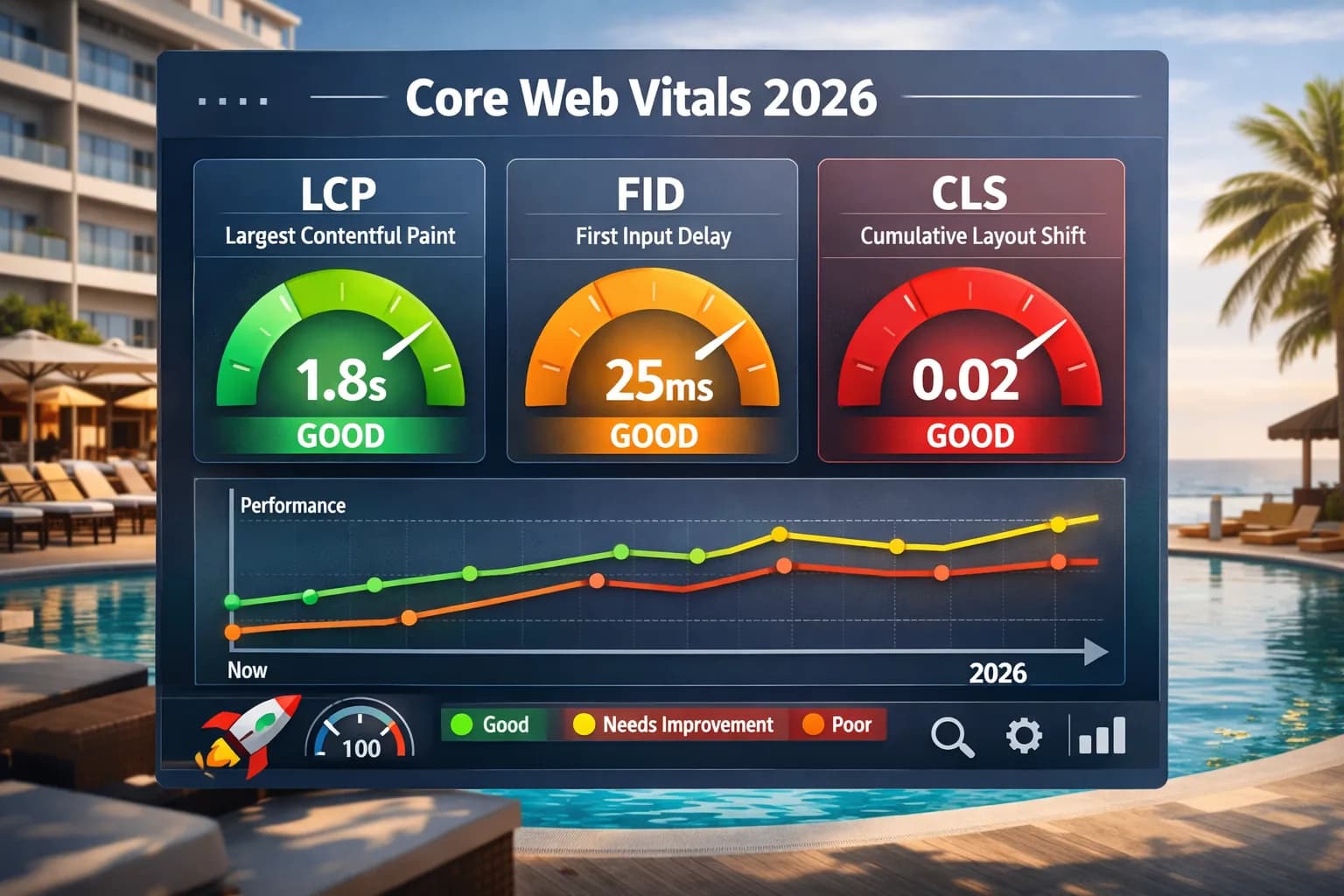
Technical SEO is the foundation. Without it, great content and perfect keywords won't rank. Hotels face unique challenges: booking engine integrations, multi-language sites, rate calendars, and third-party widgets that can tank performance.
This checklist covers everything from crawlability to Core Web Vitals—use it as your quarterly maintenance and governance template.
If you need a faster diagnostic workflow first, start with our Technical SEO Audit Checklist for Hotels. This page is the broader ongoing checklist you revisit after the audit.
1) Site architecture and URL structure
URL best practices
- [ ] Clean, readable URLs —
/rooms/deluxe-king/not/room.php?id=47&lang=en. - [ ] Consistent structure — same pattern across all page types.
- [ ] No parameter pollution — filter/sort parameters handled via canonicals or noindex.
- [ ] HTTPS everywhere — no mixed content, proper redirects from HTTP.
Navigation hierarchy
- [ ] Flat architecture — important pages within 3 clicks of homepage.
- [ ] Logical grouping — Rooms, Offers, Dining, Events, Location, Blog.
- [ ] Breadcrumbs — implemented with structured data.
- [ ] Internal linking — room pages link to relevant offers, blog links to services.
Mobile navigation
- [ ] Hamburger menu works — no JS errors blocking access.
- [ ] Tap targets adequate — minimum 48×48px, 8px spacing.
- [ ] No horizontal scroll — content fits viewport.
For site structure patterns, see Website Architecture Guide.
2) Crawlability and indexation
Robots.txt
- [ ] Allows Googlebot — no accidental blocks on important paths.
- [ ] Blocks irrelevant paths —
/admin/,/cart/,/checkout/, internal search. - [ ] Points to sitemap —
Sitemap: https://yourhotel.com/sitemap.xml.
# Example robots.txt
User-agent: *
Allow: /
Disallow: /admin/
Disallow: /booking/cart/
Disallow: /search?

Sitemap: https://yourhotel.com/sitemap.xml
XML sitemap
- [ ] All indexable pages included — rooms, offers, location pages, blog posts.
- [ ] No 404s or redirects — only 200-status URLs.
- [ ] Updated regularly — reflects new content within 24 hours.
- [ ] Under 50MB / 50,000 URLs — split if larger.
- [ ] Submitted to GSC — and re-submitted after major changes.
Indexation health
- [ ] Check "Pages" report in GSC — identify crawled/not indexed issues.
- [ ] No accidental noindex — verify meta robots on key pages.
- [ ] Canonical tags correct — self-referencing on unique pages.
- [ ] No orphan pages — every page reachable via internal links.
Use Indexed Pages Checker to verify indexation status.
3) Core Web Vitals
Largest Contentful Paint (LCP)
Target: ≤2.5 seconds on mobile.
- [ ] Hero image optimised — WebP/AVIF, properly sized, preloaded.
- [ ] Server response fast — TTFB under 600ms.
- [ ] No render-blocking resources — critical CSS inlined, JS deferred.
- [ ] CDN for assets — images and static files served from edge.
Interaction to Next Paint (INP)
Target: ≤200ms.
- [ ] No long tasks — break up JS execution over 50ms.
- [ ] Efficient event handlers — debounce/throttle where appropriate.
- [ ] Minimal third-party impact — audit booking widgets, chat tools, analytics.
Cumulative Layout Shift (CLS)
Target: ≤0.1.
- [ ] Image dimensions set — width/height attributes or aspect-ratio CSS.
- [ ] Font loading stable —
font-display: swapwith size-adjust fallback. - [ ] No injected content above fold — cookie banners, promo bars sized upfront.
- [ ] Ad/widget space reserved — if using display ads.
Test with Website Speed Tester and PageSpeed Insights.
4) Structured data (schema markup)
Essential schemas for hotels
- [ ] Hotel schema — name, address, star rating, amenities, images.
- [ ] LocalBusiness — for map/local pack eligibility.
- [ ] BreadcrumbList — navigation path.
- [ ] FAQPage — if FAQ content exists.
- [ ] Article/BlogPosting — for blog content.
Hotel schema example
{
  "@context": "https://schema.org",
  "@type": "Hotel",
  "name": "The Grand Hotel",
  "description": "Luxury boutique hotel in central London",
  "address": {
    "@type": "PostalAddress",
    "streetAddress": "123 High Street",
    "addressLocality": "London",
    "postalCode": "W1A 1AA",
    "addressCountry": "GB"
  },
  "starRating": {
    "@type": "Rating",
    "ratingValue": "4"
  },
  "amenityFeature": [
    {"@type": "LocationFeatureSpecification", "name": "Free WiFi"},
    {"@type": "LocationFeatureSpecification", "name": "Restaurant"},
    {"@type": "LocationFeatureSpecification", "name": "Spa"}
  ],
  "image": "https://yourhotel.com/images/exterior.jpg",
  "telephone": "+44 20 1234 5678",
  "url": "https://yourhotel.com"
}
Validation
- [ ] Test with Rich Results Test — Rich Results Test.
- [ ] No errors in GSC — check Enhancements reports.
- [ ] Accurate data — schema matches visible page content.
For implementation guidance, see Schema Markup for Hotels.
5) Mobile optimisation
Mobile-first indexing
Google primarily uses mobile version for ranking. Ensure:
- [ ] Same content on mobile and desktop — no hidden text, no missing sections.
- [ ] Same structured data — present on mobile version.
- [ ] Same meta tags — titles, descriptions, canonicals identical.
Mobile UX
- [ ] Responsive design — works across device widths.
- [ ] No interstitials blocking content — compliant with Google guidelines.
- [ ] Forms usable — appropriate input types, autocomplete attributes.
- [ ] Booking widget mobile-friendly — test the full flow on phone.
Testing
- [ ] Chrome DevTools mobile emulation — check all key pages.
- [ ] Real device testing — iOS Safari, Android Chrome.
- [ ] GSC Mobile Usability report — address any flagged issues.
6) Page speed optimisation
Images
- [ ] Modern formats — WebP or AVIF with fallbacks.
- [ ] Responsive images — srcset with multiple sizes.
- [ ] Lazy loading — below-fold images load on scroll.
- [ ] Compression — 80-85% quality typically sufficient.
JavaScript
- [ ] Defer non-critical JS — booking widget, analytics, chat.
- [ ] Remove unused code — audit with Coverage tool in DevTools.
- [ ] Minify and bundle — reduce request count and file size.
CSS
- [ ] Critical CSS inlined — above-fold styles in
<head>. - [ ] Unused CSS removed — purge frameworks if using Tailwind/Bootstrap.
- [ ] Minified — remove whitespace and comments.
Server and caching
- [ ] Gzip/Brotli compression — enabled on server.
- [ ] Browser caching — long cache headers for static assets.
- [ ] CDN — Cloudflare, Fastly, or similar for global edge delivery.
- [ ] HTTP/2 or HTTP/3 — multiplexing reduces latency.
7) Security
HTTPS
- [ ] Valid SSL certificate — not expired, correct domain.
- [ ] No mixed content — all resources loaded via HTTPS.
- [ ] HSTS enabled — prevents downgrade attacks.
Security headers
- [ ] Content-Security-Policy — restricts resource loading.
- [ ] X-Frame-Options — prevents clickjacking.
- [ ] X-Content-Type-Options — prevents MIME sniffing.
Booking security
- [ ] PCI compliance — if handling payments directly.
- [ ] Secure booking engine integration — HTTPS, proper authentication.
8) International and multi-language
Hreflang implementation
If you have multiple language versions:
- [ ] Hreflang tags on all pages — specify language-region codes.
- [ ] Self-referencing hreflang — each page includes itself.
- [ ] x-default for fallback — typically your primary language.
- [ ] Consistent implementation — HTML, HTTP header, or sitemap (pick one).
<link rel="alternate" hreflang="en-gb" href="https://yourhotel.com/rooms/" />
<link rel="alternate" hreflang="de" href="https://yourhotel.com/de/zimmer/" />
<link rel="alternate" hreflang="x-default" href="https://yourhotel.com/rooms/" />
Content localisation
- [ ] Unique content per language — not just machine translated.
- [ ] Local currency and formats — dates, phone numbers.
- [ ] Local schema markup — correct address format per region.
For multi-language SEO, see Hreflang Implementation Guide.
9) Duplicate content
Common hotel issues
- Rate calendars — same room, different dates = thousands of URLs.
- Filter/sort parameters —
/rooms/?sort=price&filter=seaview. - Tracking parameters — UTM tags creating duplicate URLs.
- WWW vs non-WWW — or trailing slash inconsistency.
Solutions
- [ ] Canonical tags — point duplicates to preferred version.
- [ ] Parameter handling in GSC — configure (legacy, but check).
- [ ] Consistent internal linking — always link to canonical URL.
- [ ] 301 redirects — for hard duplicates (www redirect, HTTPS redirect).
For more detail, see Canonicals and Duplicate Content.
10) Booking engine integration
Cross-domain tracking
- [ ] GA4 cross-domain configured — seamless session tracking.
- [ ] Linker parameter passing —
_glparameter preserved. - [ ] Enhanced ecommerce events —
begin_checkout,purchasefiring correctly.
See Cross-Domain Booking Setup for implementation.
SEO considerations
- [ ] Booking engine pages noindexed — unless valuable landing pages.
- [ ] No canonical pointing to booking engine — keep authority on main site.
- [ ] Fast widget loading — async/defer, lazy load if below fold.
Quarterly audit schedule
| Month | Focus area | |-------|-----------| | January | Full technical audit, Core Web Vitals baseline | | April | Crawlability, indexation, sitemap health | | July | Structured data validation, mobile UX | | October | Pre-peak season check, speed optimisation |
Technical SEO tools
| Tool | Use case | |------|----------| | Website Speed | Core Web Vitals testing | | Indexed Pages | Indexation verification | | Meta Tags Analyser | On-page element audit | | Google Search Console | Crawl stats, coverage, enhancements | | Screaming Frog | Site crawling, technical issues | | Rich Results Test | Structured data validation |
Action checklist
- Run a crawl — Screaming Frog or similar, export issues.
- Check GSC coverage — address "Crawled – currently not indexed" pages.
- Test Core Web Vitals — PageSpeed Insights on key templates.
- Validate structured data — Rich Results Test on homepage, room, offer pages.
- Audit booking integration — verify cross-domain tracking fires correctly.
- Schedule quarterly reviews — set calendar reminders for ongoing health.

Kiril Ivanov
Специалист по дигитален маркетинг
Кирил Иванов е специалист по дигитален маркетинг с опит в управлението на локални, национални и международни кампании за широк спектър от бизнеси — от независими компании до водещи потребителски марки. Неговият професионален опит включва ръководене на проекти за автоматизация на рекламата за Michael Kors и работа по кампании за Canon, Dormeo, esure, DLG Group, Village Gym, Cameron House, Crerar Hotels, Cromlix Hotel, Harrison Fund и Advertising Standards Authority (ASA). Опитът му обхваща платено търсене (PPC), платени социални мрежи, автоматизация на рекламата, SEO, оптимизация на процента на конверсия (CRO) и цялостна дигитална стратегия в хотелиерството, ритейла, финансовите и професионалните услуги.
Виж профила на автора →Свързани ръководства за хотелски маркетинг
Продължете със свързани теми, за да изградите пълна стратегия.