Technical SEO Audit Checklist for Hotels: Prioritised Audit Workflow
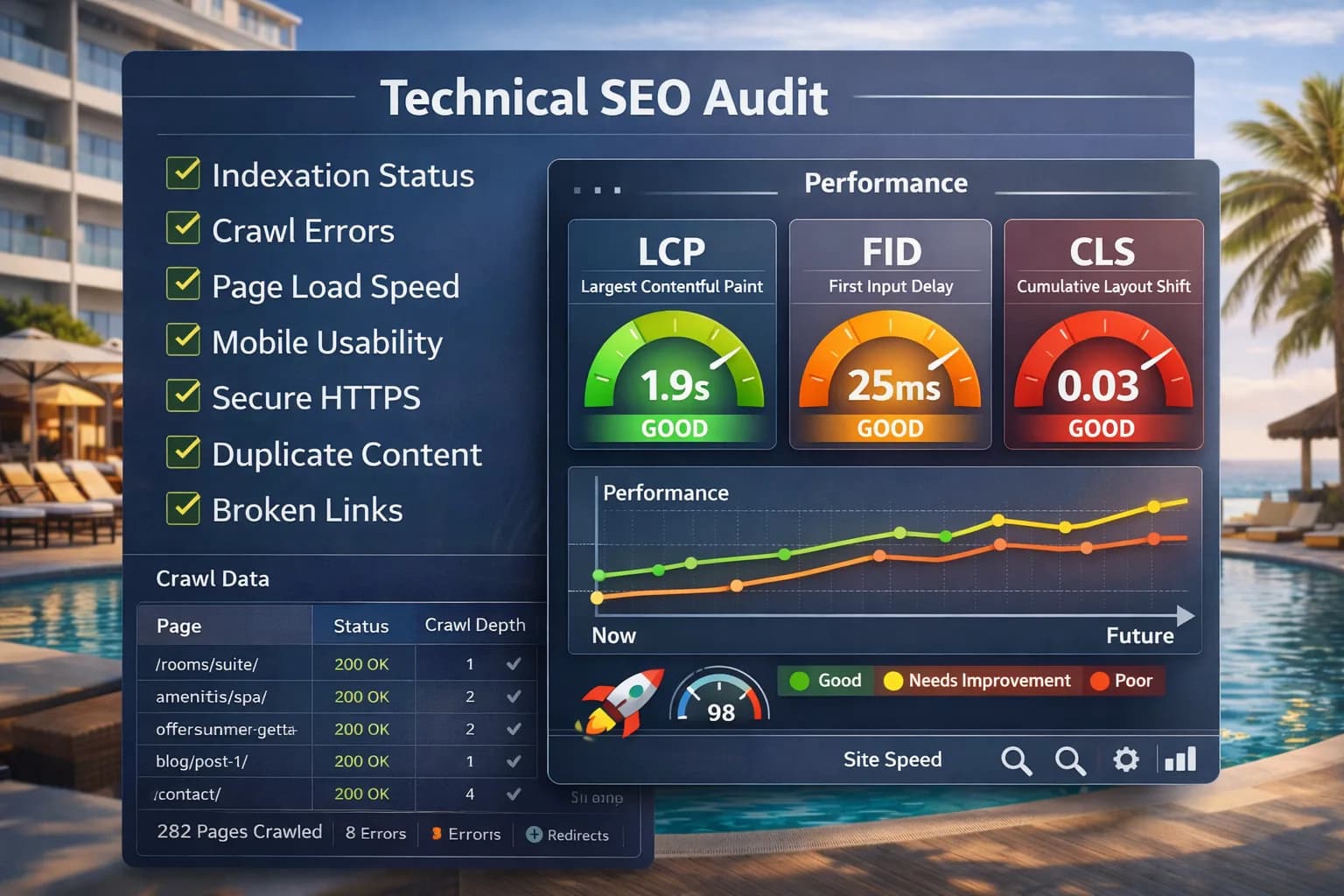
Hotel websites are rarely simple. Multiple templates, booking engines, legacy content and tracking scripts can quietly create technical SEO issues that limit your visibility – even when your content and branding look impressive on the surface.
This guide gives you a structured, hotel‑specific technical SEO audit checklist so you can quickly understand what needs fixing, in what order, and how each fix contributes to more stable rankings and direct bookings.
If you want the broader recurring maintenance list, use our Technical SEO Checklist for Hotels. This page is specifically for audit triage and prioritisation.
1. Crawlability & Site Structure
Before looking at speed scores or Core Web Vitals, confirm that search engines can reliably discover and crawl your key pages. If crawlers cannot reach your most valuable templates, nothing else matters.
Key checks
- Run a crawl with your preferred tool and export a list of all indexable URLs.
- Check for 4xx/5xx errors, redirect chains and orphaned pages – especially for rooms, offers and meeting spaces.
- Ensure navigation and internal links expose all revenue‑critical pages within a few clicks.
- Confirm that language / country variants are structured consistently.
2. Indexation & Canonicals
It is not enough for pages to be crawlable; they also need to be indexed correctly, without confusing duplicates or conflicting signals.
- Use Search Console coverage reports to identify patterns like "Crawled – currently not indexed".
- Check canonical tags: do key pages point to themselves, or are they silently canonicalised to another URL?
- Audit parameterised URLs and search result pages that might be wasting crawl budget.
- Confirm that your XML sitemaps include only indexable, canonical URLs.
3. Core Web Vitals & Performance
Performance affects both guests and search engines. Focus your optimisation work on templates closest to bookings: room pages, offers and booking flows.
- Measure LCP, INP and CLS using field data where possible (Search Console + CrUX‑powered tools).
- Compress, resize and defer heavy above‑the‑fold media such as hero slideshows and background video.
- Lazy‑load below‑the‑fold images and third‑party widgets (chat, reviews, maps).
- Work with your dev or platform team to reduce render‑blocking CSS and JavaScript.
4. Mobile Experience
Most discovery and a growing portion of bookings happen on mobile devices. Treat mobile as the default and desktop as the optional extra.
- Test critical journeys (search → room → booking) on real phones and networks, not just emulators.
- Check that tap targets, menus and forms are easy to use with one thumb.
- Watch for layout issues caused by booking engine iframes or third‑party widgets.
5. Structured Data & Entities
Structured data helps search engines and AI systems understand who you are, what you offer and where you operate – crucial for AEO/GEO.
In our benchmark of 139 UK luxury hotel websites, only 21 properties had explicit Hotel schema in place, while 68 used generic WebSite schema and zero used FAQPage. That gap is common and consistently fixable.
- Validate existing schema (Hotel, LocalBusiness, FAQ, Review) using testing tools.
- Remove legacy or conflicting markup left by older plugins or templates.
- Consider FAQ schema on support content where it genuinely matches user questions.
6. CMS & Platform Gotchas
Many hotel platforms introduce technical quirks by default. Your checklist should explicitly look for these recurring issues.
- Duplicate content across language or brand variants without hreflang or clear canonicals.
- Auto‑generated tag/search pages being indexed and competing with more important URLs.
- Staging, dev or archived sites accidentally exposed to search engines.
7. Prioritising & Acting on Findings
A long list of issues is not a strategy. Group your findings into themes and prioritise by potential impact on bookings and the effort required to fix them.
- Fix blocking issues first: indexation, major performance problems, security issues.
- Then tackle template‑level improvements that benefit many URLs at once.
- Finally, schedule nice‑to‑have enhancements as part of regular site maintenance.
The aim is to create a simple, prioritised backlog that your dev or platform team can realistically work through, not a one‑off PDF that nobody uses.
Talk through your technical SEO priorities
Kiril Ivanov
Специалист по дигитален маркетинг
Кирил Иванов е специалист по дигитален маркетинг с опит в управлението на локални, национални и международни кампании за широк спектър от бизнеси — от независими компании до водещи потребителски марки. Неговият професионален опит включва ръководене на проекти за автоматизация на рекламата за Michael Kors и работа по кампании за Canon, Dormeo, esure, DLG Group, Village Gym, Cameron House, Crerar Hotels, Cromlix Hotel, Harrison Fund и Advertising Standards Authority (ASA). Опитът му обхваща платено търсене (PPC), платени социални мрежи, автоматизация на рекламата, SEO, оптимизация на процента на конверсия (CRO) и цялостна дигитална стратегия в хотелиерството, ритейла, финансовите и професионалните услуги.
Виж профила на автора →Свързани ръководства за хотелски маркетинг
Продължете със свързани теми, за да изградите пълна стратегия.